
Search Market Research Report
Electrical Deicing System Market Size, Share Global Analysis Report, 2026 - 2034

Electrical Deicing System Market Size, Share, Growth Analysis Report By Type (Brush Block Assemblies, Slip-rings, Boots and Timers, Wire Harnesses and Others), By Application (Civil Helicopter Propellers, Military Helicopter Propellers and Others), And By Region - Global Industry Insights, Overview, Comprehensive Analysis, Trends, Statistical Research, Market Intelligence, Historical Data and Forecast 2026 - 2034
Industry Insights
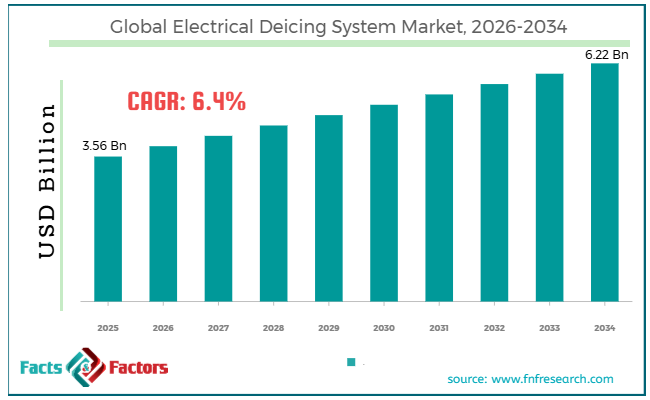
[225+ Pages Report] According to Facts & Factors, the global electrical deicing system market size was worth around USD 3.56 billion in 2025 and is predicted to grow to around USD 6.22 billion by 2034 with a compound annual growth rate (CAGR) of roughly 6.4% between 2026 and 2034.
 Market Overview
A technique called an electrical deicing system is mostly utilized in the aviation industry as well as other sectors to stop ice from accumulating on surfaces like power lines, airplane wings, and windshields. Ice buildup on these surfaces can impede airflow, decrease aerodynamic effectiveness, and raise the possibility of mishaps. Electrically conducting components that are either affixed to or incorporated in the surface that has to be protected make up the majority of electrical deicing systems. When an electric current is sent through these elements, heat is produced, which melts any ice that may have formed. This procedure guarantees safe functioning while assisting in preserving the integrity of the surface. Sensors that measure temperature, humidity, and ice formation are frequently used to operate the system and initiate the deicing process automatically as needed. Systems for electrical deicing are essential for preserving operating effectiveness and safety in areas where icing conditions are common.
Key Insights
- As per the analysis shared by our research analyst, the global electrical deicing system market is estimated to grow annually at a CAGR of around 6.4% over the forecast period (2026-2034).
- In terms of revenue, the global electrical deicing system market size was valued at around USD 3.56 billion in 2025 and is projected to reach USD 6.22 billion, by 2034.
- The rising product launch is expected to drive market growth over the forecast period.
- Based on the type, the slip-rings segment is expected to dominate the market during the forecast period.
- Based on the application, the military helicopter segment is expected to capture the largest market share over the projected period.
- Based on region, North America is expected to dominate the market during the forecast period.
Growth Drivers
- Increasing air traffic drives market growth
Aircraft operations in all meteorological conditions, particularly icing-prone ones, have increased due to the growing number of people traveling by air. This accentuates how effective deicing technology is required to enable safe flight operations. Revenue passenger kilometers, or RPKs, climbed 36.9% over 2022 and were used to estimate overall traffic in 2025, according to the IATA figure. Global traffic over the whole year 2025 was 94.1% of pre-pandemic (2019) levels. After growing by 25.3% from December 2022 to December 2025, the total traffic reached 97.5% of that in December 2019. The amount of traffic in the fourth quarter was 98.2% of the total at the end of the year, suggesting a strong recovery.
Restraints
- Limited skilled workforce hinders market growth
One of the main issues impeding the market's expansion is the scarcity of competent labor. The safe and effective removal of ice and snow from aircraft before takeoff is a highly specialized task that calls for qualified experts. Nonetheless, there is a serious lack of qualified deicers in airports throughout the world. It takes years to become qualified experts in the sector because the work entails complicated methods to design various aircraft types utilizing specialized vehicles and fluids. When working near engines and airplanes, technicians must adhere to tight safety regulations and comprehend complex equipment functions. Additionally, they require certification, which entails intensive on-the-job training.
However, attrition rates are also high in this job due to challenging work conditions with long hours spent outdoors in extreme weather conditions. This shortage might be a major restraining factor for the market growth.
Opportunities
- Increasing product launches provide a lucrative opportunity for market growth
The increasing product launches are expected to offer a lucrative opportunity for market growth during the forecast period. For instance, in November 2022, Aéroport Clermont-Ferrand Auvergne declared the arrival of the Elephant® e-Mini MY Lite, the company's first Vestergaard deicer. As the world's first fully electrical deicer, the Elephant® e-Mini MY Lite to Aéroport Clermont-Ferrand Auvergne represents a significant advancement in sustainable ground handling practices. It also aligns perfectly with Aéroport Clermont-Ferrand Auvergne's sustainable strategy of reducing carbon emissions, as part of VINCI Airports, to reach net zero emissions by 2050. Thus, the airport has taken a new step—electrifying airport ground handling vehicles—with financial support from SMACFA (Syndicat Mixte Aéroport Clermont-Ferrand Auvergne).
This is in addition to other actions that have already been implemented, like replacing the entire lighting system with LEDs or implementing temperature controls to lower building energy consumption. The fluid is heated electrically, and the e-Mini MY Lite is constructed on the "Vestergaard e" electrical chassis. The deicer can service aircraft up to B757, which has a 4,000-liter tank. With a 40-kwh battery (a 62-kwh battery is also an option), the e-Mini MY Lite to Aéroport Clermont-Ferrand can withstand 8–12 deicings based on the rate of contamination and fluid requirements. It can also go 40–75 km on a single charge. The item has a heater plug and an on-board charger for the chassis.
Challenges
- High cost poses a major challenge to market expansion
The high initial cost of installing electrical deicing devices is one of the main obstacles, particularly for large-scale applications like wind turbine blades or airplane wings. Some prospective buyers may be put off by this initial outlay, especially smaller operations or businesses with limited funds. In addition, routine maintenance is necessary to guarantee the effective operation of electrical deicing devices. Inspections, fixes, and sporadic replacements of parts like control systems or heating elements are all included in this maintenance. The total cost of owning and running deicing systems may increase due to these recurring maintenance requirements.
Report Scope
Report Attribute |
Details |
Market Size in 2025 |
USD 3.56 Billion |
Projected Market Size in 2034 |
USD 6.22 Billion |
CAGR Growth Rate |
6.4% CAGR |
Base Year |
2025 |
Forecast Years |
2026-2034 |
Key Market Players |
Culver Props, Delta Propeller Company, Hartzell Propeller, Advanced Technologies, Catto Propellers, Dowty, Chauviere, McCauley, Sensenich Propeller, De Havilland Propellers, IPT, Kasparaero, NeuraJet, and others. |
Key Segment |
By Type, By Application, and Region |
Major Regions Covered |
North America, Europe, Asia Pacific, Latin America, and the Middle East &, Africa |
Purchase Options |
Request customized purchase options to meet your research needs. Explore purchase options |
Segmentation Analysis
The global electrical deicing system industry is segmented based on type, application and region.
Based on the type, the global electrical deicing system market is bifurcated into brush block assemblies, slip-rings, boots and timers, wire harnesses and others. The slip-rings segment is expected to dominate the market during the forecast period. The market for electrical deicing systems is growing, and this is driving up demand for parts like slip rings. The smooth transfer of power and signals between the deicing system's spinning and stationary components depends on these pieces. Manufacturers of slip rings may so see an increase in demand for their goods.
Additionally, slip ring producers can boost income by providing creative solutions that are specifically designed to meet the needs of electrical deicing systems. To satisfy the demanding operating circumstances of deicing applications, this may involve creating slip rings with the ability to transmit high currents efficiently or including features like greater durability and compact designs.
Based on the application, the global electrical deicing system industry is bifurcated into civil helicopter propellers, military helicopter propellers and others. The military helicopter segment is expected to capture the largest market share over the projected period. Military helicopters frequently operate in a variety of difficult circumstances, including places where there is bad weather, such as snow, ice, and freezing rain. Military helicopters need strong deicing systems that can successfully avoid ice development on vital surfaces including rotor blades, tail booms, and sensors to guarantee mission success and crew safety.
Modern materials, sensors, and control systems have made it possible to create increasingly complex electrical deicing solutions that are specifically designed to meet the requirements of military helicopters. These developments include integrated sensor systems that offer real-time ice accretion monitoring, lightweight materials that reduce excess weight and aerodynamic drag, and clever control algorithms that maximize energy use. Manufacturers that provide state-of-the-art deicing technology stand to gain from the military helicopter market's need for sophisticated solutions.
Regional Analysis
- North America is expected to dominate the market during the forecast period
North America is expected to capture the largest revenue share of the market during the forecast period. This is because there are more and more flights and air travel in the country. The growing number of people choosing to travel by air, especially during the winter, emphasizes how crucial it is to keep operations safe by removing snow and ice from aircraft surfaces. By 2022, commercial aviation is expected to have contributed USD 1.25 trillion, or 5% of the US GDP, according to the Airlines for America group.
As a result, it is expected that the United States' rising aviation sector will drive product demand during the forecast period. The country's climates are very diverse; several regions get exceptionally low temperatures and a lot of snowfall. De-icing procedures are necessary to maintain the aircraft's performance and safety. Furthermore, the U.S. aviation authorities' regulatory requirements, which enforce adherence to de-icing norms, further stimulate demand for the product in the nation.
Competitive Analysis
The global electrical deicing system market is dominated by players like:
- Culver Props
- Delta Propeller Company
- Hartzell Propeller
- Advanced Technologies
- Catto Propellers
- Dowty
- Chauviere
- McCauley
- Sensenich Propeller
- De Havilland Propellers
- IPT
- Kasparaero
- NeuraJet
The global electrical deicing system market is segmented as follows:
By Type
- Brush Block Assemblies
- Slip-rings
- Boots and Timers
- Wire Harnesses
- Others
By Application
- Civil Helicopter Propellers
- Military Helicopter Propellers
- Others
By Region
- North America
- The U.S.
- Canada
- Mexico
- Europe
- France
- The UK
- Spain
- Germany
- Italy
- Rest of Europe
- Asia Pacific
- China
- Japan
- India
- Australia
- Southeast Asia
- Rest of Asia Pacific
- The Middle East & Africa
- Saudi Arabia
- UAE
- Egypt
- Kuwait
- South Africa
- Rest of the Middle East & Africa
- Latin America
- Brazil
- Argentina
- Rest of Latin America
Table of Content
Industry Major Market Players
- Culver Props
- Delta Propeller Company
- Hartzell Propeller
- Advanced Technologies
- Catto Propellers
- Dowty
- Chauviere
- McCauley
- Sensenich Propeller
- De Havilland Propellers
- IPT
- Kasparaero
- NeuraJet



Copyright © 2025 - 2026, All Rights Reserved, Facts and Factors