
Search Market Research Report
Aviation Analytics Market Size, Share Global Analysis Report, 2026-2034

Aviation Analytics Market Size, Share, Growth Analysis Report By Component (Software, Services), By Application (Fuel Management, Flight Risk Management, Revenue Management, Customer Analytics, Inventory Management, Navigation Services, and Others), By End-User (Airlines, Airports, and Others), and By Region - Global Industry Insights, Overview, Comprehensive Analysis, Trends, Statistical Research, Market Intelligence, Historical Data and Forecast 2026-2034
Industry Insights
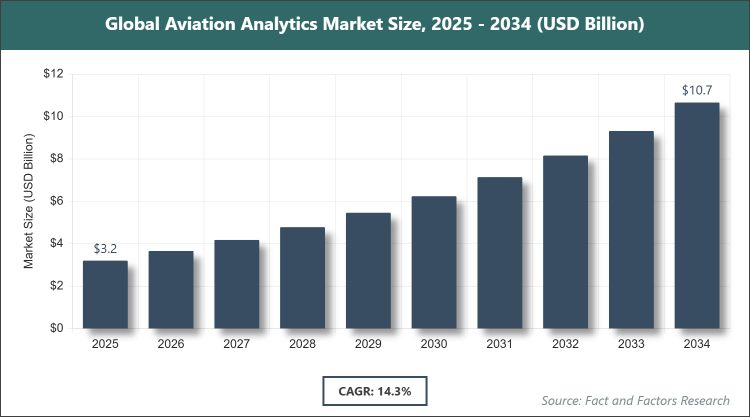
[235+ Pages Report] According to Facts & Factors, the global Aviation Analytics market size was estimated at USD 3.2 billion in 2025 and is expected to reach USD 12.5 billion by the end of 2034. The Aviation Analytics industry is anticipated to grow by a CAGR of 14.3% between 2026 and 2034. The Aviation Analytics Market is driven by increasing adoption of data-driven decision-making and rising demand for operational efficiency in the aviation sector.
 Market Overview
The aviation analytics market refers to the application of data analytics, artificial intelligence, and machine learning technologies to process and interpret large volumes of aviation-related data. This includes information from flight operations, passenger interactions, aircraft maintenance, supply chains, and external factors like weather and air traffic. The primary goal is to enable stakeholders such as airlines, airports, and regulatory bodies to make informed decisions that enhance safety, optimize resource allocation, reduce costs, and improve overall performance without relying on traditional manual methods.
Key Insights
- As per the analysis shared by our research analyst, the global Aviation Analytics market is estimated to grow annually at a CAGR of around 14.3% over the forecast period (2026-2034).
- In terms of revenue, the global Aviation Analytics market size was valued at around USD 3.2 billion in 2025 and is projected to reach USD 12.5 billion, by 2034.
- The market is driven by the surge in air passenger traffic, advancements in AI and big data technologies, and the need for predictive maintenance to minimize downtime.
- Based on the Component, the Software segment dominated the market in 2025 with a share of 60% & why it is dominated due to its scalability, real-time data processing capabilities, and integration with AI tools that enable efficient decision-making across aviation operations.
- Based on the Application, the Fuel Management segment dominated the market in 2025 with a share of 28% & why it is dominated as fuel costs represent a significant portion of airline expenses, and analytics optimize consumption through route planning and efficiency algorithms.
- Based on the End-User, the Airlines segment dominated the market in 2025 with a share of 55% & why it is dominated owing to their direct involvement in flight operations, where analytics improve fleet management, revenue strategies, and customer satisfaction.
- North America dominated the market in 2025 with a share of 35% & why it is dominated due to the presence of major airlines, advanced technological infrastructure, and early adoption of analytics solutions in the U.S. and Canada.
Growth Drivers
- Rising Air Passenger Traffic and Operational Efficiency Needs
The aviation industry is experiencing a substantial increase in global air travel, prompting airlines and airports to seek ways to manage higher volumes of passengers and flights without compromising service quality. Analytics solutions play a crucial role by providing insights into traffic patterns, enabling better scheduling, and reducing delays through predictive modeling. This not only enhances passenger experiences but also helps in resource optimization, such as crew allocation and gate management, leading to cost savings and improved profitability.
Furthermore, the integration of real-time data from IoT devices on aircraft and at airports allows for proactive decision-making. For instance, analytics can forecast potential bottlenecks in air traffic or maintenance needs, preventing disruptions that could cascade across networks. As the industry recovers from global challenges, the emphasis on resilience through data-driven strategies continues to propel the adoption of these technologies.
Restraints
- High Implementation Costs and Data Integration Issues
Deploying aviation analytics systems requires significant upfront investments in software, hardware, and training, which can be a barrier for smaller airlines or airports with limited budgets. The complexity of integrating diverse data sources, including legacy systems and new digital platforms, often leads to compatibility issues, delaying rollout and increasing expenses.
Additionally, concerns over data quality and standardization across global operations hinder effective analysis. Without clean, unified data, insights may be inaccurate, leading to mistrust in analytics outputs and slower adoption rates among stakeholders who rely on traditional methods.
Opportunities
- Advancements in AI and Machine Learning Integration
The incorporation of AI and machine learning into aviation analytics opens new avenues for predictive capabilities, such as forecasting maintenance needs or passenger demand with greater accuracy. This allows for personalized services, like tailored in-flight experiences or dynamic pricing, enhancing customer loyalty and revenue streams.
Moreover, emerging markets in developing regions present untapped potential where analytics can support infrastructure growth and efficiency improvements. Partnerships between tech firms and aviation entities can accelerate innovation, creating customized solutions that address specific regional challenges and drive long-term market expansion.
Challenges
- Data Privacy and Security Concerns
With the increasing reliance on data collection from passengers and operations, ensuring compliance with global privacy regulations like GDPR poses significant hurdles. Breaches or misuse of sensitive information can lead to legal repercussions and loss of trust, deterring investment in analytics platforms.
In addition, the aviation sector's interconnected nature makes it vulnerable to cyber threats, where a single vulnerability can compromise entire networks. Balancing the need for comprehensive data access with robust security measures requires ongoing investment in encryption and monitoring, which can strain resources.
Report Scope
Report Attribute |
Details |
Market Size 2025 |
USD 3.2 Billion |
Projected Market Size in 2034 |
USD 12.5 Billion |
CAGR Growth Rate |
14.3% CAGR |
Base Year |
2025 |
Forecast Years |
2026-2034 |
Key Market Players |
IBM Corporation, Oracle Corporation, SAP SE, General Electric, SAS Institute, Honeywell International Inc., The Boeing Company, Cirium, Ramco Systems, Mu-Sigma, Booz Allen Hamilton, and Others. |
Key Segment |
By Component, By Application, By End-User, and By Region |
Major Regions Covered |
North America, Europe, Asia Pacific, Latin America, and the Middle East & Africa |
Purchase Options |
Request customized purchase options to meet your research needs. Explore purchase options |
Market Segmentation
The Aviation Analytics market is segmented by component, application, end-user, and region.
Based on Component Segment, the Aviation Analytics market is divided into Software, Services, and others. The most dominant segment is Software, followed by Services as the second most dominant. The Software segment leads due to its core role in enabling data processing, visualization, and predictive modeling, which directly contributes to operational efficiencies and cost reductions by automating complex analyses and integrating with existing systems to drive real-time insights and strategic decisions in the aviation ecosystem.
Based on Application Segment, the Aviation Analytics market is divided into Fuel Management, Flight Risk Management, Revenue Management, Customer Analytics, Inventory Management, Navigation Services, and others. The most dominant segment is Fuel Management, followed by Revenue Management as the second most dominant. Fuel Management dominates because it addresses one of the largest operational costs in aviation, using analytics to optimize fuel usage through route adjustments, weight management, and efficiency monitoring, thereby significantly lowering expenses and environmental impact while boosting overall market growth through sustainable practices.
Based on End-User Segment, the Aviation Analytics market is divided into Airlines, Airports, and others. The most dominant segment is Airlines, followed by Airports as the second most dominant. Airlines hold the top position as they utilize analytics extensively for fleet optimization, passenger demand forecasting, and maintenance scheduling, which enhances profitability and safety, directly fueling market expansion by addressing high-stakes operational needs in a competitive global landscape.
Recent Developments
- In April 2025, Boeing agreed to sell parts of its Digital Aviation Solutions business to Thoma Bravo for USD 10.55 billion, focusing internal resources on core airframe programs while supplying maintenance analytics under long-term contracts.
- In September 2024, Safran acquired AI firm Preligens for EUR 220 million (USD 255.1 million) to deepen analytics capabilities in autonomous systems and enhance predictive maintenance offerings.
- In June 2024, IBM Corporation expanded its partnership with Delta Air Lines to implement an AI-driven predictive maintenance platform across Delta’s fleet of over 800 aircraft, aiming to reduce unscheduled downtime.
- In April 2024, The Boeing Company introduced the Parts Planning Hub, a tool utilizing advanced analytics and machine learning to optimize airline spare parts inventory and improve operational efficiency.
- In March 2024, Honeywell International Inc. launched Honeywell Forge for Airlines, an analytics platform designed to optimize operations, potentially reducing unscheduled maintenance by 15-20% and fuel consumption by 3-5%.
Regional Analysis
- North America to dominate the global market
North America leads the aviation analytics market, primarily driven by the United States, which hosts major airlines and technology innovators. The region's advanced infrastructure supports seamless integration of analytics for operational enhancements, while a strong focus on safety regulations encourages data-driven compliance. Investments in AI and cloud technologies further enable real-time decision-making, fostering innovation in areas like predictive maintenance and customer personalization. This dominance stems from a mature aviation ecosystem that prioritizes efficiency amid high air traffic volumes.
Europe follows closely, with Germany and the United Kingdom as key contributors due to their robust aerospace industries and emphasis on sustainability. Collaborative efforts among European airlines promote shared analytics platforms for route optimization and emissions tracking. The region's regulatory framework, including strict environmental standards, drives adoption of analytics to meet compliance while improving competitiveness. Ongoing digital transformation initiatives enhance connectivity across airports, supporting seamless passenger experiences and operational resilience.
Asia Pacific is experiencing rapid growth, led by China and India, where expanding air travel demands efficient management solutions. Governments in these countries invest heavily in airport modernization, integrating analytics for traffic forecasting and resource allocation. The rise of low-cost carriers amplifies the need for cost-effective tools to optimize fuel and maintenance. Cultural shifts toward technology adoption accelerate market penetration, positioning the region as a hub for innovative aviation solutions.
Latin America shows emerging potential, with Brazil dominating through its large domestic market and international connections. Analytics help address challenges like infrastructure limitations by improving flight scheduling and safety monitoring. Partnerships with global tech firms introduce advanced tools, enhancing operational capabilities amid economic fluctuations. The focus on tourism drives demand for customer-centric analytics to boost satisfaction and revenue.
The Middle East & Africa region, spearheaded by the United Arab Emirates, leverages analytics to support ambitious aviation hubs like Dubai. Investments in smart airports integrate data for seamless operations and passenger flow management. Challenges such as geopolitical tensions are mitigated through predictive risk analytics, ensuring reliability. Africa's growing connectivity, particularly in South Africa, benefits from analytics to expand networks efficiently.
Competitive Analysis
The global Aviation Analytics market is dominated by players:
- IBM Corporation
- Oracle Corporation
- SAP SE
- General Electric
- SAS Institute
- Honeywell International Inc.
- The Boeing Company
- Cirium
- Ramco Systems
- Mu-Sigma
- Booz Allen Hamilton
- And Others
The global Aviation Analytics market is segmented as follows:
By Component
- Software
- Services
By Application
- Fuel Management
- Flight Risk Management
- Revenue Management
- Customer Analytics
- Inventory Management
- Navigation Services
- Others
By End-User
- Airlines
- Airports
- Others
By Region
- North America
- The U.S.
- Canada
- Mexico
- Europe
- France
- The UK
- Spain
- Germany
- Italy
- Rest of Europe
- Asia Pacific
- China
- Japan
- India
- Australia
- Southeast Asia
- Rest of Asia Pacific
- The Middle East & Africa
- Saudi Arabia
- UAE
- Egypt
- Kuwait
- South Africa
- Rest of the Middle East & Africa
- Latin America
- Brazil
- Argentina
- Rest of Latin America
Industry Major Market Players
The global Aviation Analytics market is dominated by players:
- IBM Corporation
- Oracle Corporation
- SAP SE
- General Electric
- SAS Institute
- Honeywell International Inc.
- The Boeing Company
- Cirium
- Ramco Systems
- Mu-Sigma
- Booz Allen Hamilton
- And Others
Frequently Asked Questions



Copyright © 2025 - 2026, All Rights Reserved, Facts and Factors