
Search Market Research Report
Synchronizer Ring Market Size, Share Global Analysis Report, 2026-2034

Synchronizer Ring Market Size, Share, Growth Analysis Report By Type (Brass Synchronizer Ring, Steel Synchronizer Ring, Copper Base Alloy Ring, Carbon Fiber Synchronizer Ring, and Others), By Application (Passenger Vehicles, Commercial Vehicles), By End-User (OEM, Aftermarket), and By Region - Global Industry Insights, Overview, Comprehensive Analysis, Trends, Statistical Research, Market Intelligence, Historical Data and Forecast 2026-2034
Industry Insights
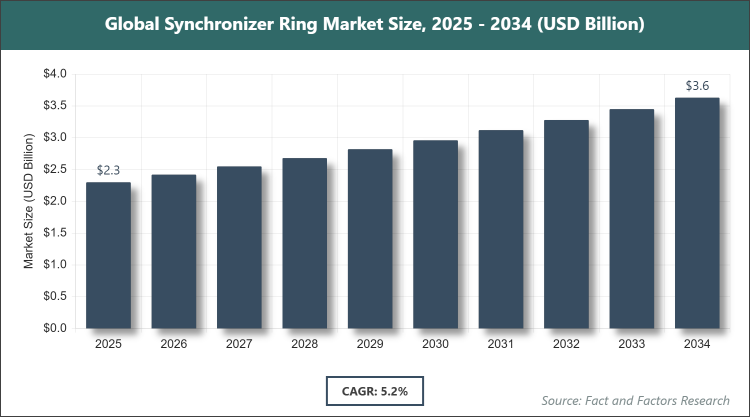
[235+ Pages Report] According to Facts & Factors, the global synchronizer ring market size was estimated at USD 2.3 billion in 2025 and is expected to reach USD 3.8 billion by the end of 2034. The synchronizer ring industry is anticipated to grow by a CAGR of 5.2% between 2026 and 2034. The synchronizer ring Market is driven by increasing demand for efficient automotive transmission systems.
 Market Overview
The synchronizer ring market encompasses components essential for smooth gear shifting in manual and semi-automatic transmissions within vehicles. These rings, typically made from materials like brass, steel, or alloys, facilitate the synchronization of gear speeds to prevent grinding and ensure seamless operation. This market serves the automotive industry, focusing on enhancing vehicle performance, durability, and driver comfort without relying on quantitative metrics.
Key Insights
- As per the analysis shared by our research analyst, the global synchronizer ring market is estimated to grow annually at a CAGR of around 5.2% over the forecast period (2026-2034).
- In terms of revenue, the global synchronizer ring market size was valued at around USD 2.3 billion in 2025 and is projected to reach USD 3.8 billion by 2034.
- The market is driven by increasing production and sales of vehicles, growing demand for improved transmission efficiency and smoother gear shifts, advancements in transmission technologies including dual-clutch and hybrid systems, and the ongoing development of lightweight and durable materials for synchronizer rings.
- Based on the type, the brass synchronizer ring segment dominated with a 40% share due to its excellent wear resistance, cost-effectiveness, and superior frictional properties that enhance gear synchronization efficiency.
- Based on the application, the passenger vehicles segment dominated with a 55% share owing to high global demand for personal mobility, rising disposable incomes in emerging markets, and the prevalence of manual transmissions in compact and mid-size cars.
- Based on the end-user, the OEM segment dominated with a 70% share because of direct integration into new vehicle manufacturing, stringent quality standards, and long-term partnerships between automakers and suppliers ensuring consistent supply and innovation.
- Based on the region, Asia Pacific dominated with a 40% share attributed to robust automotive manufacturing hubs in China and India, rapid urbanization driving vehicle ownership, and supportive government policies for electric and hybrid vehicle adoption that still incorporate transmission components.
Growth Drivers
- Increasing Demand for Manual Transmission Vehicles in Emerging Economies
The surge in vehicle ownership in developing regions has boosted the need for affordable and reliable manual transmissions, where synchronizer rings play a critical role in ensuring smooth operation. This demand is fueled by economic growth, improving infrastructure, and a preference for cost-effective mobility solutions that prioritize fuel efficiency and ease of maintenance.
As automakers expand production in these markets to meet local needs, the integration of advanced synchronizer rings helps enhance vehicle longevity and performance, further accelerating market expansion. Innovations in material science also contribute by making these components more durable against harsh driving conditions common in emerging economies.
Restraints
- Shift Toward Automatic and Electric Vehicles
The growing adoption of automatic transmissions and electric vehicles reduces the reliance on traditional synchronizer rings, as these systems often eliminate or minimize the need for manual gear synchronization. This transition is driven by consumer preferences for convenience and the global push toward electrification to meet emission standards.
High development costs for adapting synchronizer technology to hybrid systems pose additional barriers, limiting market penetration in segments shifting away from conventional manuals. Supply chain disruptions for raw materials further exacerbate these challenges, impacting production scalability.
Opportunities
- Advancements in Lightweight and Durable Materials
Emerging materials like carbon fiber and advanced alloys offer opportunities for lighter, more efficient synchronizer rings that improve fuel economy and vehicle handling. These innovations align with industry trends toward sustainability and performance optimization, opening doors for suppliers to collaborate with OEMs on next-generation transmissions.
The rise of hybrid vehicles presents a niche where enhanced synchronizer rings can bridge traditional and electric drivetrains, fostering market growth through R&D investments. Expanding aftermarket services in mature regions also provides avenues for customized solutions catering to enthusiast communities.
Challenges
- High Manufacturing Costs and Supply Chain Volatility
Precision engineering required for synchronizer rings drives up production expenses, compounded by fluctuations in metal prices and geopolitical tensions affecting raw material availability. These factors strain profit margins for manufacturers, particularly smaller players competing with established giants.
Regulatory pressures for eco-friendly manufacturing processes add complexity, requiring investments in green technologies that may delay market entry for new innovations. Balancing cost with quality remains a persistent hurdle in a competitive landscape.
Report Scope
Report Attribute |
Details |
Market Size 2025 |
USD 2.3 Billion |
Projected Market Size in 2034 |
USD 3.8 Billion |
CAGR Growth Rate |
5.2% CAGR |
Base Year |
2025 |
Forecast Years |
2026-2034 |
Key Market Players |
ZF Friedrichshafen AG, BorgWarner Inc., NSK Ltd., Allison Transmission Holdings Inc., Eaton Corporation, Koyo Bearings (JTEKT Corporation), Schaeffler Group (LuK), Tremec Corporation, Aisin Seiki Co. Ltd., Getrag, Magna International Inc., Valeo SA, and Others. |
Key Segment |
By Type, By Application, By End-User, and By Region |
Major Regions Covered |
North America, Europe, Asia Pacific, Latin America, and the Middle East & Africa |
Purchase Options |
Request customized purchase options to meet your research needs. Explore purchase options |
Market Segmentation
The synchronizer ring market is segmented by type, application, end-user, and region.
Based on Type Segment, the synchronizer ring market is divided into brass synchronizer ring, steel synchronizer ring, copper base alloy ring, carbon fiber synchronizer ring, and others. The brass synchronizer ring emerges as the most dominant subsegment, holding approximately 40% market share, primarily due to its optimal balance of frictional characteristics, corrosion resistance, and affordability, which makes it ideal for high-volume production in passenger vehicles. This dominance drives the overall market by enabling smoother gear shifts and reducing wear, thereby extending transmission lifespan and supporting fuel efficiency goals. The steel synchronizer ring follows as the second most dominant, with around 30% share, valued for its superior strength and heat tolerance in heavy-duty applications like commercial vehicles, contributing to market growth through enhanced durability in demanding conditions and facilitating adoption in emerging hybrid systems.
Based on Application Segment, the synchronizer ring market is divided into passenger vehicles and commercial vehicles. The passenger vehicles subsegment is the most dominant, capturing about 55% share, as it benefits from surging global demand for personal cars equipped with manual transmissions, where synchronizer rings ensure seamless shifting and improved driving experience. This leadership propels the market forward by aligning with urbanization trends and rising consumer spending on comfortable, efficient mobility solutions. Commercial vehicles rank as the second most dominant with roughly 45% share, driven by the need for robust components in logistics and fleet operations, aiding market expansion through reliability in high-mileage scenarios and integration with advanced fleet management technologies.
Based on End-User Segment, the synchronizer ring market is divided into OEM and aftermarket. The OEM subsegment dominates with a 70% share, owing to its direct involvement in vehicle assembly lines where standardized, high-quality synchronizer rings are essential for meeting performance and safety regulations. This position accelerates market growth by fostering innovation through close collaborations with automakers, ensuring components evolve with new transmission designs. The aftermarket holds the second spot at 30%, supported by replacement needs in aging vehicles, driving the market via accessibility for repairs and custom upgrades that extend vehicle usability in cost-sensitive regions.
Recent Developments
- In March 2025, General Motors announced a strategic partnership with Honda Motor Co. to co-develop next-generation transmission technologies and electrified drivetrain components, including advanced synchronizer rings, aiming to enhance efficiency in hybrid vehicles.
- In June 2025, ZF Friedrichshafen AG collaborated with Nissan Motor Corporation to create lightweight transmission modules featuring improved synchronizer rings, targeting global markets for better fuel economy and performance in passenger cars.
- In February 2025, Daimler AG secured a major contract with BorgWarner Inc. to supply high-precision gearing components, including synchronizer rings, for new automatic transmissions, strengthening supply chains for traditional and hybrid drivetrains.
Regional Analysis
- Asia Pacific to Dominate the Global Market
The Asia Pacific region leads the synchronizer ring market, driven by its massive automotive manufacturing base and rapid economic expansion. China stands out as the dominating country, with its vast production capabilities and government incentives for vehicle electrification that still incorporate transmission enhancements. This region's growth is fueled by increasing exports, technological integrations, and a shift toward sustainable mobility solutions that demand reliable components.
North America follows closely, with the United States as the key player, benefiting from advanced R&D in automotive tech and a strong aftermarket sector. The focus here is on innovation in hybrid systems and stringent emission standards that push for efficient transmissions, supporting steady market progression amid consumer preferences for performance vehicles.
Europe maintains a significant presence, led by Germany, where precision engineering and luxury automotive brands emphasize high-quality synchronizer rings. The region's emphasis on environmental regulations and electric vehicle adoption influences market dynamics, promoting materials that enhance efficiency while adapting to evolving drivetrain technologies.
Latin America shows emerging potential, with Brazil dominating due to growing vehicle fleets and infrastructure developments. Challenges like economic volatility are offset by rising foreign investments in auto manufacturing, gradually integrating advanced transmission parts to meet regional demand.
The Middle East & Africa region, spearheaded by South Africa, experiences moderate growth through mining and logistics sectors requiring durable commercial vehicles. Opportunities arise from urbanization and trade expansions, though limited by import dependencies and infrastructural constraints.
Competitive Analysis
The global synchronizer ring market is dominated by players:
- ZF Friedrichshafen AG
- BorgWarner Inc.
- NSK Ltd.
- Allison Transmission Holdings Inc.
- Eaton Corporation
- Koyo Bearings (JTEKT Corporation)
- Schaeffler Group (LuK)
- Tremec Corporation
- Aisin Seiki Co. Ltd.
- Getrag
- Magna International Inc.
- Valeo SA
The global synchronizer ring market is segmented as follows:
By Type
- Brass Synchronizer Ring
- Steel Synchronizer Ring
- Copper Base Alloy Ring
- Carbon Fiber Synchronizer Ring
- Others
By Application
- Passenger Vehicles
- Commercial Vehicles
By End-User
- OEM
- Aftermarket
By Region
- North America
- The U.S.
- Canada
- Mexico
- Europe
- France
- The UK
- Spain
- Germany
- Italy
- Rest of Europe
- Asia Pacific
- China
- Japan
- India
- Australia
- Southeast Asia
- Rest of Asia Pacific
- The Middle East & Africa
- Saudi Arabia
- UAE
- Egypt
- Kuwait
- South Africa
- Rest of the Middle East & Africa
- Latin America
- Brazil
- Argentina
- Rest of Latin America
Industry Major Market Players
The global synchronizer ring market is dominated by players:
- ZF Friedrichshafen AG
- BorgWarner Inc.
- NSK Ltd.
- Allison Transmission Holdings Inc.
- Eaton Corporation
- Koyo Bearings (JTEKT Corporation)
- Schaeffler Group (LuK)
- Tremec Corporation
- Aisin Seiki Co. Ltd.
- Getrag
- Magna International Inc.
- Valeo SA
Frequently Asked Questions



Copyright © 2025 - 2026, All Rights Reserved, Facts and Factors