
Search Market Research Report
Case Erectors Market Size, Share Global Analysis Report, 2026-2034

Case Erectors Market Size, Share, Growth Analysis Report By Machine Type (Automatic and Semi-Automatic), By End Use (Food & Beverages Packaging, Chemical & Petrochemical Packaging, Electronics Packaging, Cosmetics Packaging, Manufacturing, Pharmaceutical Packaging, Automobile Manufacturing, and Others), and By Region - Global Industry Insights, Overview, Comprehensive Analysis, Trends, Statistical Research, Market Intelligence, Historical Data and Forecast 2026-2034
Industry Insights
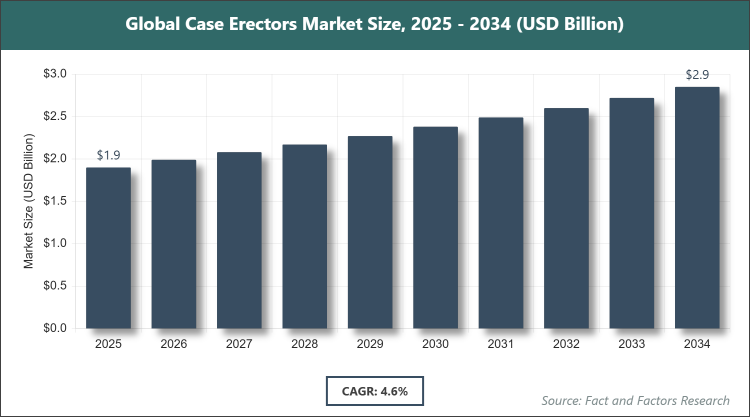
[216+ Pages Report] According to Facts & Factors, the global case erectors market size was estimated at USD 1.9 billion in 2025 and is expected to reach USD 2.8 billion by the end of 2034. The case erectors industry is anticipated to grow by a CAGR of 4.6% between 2026 and 2034. The case erectors Market is driven by rising adoption of automated packaging solutions across various industries.
 Market Overview
Case erectors, also known as box erectors or carton forming machines, are automated or semi-automated equipment designed to fold and seal the bottom flaps of corrugated cardboard boxes from flat blanks, preparing them for filling and further packaging processes. These machines are integral to end-of-line packaging systems, enhancing efficiency by reducing manual labor and ensuring consistent box formation. They are widely used in industries requiring high-volume packaging, where precision and speed are essential to maintain production flow without bottlenecks.
Key Insights
- As per the analysis shared by our research analyst, the global case erectors market is estimated to grow annually at a CAGR of around 4.6% over the forecast period (2026-2034)
- In terms of revenue, the global case erectors market size was valued at around USD 1.9 billion in 2025 and is projected to reach USD 2.8 billion, by 2034.
- The market is driven by increasing demand for automation in packaging lines, growth in e-commerce, and the need for efficient supply chain operations.
- Based on the machine type, the automatic segment dominated the market with 66% share due to its high efficiency and labor-saving capabilities in high-volume production environments.
- Based on the end use, the food and beverages packaging segment dominated the market with 32% share owing to the sector's emphasis on speed, hygiene, and high-throughput packaging requirements.
- Based on region, Asia Pacific dominated the market with 35% share attributed to rapid industrialization, expanding manufacturing bases, and booming e-commerce in countries like China and India.
Growth Drivers
- Rising Adoption of Automated Packaging Lines
The shift toward automation in manufacturing and distribution is a primary driver for the case erectors market, as companies seek to optimize operations amid rising labor costs and workforce shortages. Automated case erectors integrate seamlessly into high-speed production lines, reducing downtime and ensuring consistent box quality, which is crucial for industries like food and beverage where precision packaging prevents product damage and contamination.
This trend is amplified by advancements in robotics and AI, enabling machines to handle variable box sizes with minimal human intervention. As global supply chains become more complex, the demand for reliable, scalable automation solutions continues to propel market growth, particularly in regions with stringent efficiency standards.
- Growth in E-Commerce and Logistics Sectors
The exponential rise of online retail has increased the need for efficient packaging solutions to handle diverse shipment volumes, driving adoption of case erectors for quick and customizable box assembly. These machines support just-in-time packaging, reducing inventory costs and enabling faster order fulfillment, which is vital for e-commerce giants facing consumer demands for rapid delivery.
Furthermore, integration with warehouse management systems allows for real-time adjustments, enhancing overall supply chain resilience. This driver is particularly strong in emerging markets where e-commerce penetration is surging, fostering investments in automated infrastructure to meet global standards.
- Demand for Efficiency and Sustainability in Packaging
Industries are increasingly focusing on sustainable practices, with case erectors facilitating the use of recyclable materials and minimizing waste through precise forming. This aligns with regulatory pressures for eco-friendly packaging, encouraging manufacturers to adopt energy-efficient machines that reduce material usage and operational carbon footprints.
Technological innovations, such as modular designs, further support this by allowing easy upgrades without full system overhauls, promoting long-term cost savings. As consumer awareness grows, companies leveraging these efficiencies gain competitive advantages, boosting market expansion.
Restraints
- High Initial Capital Investment
The substantial upfront costs associated with purchasing and installing advanced case erectors pose a significant barrier, especially for small and medium-sized enterprises with limited budgets. These expenses include not only the machinery but also integration with existing lines and training for operators, which can delay ROI realization.
In volatile economic conditions, businesses may hesitate to commit to such investments, opting instead for manual processes despite long-term inefficiencies. This restraint is more pronounced in developing regions where access to financing for automation is limited.
- Maintenance and Operational Complexity
Complex machinery requires regular servicing and skilled technicians, leading to potential downtime and increased maintenance costs that can hinder market adoption. Inconsistent raw material quality, such as varying corrugated board specifications, can cause frequent jams or faults, exacerbating operational challenges.
For industries with high-mix production, frequent changeovers add to complexity, requiring specialized knowledge that may not be readily available. This often results in reliance on external service providers, increasing dependency and costs.
Opportunities
- Advancements in AI and IoT Integration
The incorporation of AI-powered predictive maintenance and IoT-enabled monitoring presents opportunities for smarter case erectors that optimize performance and reduce unplanned downtime. These technologies enable real-time data analytics, allowing proactive adjustments and enhancing overall equipment effectiveness.
As Industry 4.0 gains traction, manufacturers can develop connected systems that integrate with broader smart factory ecosystems, opening new revenue streams through software subscriptions and remote services. This opportunity is ripe in tech-savvy regions investing in digital transformation.
- Expansion into Emerging Markets
Rapid industrialization in Asia Pacific and Latin America offers untapped potential for case erectors, driven by growing manufacturing and export activities. Local governments' incentives for automation to boost productivity create favorable conditions for market entry.
Customized, cost-effective solutions tailored to regional needs, such as handling diverse packaging materials, can capture market share. Partnerships with local distributors further facilitate penetration, capitalizing on the shift from manual to automated processes.
Challenges
- Supply Chain Disruptions and Material Fluctuations
Global supply chain vulnerabilities, including raw material shortages and price volatility for corrugated boards, challenge consistent operation of case erectors. Disruptions can lead to production halts, affecting industries reliant on just-in-time inventory.
Geopolitical tensions and trade policies exacerbate these issues, increasing lead times for components and raising costs. Manufacturers must navigate these uncertainties while maintaining quality standards.
- Regulatory Compliance and Cybersecurity Risks
Stringent regulations on packaging sustainability and safety require ongoing adaptations, posing challenges for compliance without disrupting operations. As machines become more connected, cybersecurity threats to IoT systems risk data breaches and operational sabotage.
Balancing innovation with security measures demands investment in robust protocols, which can strain resources. This challenge is critical in regulated sectors like pharmaceuticals, where non-compliance carries severe penalties.
Report Scope
Report Attribute |
Details |
Market Size 2025 |
USD 1.9 Billion |
Projected Market Size in 2034 |
USD 2.8 Billion |
CAGR Growth Rate |
4.6% CAGR |
Base Year |
2025 |
Forecast Years |
2026-2034 |
Key Market Players |
Wexxar Bel (ProMach), Lantech, Combi Packaging Systems, Wayne Automation, EndFlex, Hamrick Manufacturing & Services, Recopak Machinery PTY Ltd., WestRock Company, Pearson Packaging Systems, A.B. Sealer Incorporated, and Others. |
Key Segment |
By Machine Type, By End Use, and By Region |
Major Regions Covered |
North America, Europe, Asia Pacific, Latin America, and the Middle East & Africa |
Purchase Options |
Request customized purchase options to meet your research needs. Explore purchase options |
Market Segmentation
The case erectors market is segmented by machine type, end use, and region.
Based on Machine Type Segment, the case erectors market is divided into automatic and semi-automatic. The most dominant segment is automatic case erectors, holding approximately 66% market share, due to their superior efficiency in high-volume environments, reducing labor needs and minimizing errors through advanced robotics and sensors. This dominance drives the market by enabling faster production cycles and integration with automated lines, supporting industries with stringent throughput demands. The second most dominant is semi-automatic, favored for its flexibility in smaller operations where cost and adaptability are key, helping to bridge the gap for businesses transitioning to full automation while maintaining control over variable production runs.
Based on End Use Segment, the case erectors market is divided into food and beverages packaging, chemical and petrochemical packaging, electronics packaging, cosmetics packaging, manufacturing, pharmaceutical packaging, automobile manufacturing, and others. The most dominant segment is food and beverages packaging, capturing around 32% share, as it benefits from high-speed, hygienic designs that ensure product integrity and comply with food safety standards, driving market growth through increased demand for ready-to-eat and packaged goods. The second most dominant is pharmaceutical packaging, valued for precision and cleanroom compatibility, which helps propel the market by addressing needs for tamper-evident and regulated packaging in a sector focused on quality control and traceability.
Recent Developments
- In September 2024, Kite Packaging unveiled new case erectors designed to accelerate operations and improve efficiency in packaging lines.
- In May 2023, MGS introduced the Matrix TL top-loading case packer, offering a comprehensive automated form, fill, and seal system for enhanced throughput.
- In November 2024, Celsius Holdings acquired expertise through partnerships to innovate packaging operations, focusing on advanced case erecting technologies.
- In August 2024, ValTara launched the PKR-Dual Delta Robot pick and place case packing cell, integrating with case erectors for streamlined automation.
- In 2025, Pearson Packaging Systems introduced a next-generation servo-driven automatic case erector for high-speed e-commerce applications.
Regional Analysis
- Asia Pacific to dominate the global market
Asia Pacific leads the case erectors market due to its robust manufacturing ecosystem and rapid e-commerce expansion. China dominates within the region as a manufacturing powerhouse, with heavy investments in automation to support export-oriented industries like electronics and consumer goods. The region's focus on cost-effective production and technological adoption, including AI-integrated systems, enhances efficiency and scalability. Government initiatives promoting Industry 4.0 further accelerate growth, making Asia Pacific a hub for innovative packaging solutions.
North America holds a significant share, driven by advanced automation infrastructure and high labor costs incentivizing machine adoption. The United States is the dominating country, with strong presence in food processing and pharmaceuticals, where regulatory compliance demands precise packaging. Investments in sustainable technologies and IoT integration bolster market resilience, while e-commerce giants push for faster fulfillment centers equipped with high-speed erectors.
Europe emphasizes sustainable and energy-efficient packaging, with Germany leading as the dominant country through its engineering prowess and Industry 4.0 leadership. The region's strict environmental regulations drive innovations in recyclable material handling, supporting sectors like cosmetics and automotive. Collaborative efforts among manufacturers enhance modular designs, ensuring adaptability to diverse production needs.
Latin America is emerging with growth in manufacturing and retail, where Brazil dominates due to its expanding food and beverage sector. Investments in automation address labor shortages, while trade agreements facilitate technology imports, enabling better integration into global supply chains.
The Middle East & Africa shows potential through industrialization, with South Africa leading in adoption for mining and consumer goods packaging. Infrastructure developments and foreign investments introduce automated solutions, though challenges like supply chain variability persist.
Competitive Analysis
The global case erectors market is dominated by players:
- Wexxar Bel (ProMach)
- Lantech
- Combi Packaging Systems
- Wayne Automation
- EndFlex
- Hamrick Manufacturing & Services
- Recopak Machinery PTY Ltd.
- WestRock Company
- Pearson Packaging Systems
- A.B. Sealer Incorporated
- Marq Packaging System
- A-B-C Packaging Machine Corporation
- Delkor Systems
- Econocorp Inc.
- BluePrint Automation (BPA)
- And Others.
The global case erectors market is segmented as follows:
By Machine Type
- Automatic
- Semi-Automatic
By End Use
- Food and Beverages Packaging
- Chemical and Petrochemical Packaging
- Electronics Packaging
- Cosmetics Packaging
- Manufacturing
- Pharmaceutical Packaging
- Automobile Manufacturing
- Others
By Region
- North America
- The U.S.
- Canada
- Mexico
- Europe
- France
- The UK
- Spain
- Germany
- Italy
- Rest of Europe
- Asia Pacific
- China
- Japan
- India
- Australia
- Southeast Asia
- Rest of Asia Pacific
- The Middle East & Africa
- Saudi Arabia
- UAE
- Egypt
- Kuwait
- South Africa
- Rest of the Middle East & Africa
- Latin America
- Brazil
- Argentina
- Rest of Latin America
Industry Major Market Players
The global case erectors market is dominated by players:
- Wexxar Bel (ProMach)
- Lantech
- Combi Packaging Systems
- Wayne Automation
- EndFlex
- Hamrick Manufacturing & Services
- Recopak Machinery PTY Ltd.
- WestRock Company
- Pearson Packaging Systems
- A.B. Sealer Incorporated
- Marq Packaging System
- A-B-C Packaging Machine Corporation
- Delkor Systems
- Econocorp Inc.
- BluePrint Automation (BPA)
- And Others.



Copyright © 2025 - 2026, All Rights Reserved, Facts and Factors