
Search Market Research Report
Aluminum-Air Battery Market Size, Share Global Analysis Report, 2026-2034

Aluminum-Air Battery Market Size, Share, Growth Analysis Report By Type (Primary Aluminum-Air Battery, Mechanical Rechargeable Secondary Aluminum-Air Battery, and Others), By Electrolyte (Water-Based, Potassium Hydroxide, and Others), By Application (Automotive, Grid Storage Devices, Consumer Electronics, Military & Aerospace, and Others), and By Region - Global Industry Insights, Overview, Comprehensive Analysis, Trends, Statistical Research, Market Intelligence, Historical Data and Forecast 2026-2034
Industry Insights
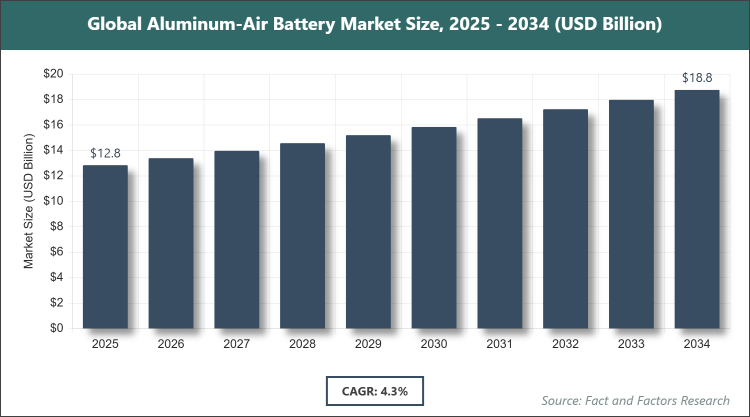
[237+ Pages Report] According to Facts & Factors, the global Aluminum-Air Battery market size was estimated at USD 12.84 billion in 2025 and is expected to reach USD 20.12 billion by the end of 2034. The Aluminum-Air Battery industry is anticipated to grow by a CAGR of 4.3% between 2026 and 2034. The Aluminum-Air Battery Market is driven by the increasing adoption of electric vehicles and demand for sustainable energy storage solutions.
 Market Overview
The aluminum-air battery market encompasses the development, production, and deployment of batteries that utilize aluminum as the anode and oxygen from the air as the cathode, generating electricity through an electrochemical reaction that offers high energy density and environmental benefits. These batteries are non-rechargeable in traditional forms but can be mechanically refueled by replacing the aluminum anode, making them suitable for applications requiring long-range power without frequent recharging. The market focuses on advancing materials and designs to overcome challenges like corrosion and electrolyte management, serving sectors that prioritize lightweight, cost-effective, and eco-friendly energy storage solutions over conventional lithium-based technologies.
Key Insights
- As per the analysis shared by our research analyst, the global Aluminum-Air Battery market is estimated to grow annually at a CAGR of around 4.3% over the forecast period (2026-2034).
- In terms of revenue, the global Aluminum-Air Battery market size was valued at around USD 12.84 billion in 2025 and is projected to reach USD 20.12 billion by 2034.
- The Aluminum-Air Battery market is projected to witness significant growth due to rising demand for sustainable energy storage in electric vehicles and grid applications.
- Based on the Type, the Primary Aluminum-Air Battery segment accounted for the largest market share of 65% due to its simplicity and high energy density for single-use applications.
- Based on the Electrolyte, the Water-Based segment dominated the market with the highest share, owing to its environmental safety and cost-effectiveness.
- Based on the Application, the Automotive segment held the leading position with a substantial share because of the need for lightweight, high-range batteries in electric vehicles.
- Based on the region, the Asia Pacific region captured around 40% market share, driven by rapid industrialization and government support for green energy initiatives.
Growth Drivers
- Rising Demand for Electric Vehicles
The surge in electric vehicle adoption globally is propelling the aluminum-air battery market, as these batteries offer superior energy density compared to lithium-ion alternatives, enabling longer driving ranges without increasing vehicle weight. Governments worldwide are implementing stringent emission regulations and incentives for EV purchases, further accelerating demand for innovative battery technologies. Advancements in aluminum-air systems, such as improved anode designs to minimize corrosion, enhance reliability, and appeal for automotive applications.
Additionally, collaborations between battery manufacturers and automakers are fostering rapid prototyping and integration, reducing time-to-market for new models. This synergy not only boosts production scales but also lowers costs through economies of scale, making aluminum-air batteries a viable option for mass-market EVs and supporting the transition to sustainable transportation.
Restraints
- Corrosion and Electrolyte Management Issues
Aluminum's tendency to corrode in aqueous electrolytes limits battery lifespan and efficiency, requiring complex inhibitors that increase production costs and complexity. This challenge hinders widespread adoption, particularly in high-humidity environments where performance degradation is accelerated. Regulatory requirements for safe disposal of byproducts add further operational hurdles.
Moreover, the need for specialized maintenance infrastructure for mechanical refueling deters investment in regions lacking supportive ecosystems. These technical barriers slow market penetration, necessitating ongoing R&D to develop robust, corrosion-resistant materials and electrolytes.
Opportunities
- Advancements in Rechargeable Designs
Research into hybrid systems combining aluminum-air with rechargeable technologies opens avenues for versatile applications, blending high energy density with cyclability. This innovation attracts funding from governments and venture capital, targeting grid storage where long-duration energy is crucial. Patents in advanced electrolytes promise improved stability and performance.
Furthermore, partnerships with renewable energy firms enable pilot projects for off-grid solutions, expanding market reach. This opportunity enhances competitiveness against lithium-ion batteries, positioning aluminum-air as a key player in the green energy transition.
Challenges
- Limited Infrastructure for Refueling
The absence of widespread refueling stations for aluminum anode replacement restricts practical deployment, particularly in remote areas. High initial setup costs for infrastructure deter investors, slowing ecosystem development. Standardization issues across manufacturers complicate scalability.
In addition, supply chain vulnerabilities for high-purity aluminum affect availability and pricing. These challenges require coordinated efforts from stakeholders to build networks and standardize protocols for sustained growth.
Report Scope
Report Attribute |
Details |
Market Size 2025 |
USD 12.84 Billion |
Projected Market Size in 2034 |
USD 20.12 Billion |
CAGR Growth Rate |
4.3% CAGR |
Base Year |
2025 |
Forecast Years |
2026-2034 |
Key Market Players |
Phinergy, Alcoa, Fuji-Pigment, Renault-Nissan, China Dynamics, Geely, Zhongke Metal, ACTXE, JOINWORLD, ANYUAN, Mingtai, Super New Power, and Others. |
Key Segment |
By Type, By Electrolyte, By Application, and By Region |
Major Regions Covered |
North America, Europe, Asia Pacific, Latin America, and the Middle East & Africa |
Purchase Options |
Request customized purchase options to meet your research needs. Explore purchase options |
Market Segmentation
The Aluminum-Air Battery market is segmented by type, electrolyte, application, and region.
Based on Type Segment, the Aluminum-Air Battery market is divided into Primary Aluminum-Air Battery, Mechanical Rechargeable Secondary Aluminum-Air Battery, and others. The most dominant segment is Primary Aluminum-Air Battery, which holds the largest share due to its high energy output and simplicity in design for disposable use in emergency power systems, driving the market by providing cost-effective solutions for remote and military applications; the second most dominant is Mechanical Rechargeable Secondary Aluminum-Air Battery, gaining traction for its refuelable nature in electric vehicles, contributing to market growth through enhanced sustainability and reduced operational costs.
Based on Electrolyte Segment, the Aluminum-Air Battery market is divided into Water-Based, Potassium Hydroxide, and others. The most dominant segment is Water-Based, commanding the highest share because of its non-toxic properties and lower environmental impact, which drives the market by aligning with global sustainability goals in consumer electronics; the second most dominant is Potassium Hydroxide, preferred for its higher conductivity in high-power applications, propelling market expansion via improved efficiency in grid storage.
Based on Application Segment, the Aluminum-Air Battery market is divided into Automotive, Grid Storage Devices, Consumer Electronics, Military & Aerospace, and others. The most dominant segment is Automotive, holding the biggest share due to the demand for extended range in EVs without heavy batteries, driving the market by supporting the shift to zero-emission transportation; the second most dominant is Grid Storage Devices, utilized for long-duration energy storage in renewables, contributing to market growth amid increasing clean energy adoption.
Recent Developments
- In March 2024, Institut Teknologi Sepuluh Nopember (ITS) conducted a trial of its first-generation aluminum-air battery prototype on a motorbike, advancing practical applications in transportation.
- In June 2024, AlumaPower Corporation raised USD 10 million in Series A funding to develop its aluminum-air Galvanic Generator for clean energy solutions.
- In January 2025, General Motors announced a multi-year agreement with Vianode for synthetic graphite, indirectly supporting advancements in battery materials including aluminum-air systems.
- In February 2024, Indian Oil increased its stake in Phinergy to 17% with a USD 12.5 million investment, boosting metal-air technology for telecom backups.
- In July 2022, Phinergy partnered with Hindalco for R&D on aluminum plates for aluminum-air batteries and recycling.
Regional Analysis
- Asia Pacific to dominate the global market
Asia Pacific leads the aluminum-air battery market, with China as the dominant country due to its massive manufacturing capacity and government incentives for EV adoption, fostering rapid deployment in urban mobility and renewable integration. The region's focus on sustainable energy, supported by policies like China's dual-carbon goals, accelerates R&D in high-density batteries. Infrastructure investments in charging and refueling networks enhance accessibility, while abundant aluminum resources reduce costs. China's dominance stems from its export-oriented industry and collaborations with global players, driving technological advancements.
North America exhibits strong growth through innovation in aerospace and military applications, led by the United States with its advanced R&D ecosystems and federal funding for clean tech. The region's emphasis on reducing emissions aligns with aluminum-air's eco-friendly profile, boosting adoption in grid storage. Partnerships between startups and tech giants foster breakthroughs in rechargeable designs. The U.S. leads due to policies like the Inflation Reduction Act, incentivizing domestic production and supply chain resilience.
Europe advances with stringent environmental regulations and a focus on circular economies, dominated by Germany through its automotive heritage and investments in green mobility. EU initiatives for battery recycling enhance sustainability, promoting aluminum-air in EVs and renewables. Collaborative projects across borders accelerate standardization and commercialization. Germany's position strengthens from its engineering expertise and export markets, supporting energy transition goals.
Latin America emerges with resource-rich economies leveraging aluminum abundance, led by Brazil via mining and renewable energy expansions. Infrastructure projects in remote areas drive off-grid applications, while foreign investments bolster local manufacturing. Brazil's dominance arises from biofuel synergies and policies promoting clean tech adoption.
The Middle East & Africa progresses through energy diversification efforts, with Saudi Arabia dominating via Vision 2030's focus on non-oil sectors like renewables. Investments in desalination and remote power enhance battery utility, while partnerships with international firms transfer technology. Saudi Arabia's lead comes from substantial funding and strategic location for exports.
Competitive Analysis
The global Aluminum-Air Battery market is dominated by players:
- Phinergy
- Alcoa
- Fuji-Pigment
- Renault-Nissan
- China Dynamics
- Geely
- Zhongke Metal
- ACTXE
- JOINWORLD
- ANYUAN
- Mingtai
- Super New Power
The global Aluminum-Air Battery market is segmented as follows:
By Type
- Primary Aluminum-Air Battery
- Mechanical Rechargeable Secondary Aluminum-Air Battery
- Others
By Electrolyte
- Water-Based
- Potassium Hydroxide
- Others
By Application
- Automotive
- Grid Storage Devices
- Consumer Electronics
- Military & Aerospace
- Others
By Region
- North America
- The U.S.
- Canada
- Mexico
- Europe
- France
- The UK
- Spain
- Germany
- Italy
- Rest of Europe
- Asia Pacific
- China
- Japan
- India
- Australia
- Southeast Asia
- Rest of Asia Pacific
- The Middle East & Africa
- Saudi Arabia
- UAE
- Egypt
- Kuwait
- South Africa
- Rest of the Middle East & Africa
- Latin America
- Brazil
- Argentina
- Rest of Latin America
Industry Major Market Players
- Phinergy
- Alcoa
- Fuji-Pigment
- Renault-Nissan
- China Dynamics
- Geely
- Zhongke Metal
- ACTXE
- JOINWORLD
- ANYUAN
- Mingtai
- Super New Power



Copyright © 2025 - 2026, All Rights Reserved, Facts and Factors