
Search Market Research Report
Acetylene Cylinder Market Size, Share Global Analysis Report, 2026-2034

Acetylene Cylinder Market Size, Share, Growth Analysis Report By Capacity (Below 10L, 10L-40L, Above 40L, and Others), By Material (Steel Cylinders, Composite Cylinders, and Others), By Application (Industrial, Chemical Synthesis, Scientific Research, and Others), By End-User (Manufacturing, Construction, Automotive, Shipbuilding, Chemical Industry, and Others), and By Region - Global Industry Insights, Overview, Comprehensive Analysis, Trends, Statistical Research, Market Intelligence, Historical Data and Forecast 2026-2034
Industry Insights
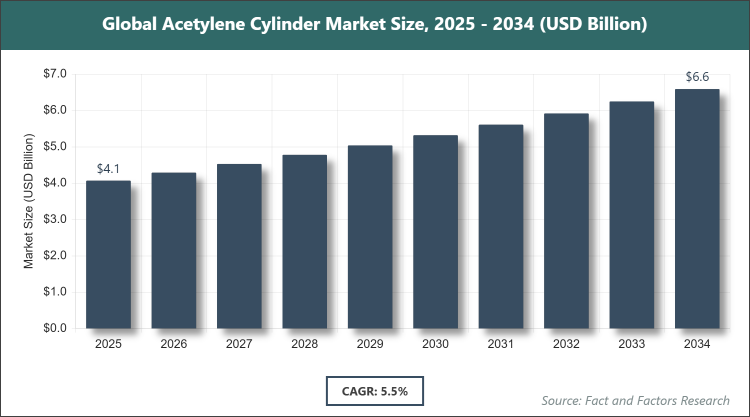
[235+ Pages Report] According to Facts & Factors, the global Acetylene Cylinder market size was estimated at USD 4.07 billion in 2025 and is expected to reach USD 6.57 billion by the end of 2034. The Acetylene Cylinder industry is anticipated to grow by a CAGR of 5.5% between 2026 and 2034. The Acetylene Cylinder Market is driven by increasing infrastructure development and rising demand in welding and chemical synthesis applications.
 Market Overview
The acetylene cylinder market encompasses the production, distribution, and utilization of specialized containers designed for the safe storage and transportation of acetylene gas, a highly flammable hydrocarbon used primarily in industrial processes. These cylinders are engineered with porous materials and solvents like acetone to stabilize the gas and prevent decomposition or explosions under pressure. The market serves diverse sectors where acetylene is essential for high-temperature operations, chemical reactions, and material processing, reflecting a critical component in modern manufacturing and research ecosystems.
Key Insights
- As per the analysis shared by our research analyst, the global Acetylene Cylinder market is estimated to grow annually at a CAGR of around 5.5% over the forecast period (2026-2034).
- In terms of revenue, the global Acetylene Cylinder market size was valued at around USD 4.07 billion in 2025 and is projected to reach USD 6.57 billion, by 2034.
- The Acetylene Cylinder market is projected to witness significant growth due to expanding infrastructure projects and advancements in industrial applications.
- Based on the Capacity, the 10L-40L segment accounted for the largest market share of 58.47% due to its optimal balance of portability and sufficient gas volume for medium-scale operations.
- Based on the Material, the Steel Cylinders segment dominated the market with the highest share owing to its proven durability, cost-effectiveness, and established safety standards in heavy-duty environments.
- Based on the Application, the Industrial segment held the leading position with a substantial share because of widespread use in welding, cutting, and metal fabrication processes across manufacturing hubs.
- Based on the End-User, the Manufacturing segment led with the largest share as it relies heavily on acetylene for precision operations in assembly lines and component production.
- Based on the region, the Asia Pacific region captured around 33% market share, driven by rapid industrialization and high demand from emerging economies.
Growth Drivers
- Infrastructure Development
Infrastructure projects worldwide, including the construction of bridges, highways, railways, and pipelines, heavily depend on acetylene cylinders for welding and cutting metals. The high flame temperature produced by acetylene-oxygen mixtures makes it ideal for these tasks, ensuring strong and precise joins in structural elements. As governments and private sectors invest in urban expansion and transportation networks, the need for reliable gas storage solutions rises, boosting cylinder demand. This trend is particularly evident in developing regions where modernization efforts accelerate, creating a sustained push for acetylene in on-site applications.
Additionally, the integration of acetylene in advanced infrastructure techniques, such as prefabricated steel assembly, enhances efficiency and reduces project timelines. Innovations in cylinder design, like improved valve systems for safer handling, further support this growth by addressing logistical challenges in remote construction sites. Overall, the alignment of acetylene cylinders with global infrastructure goals not only drives market expansion but also fosters technological advancements in gas containment and delivery systems.
Restraints
- High Flammability and Instability
Acetylene's inherent properties pose significant safety risks, requiring specialized cylinders and strict handling protocols to prevent accidents. This instability limits storage options and increases the complexity of transportation, often leading to higher insurance premiums and operational hurdles for suppliers. Regulatory bodies enforce rigorous standards, which can delay market entry for new players and raise barriers in regions with underdeveloped safety infrastructure.
Moreover, incidents related to improper usage can damage industry reputation, deterring potential adopters and slowing adoption in sensitive sectors. The need for ongoing training and equipment upgrades adds to costs, potentially constraining growth in cost-sensitive markets. These factors collectively create a cautious environment, where innovation in stabilization technologies becomes essential to mitigate risks and sustain market momentum.
Opportunities
- R&D on Bio-Based Production
Advancements in producing acetylene from renewable sources like biogas offer a pathway to reduce dependency on fossil fuels, aligning with global sustainability goals. This shift could lower production costs over time and appeal to eco-conscious industries, expanding market reach. Research into electrochemical methods using CO2 and water as feedstocks presents innovative, low-emission alternatives, potentially revolutionizing supply chains.
Furthermore, the successful commercialization of these methods could open new applications in green chemistry, enhancing cylinder demand for specialized, high-purity gases. Collaborations between academia and industry accelerate these developments, fostering patents and scalable solutions. This opportunity not only addresses environmental concerns but also positions the market for long-term resilience amid fluctuating energy prices.
Challenges
- Strict Regulations and Compliance Costs
Global safety regulations for flammable gases mandate extensive testing and certification for cylinders, escalating manufacturing expenses. Compliance with varying standards across regions complicates international trade and supply chain management, often resulting in delays and increased administrative burdens. Small-scale manufacturers struggle to meet these requirements, leading to market consolidation and reduced competition.
In addition, evolving environmental policies on emissions from acetylene production add layers of complexity, requiring investments in cleaner technologies. Failure to adapt can result in fines or operational shutdowns, impacting profitability. These challenges necessitate strategic planning and advocacy for harmonized global standards to streamline operations and support inclusive growth.
Report Scope
Report Attribute |
Details |
Market Size 2025 |
USD 4.07 Billion |
Projected Market Size in 2034 |
USD 6.57 Billion |
CAGR Growth Rate |
5.5% CAGR |
Base Year |
2025 |
Forecast Years |
2026-2034 |
Key Market Players |
Air Products, Linde plc, Worthington Cylinders, Kanto Koatsu-Yoki Manufacturing Co., Ltd., Harris Products Group, Norris Cylinder, Axcel Gases, GCE Group, Messer Group, MATHESON, and Others. |
Key Segment |
By Capacity, By Material, By Application, By End-User, and By Region |
Major Regions Covered |
North America, Europe, Asia Pacific, Latin America, and the Middle East & Africa |
Purchase Options |
Request customized purchase options to meet your research needs. Explore purchase options |
Market Segmentation
The Acetylene Cylinder market is segmented by capacity, material, application, end-user, and region.
Based on Capacity Segment, The Acetylene Cylinder market is divided into Below 10L, 10L-40L, Above 40L, and others. The most dominant segment is 10L-40L, which holds the largest share due to its versatility in balancing portability with adequate gas capacity for medium-scale industrial tasks like welding in workshops or construction sites; this drives the market by enabling efficient operations without frequent refills, reducing downtime and costs. The second most dominant is Above 40L, favored for high-volume applications in large factories where continuous supply is critical, helping to drive the market through optimized bulk usage and enhanced productivity in heavy industries.
Based on Material Segment, The Acetylene Cylinder market is divided into Steel Cylinders, Composite Cylinders, and others. The most dominant segment is Steel Cylinders, commanding the highest share because of their superior strength, affordability, and proven track record in withstanding high pressures, which drives market growth by ensuring reliability in demanding environments like metal fabrication. The second most dominant is Composite Cylinders, gaining traction for their lighter weight and corrosion resistance, contributing to market expansion by improving handling and safety in portable applications such as field research.
Based on Application Segment, The Acetylene Cylinder market is divided into Industrial, Chemical Synthesis, Scientific Research, and others. The most dominant segment is Industrial, with the largest share attributed to extensive use in welding and cutting processes that require high flame temperatures, driving the market by supporting essential manufacturing and construction activities worldwide. The second most dominant is Chemical Synthesis, where acetylene serves as a key raw material for producing polymers and acids, propelling market growth through innovations in sustainable chemical production methods.
Based on End-User Segment, The Acetylene Cylinder market is divided into Manufacturing, Construction, Automotive, Shipbuilding, Chemical Industry, and others. The most dominant segment is Manufacturing, holding the biggest share due to its reliance on acetylene for precision metalworking and assembly, which drives the market by enhancing production efficiency in global supply chains. The second most dominant is Construction, utilizing cylinders for on-site welding of infrastructure, contributing to market growth amid rising urbanization and development projects.
Recent Developments
- In March 2024, researchers from Doshisha University and Daikin Industries in Japan developed a novel method to produce acetylene using carbon dioxide and water as raw materials, paving the way for more sustainable and environmentally friendly production processes that could reduce reliance on fossil fuels.
- In December 2024, India's vehicle production across various categories reached over 1.9 million units, highlighting robust growth in the automotive sector that increases demand for acetylene cylinders in manufacturing and repair applications.
Regional Analysis
- Asia Pacific to dominate the global market
Asia Pacific stands as the leading region in the acetylene cylinder market, driven by rapid industrialization and expansive manufacturing bases in countries like China, which dominates due to its massive chemical and automotive sectors. The region's focus on infrastructure megaprojects, such as high-speed rail networks and urban expansions, fuels consistent demand for welding and cutting applications. Technological adoption in cylinder safety and lightweight designs further enhances efficiency, while government initiatives promoting industrial growth solidify its position. China's dominance stems from its role as a global export hub, where integrated supply chains ensure cost-effective production and distribution.
North America exhibits strong market presence through advanced technological integrations in industries like aerospace and automotive, with the United States leading as the dominant country owing to its innovation-driven economy and stringent safety standards. The region's emphasis on research and development fosters new applications in scientific fields, while established infrastructure supports seamless logistics. Investments in sustainable practices, such as bio-based acetylene, align with environmental policies, ensuring steady growth. The U.S. benefits from a mature market ecosystem, where key players drive competitiveness through mergers and product enhancements.
Europe maintains a mature market characterized by high regulatory compliance and a shift toward green technologies, with Germany as the dominant country due to its engineering prowess and automotive heritage. The region's commitment to reducing carbon footprints encourages innovations in composite cylinders and efficient gas usage. Automotive and chemical industries remain key consumers, supported by collaborative R&D across borders. Germany's leadership arises from its export-oriented industries, where precision manufacturing demands reliable acetylene solutions for high-quality outputs.
Latin America is emerging with growth tied to resource extraction and construction booms, led by Brazil as the dominant country through its expanding oil and gas sector. Infrastructure investments in roads and energy projects drive cylinder adoption for on-site operations. Challenges like economic volatility are offset by foreign investments, promoting market stability. Brazil's dominance is fueled by its natural resource wealth, enabling local production and reducing import dependencies.
The Middle East & Africa region grows through oil and gas explorations and construction activities, with Saudi Arabia dominating due to its Vision 2030 diversification efforts. Increasing industrialization in petrochemicals boosts acetylene use in synthesis and fabrication. Infrastructure developments, such as smart cities, create opportunities for cylinder suppliers. Saudi Arabia's lead comes from strategic investments in non-oil sectors, enhancing domestic manufacturing capabilities.
Competitive Analysis
The global Acetylene Cylinder market is dominated by players:
- Air Products
- Linde plc
- Worthington Cylinders
- Kanto Koatsu-Yoki Manufacturing Co., Ltd.
- Harris Products Group
- Norris Cylinder
- Axcel Gases
- GCE Group
- Messer Group
- MATHESON
The global Acetylene Cylinder market is segmented as follows:
By Capacity
- Below 10L
- 10L-40L
- Above 40L
- Others
By Material
- Steel Cylinders
- Composite Cylinders
- Others
By Application
- Industrial
- Chemical Synthesis
- Scientific Research
- Others
By End-User
- Manufacturing
- Construction
- Automotive
- Shipbuilding
- Chemical Industry
- Others
By Region
- North America
- The U.S.
- Canada
- Mexico
- Europe
- France
- The UK
- Spain
- Germany
- Italy
- Rest of Europe
- Asia Pacific
- China
- Japan
- India
- Australia
- Southeast Asia
- Rest of Asia Pacific
- The Middle East & Africa
- Saudi Arabia
- UAE
- Egypt
- Kuwait
- South Africa
- Rest of the Middle East & Africa
- Latin America
- Brazil
- Argentina
- Rest of Latin America
Industry Major Market Players
- Air Products
- Linde plc
- Worthington Cylinders
- Kanto Koatsu-Yoki Manufacturing Co., Ltd.
- Harris Products Group
- Norris Cylinder
- Axcel Gases
- GCE Group
- Messer Group
- MATHESON



Copyright © 2025 - 2026, All Rights Reserved, Facts and Factors