
Search Market Research Report
Ethernet Transformer Market Size, Share Global Analysis Report, 2026-2034

Ethernet Transformer Market Size, Share, Growth Analysis Report By Type (Standard Ethernet Transformers, PoE Ethernet Transformers, Industrial Ethernet Transformers, and Others), By Application (Telecommunications, IT and Data Centers, Consumer Electronics, Industrial Automation, and Others), By End-User (Commercial, Residential, Industrial, and Others), and By Region - Global Industry Insights, Overview, Comprehensive Analysis, Trends, Statistical Research, Market Intelligence, Historical Data and Forecast 2026-2034
Industry Insights
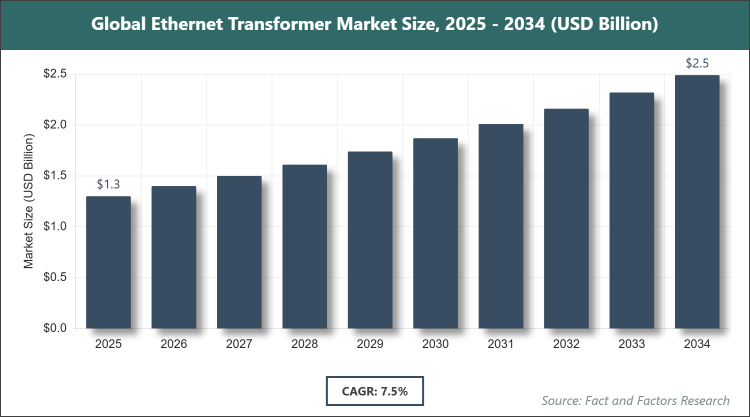
[225+ Pages Report] According to Facts & Factors, the global ethernet transformer market size was estimated at USD 1.3 billion in 2025 and is expected to reach USD 2.5 billion by the end of 2034. The ethernet transformer industry is anticipated to grow by a CAGR of 7.5% between 2026 and 2034. The ethernet transformer Market is driven by rising demand for high-speed data transmission.
 Market Overview
Ethernet transformers, also known as Ethernet magnetics or isolation transformers, are essential components in Ethernet networks that provide electrical isolation between network devices and transmission lines. They help prevent ground loops, reduce noise, and ensure signal integrity over long distances. These transformers are crucial for complying with Ethernet standards and are widely used in various networking equipment to facilitate reliable data communication.
Key Insights
- As per the analysis shared by our research analyst, the global ethernet transformer market is estimated to grow annually at a CAGR of around 7.5% over the forecast period (2026-2034).
- In terms of revenue, the global ethernet transformer market size was valued at around USD 1.3 billion in 2025 and is projected to reach USD 2.5 billion, by 2034.
- The ethernet transformer market is driven by rising demand for high-speed data transmission and expansion of data centers.
- Based on the type, the Standard Ethernet Transformers segment is dominated because it is widely adopted in standard networking applications for its cost-effectiveness and compatibility with common Ethernet speeds.
- Based on the application, the Telecommunications segment is dominated due to the high volume of data traffic and the need for reliable isolation in telecom infrastructure.
- Based on the end-user, the Commercial segment is dominated owing to extensive use in office networks, data centers, and enterprise environments requiring stable connectivity.
- North America is dominated due to early adoption of high-speed networks, presence of major data centers, and significant investments in 5G deployment.
Growth Drivers
- Rising Demand for High-Speed Data Transmission
The increasing need for faster and more reliable data transfer in modern networks is a primary driver for the ethernet transformer market. With the proliferation of bandwidth-intensive applications such as video streaming, cloud computing, and online gaming, there is a heightened requirement for components that can support higher data rates without compromising signal quality.
This demand is further amplified by the global shift towards digitalization across industries, where ethernet transformers play a vital role in maintaining network efficiency. As businesses and consumers alike rely on seamless connectivity, manufacturers are innovating to produce transformers capable of handling gigabit and multi-gigabit speeds, thereby fueling market expansion.
- Expansion of Data Centers and Cloud Services
The rapid growth of data centers worldwide, driven by the surge in cloud adoption and big data analytics, significantly boosts the demand for ethernet transformers. These facilities require robust networking components to ensure uninterrupted data flow and electrical isolation, preventing disruptions that could lead to costly downtime.
Moreover, hyperscale data centers operated by tech giants are investing heavily in advanced infrastructure, incorporating high-performance transformers to support scalable operations. This trend not only enhances market growth but also encourages technological advancements in transformer design to meet the stringent requirements of modern data environments.
Restraints
- Supply Chain Challenges
Global supply chain disruptions, including shortages of semiconductors and raw materials, pose significant restraints to the ethernet transformer market. These issues lead to increased production costs and delays, affecting manufacturers' ability to meet demand promptly.
Additionally, geopolitical tensions and trade restrictions exacerbate these challenges, making it difficult for companies to source components reliably. As a result, market players face pricing pressures and potential revenue losses, which could hinder overall growth if not addressed through diversified sourcing strategies.
- Regulatory Hurdles
Compliance with evolving industry standards and safety regulations presents a restraint for market participants. Ethernet transformers must adhere to strict guidelines set by organizations like IEEE and UL, which can increase development time and costs.
Failure to meet these requirements can result in product recalls or market entry barriers, particularly in regions with rigorous enforcement. This regulatory complexity requires ongoing investment in testing and certification, potentially slowing innovation and market penetration for smaller players.
Opportunities
- Growth in PoE Applications for Smart Buildings and IoT
The expanding use of Power over Ethernet (PoE) in smart buildings and IoT devices offers substantial opportunities for ethernet transformer manufacturers. PoE transformers enable simultaneous power and data transmission over a single cable, simplifying installations and reducing costs.
As smart home and building automation systems gain traction, the demand for specialized PoE-compatible transformers is expected to rise. This presents a chance for companies to develop innovative products tailored to these applications, capturing new market segments and driving revenue growth.
- Expansion of 5G Infrastructure
The global rollout of 5G networks creates opportunities for ethernet transformers in supporting the required high-speed backhaul and fronthaul connections. 5G demands low-latency and high-bandwidth components, where advanced transformers can ensure signal integrity in base stations and edge computing setups.
Investments in 5G by governments and telecom operators worldwide open avenues for market expansion, particularly in emerging economies. This trend encourages collaboration between transformer manufacturers and telecom firms to co-develop solutions optimized for next-generation networks.
Challenges
- Supply Chain Disruptions and Cost Pressures
Ongoing supply chain vulnerabilities and fluctuating raw material prices challenge the ethernet transformer market by increasing operational costs and affecting profitability. Manufacturers must navigate these issues while maintaining competitive pricing.
Moreover, the need for resilient supply chains requires strategic planning and partnerships, which can be resource-intensive. These challenges may lead to temporary shortages or price hikes, impacting market stability and customer satisfaction.
- Compliance with Evolving Regulations and Increased R&D Expenditures
Keeping pace with changing regulatory standards demands continuous R&D investment, posing a challenge especially for smaller firms with limited budgets. This can slow product development cycles and increase overall expenses.
Additionally, the pressure to innovate while ensuring compliance may strain resources, potentially limiting market entry for new players. Balancing innovation with regulatory adherence is crucial to overcoming this challenge and sustaining long-term growth.
Report Scope
Report Attribute |
Details |
Market Size 2025 |
USD 1.3 Billion |
Projected Market Size in 2034 |
USD 2.5 Billion |
CAGR Growth Rate |
7.5% CAGR |
Base Year |
2025 |
Forecast Years |
2026-2034 |
Key Market Players |
Texas Instruments, Broadcom Inc., NXP Semiconductors, Analog Devices, Inc., ON Semiconductor, and Others. |
Key Segment |
By Type, By Application, By End-User, and By Region |
Major Regions Covered |
North America, Europe, Asia Pacific, Latin America, and the Middle East & Africa |
Purchase Options |
Request customized purchase options to meet your research needs. Explore purchase options |
Market Segmentation
The ethernet transformer market is segmented by type, application, end-user, and region.
Based on Type Segment, the ethernet transformer market is divided into Standard Ethernet Transformers, PoE Ethernet Transformers, Industrial Ethernet Transformers, and others. The most dominant segment is Standard Ethernet Transformers, while the second most dominant is PoE Ethernet Transformers. Standard Ethernet Transformers dominate due to their widespread use in conventional networking equipment, offering cost-effective isolation and compatibility with various Ethernet speeds, which drives the market by supporting the majority of existing infrastructure upgrades. PoE Ethernet Transformers, as the second dominant, excel in applications requiring power and data over single cables, such as in IoT and smart devices, helping to drive the market through efficiency gains and reduced installation complexity.
Based on Application Segment, the ethernet transformer market is divided into Telecommunications, IT and Data Centers, Consumer Electronics, Industrial Automation, and others. The most dominant segment is Telecommunications, while the second most dominant is IT and Data Centers. Telecommunications dominates as it handles massive data volumes in networks, with ethernet transformers ensuring reliable signal transmission, driving the market via 5G and broadband expansions. IT and Data Centers, the second dominant, rely on these components for scalable, high-speed operations, contributing to market growth through cloud computing and big data demands.
Based on End-User Segment, the ethernet transformer market is divided into Commercial, Residential, Industrial, and others. The most dominant segment is Commercial, while the second most dominant is Industrial. Commercial dominates with extensive use in offices and enterprises for stable networking, driving the market through digital transformation initiatives. Industrial, as second dominant, benefits from automation needs, where rugged transformers support harsh environments, propelling growth via Industry 4.0 adoption.
Recent Developments
- In March 2023, Texas Instruments launched a new line of PoE Ethernet transformers for high-power applications in smart buildings.
- In June 2024, Broadcom Inc. expanded its Ethernet transformer portfolio by acquiring a leading manufacturer of industrial-grade transformers.
- In January 2025, NXP Semiconductors introduced a new series of Ethernet transformers with advanced security features for IoT applications.
Regional Analysis
- North America to dominate the global market
The North American ethernet transformer market is characterized by robust technological advancements and a strong presence of key industry players. The region benefits from extensive investments in data centers and telecommunications infrastructure, particularly in the United States, which serves as a hub for innovation in networking technologies. Canada also contributes significantly with its growing focus on digital transformation. The demand is further fueled by the proliferation of IoT devices and smart city initiatives. Overall, North America maintains a leading position due to its advanced ecosystem and supportive regulatory environment.
The European ethernet transformer market exhibits strong growth driven by initiatives like Industry 4.0, with Germany leading in industrial automation and manufacturing excellence. Countries such as the UK and France emphasize digital infrastructure upgrades and renewable energy integrations that require reliable networking components. The region's focus on sustainability influences transformer designs towards energy-efficient models. Collaboration between governments and private sectors fosters innovation in high-speed connectivity. Europe remains competitive through its emphasis on research and development in advanced technologies.
The Asia Pacific ethernet transformer market is experiencing rapid expansion, led by China's massive telecommunications investments and manufacturing capabilities. India and Japan contribute through burgeoning IT sectors and smart manufacturing adoption. The region benefits from increasing internet penetration and mobile network enhancements. Government policies promoting digital economies accelerate demand for networking components. Asia Pacific's dynamic market is poised for continued growth with emerging technologies like 5G.
The Latin American ethernet transformer market shows steady progress, with Brazil dominating due to rising internet access and data center developments. Mexico and Argentina support growth through industrial expansions and telecom improvements. The region focuses on bridging digital divides to enhance connectivity. Investments in infrastructure projects drive demand for reliable components. Latin America offers potential for market players through untapped opportunities in urbanization.
The Middle East & Africa ethernet transformer market is evolving, led by the UAE's smart city visions and broadband expansions. South Africa and Saudi Arabia contribute via industrial diversification and digital initiatives. The region emphasizes infrastructure resilience in harsh environments. Collaborations with global firms bring technological advancements. Middle East & Africa holds promise for growth in connectivity-driven sectors.
Competitive Analysis
The global ethernet transformer market is dominated by players:
- Texas Instruments
- Broadcom Inc.
- NXP Semiconductors
- Analog Devices, Inc.
- ON Semiconductor
The global ethernet transformer market is segmented as follows:
By Type
- Standard Ethernet Transformers
- PoE Ethernet Transformers
- Industrial Ethernet Transformers
- Others
By Application
- Telecommunications
- IT and Data Centers
- Consumer Electronics
- Industrial Automation
- Others
By End-User
- Commercial
- Residential
- Industrial
- Others
By Region
- North America
- The U.S.
- Canada
- Mexico
- Europe
- France
- The UK
- Spain
- Germany
- Italy
- Rest of Europe
- Asia Pacific
- China
- Japan
- India
- Australia
- Southeast Asia
- Rest of Asia Pacific
- The Middle East & Africa
- Saudi Arabia
- UAE
- Egypt
- Kuwait
- South Africa
- Rest of the Middle East & Africa
- Latin America
- Brazil
- Argentina
- Rest of Latin America
Industry Major Market Players
Frequently Asked Questions



Copyright © 2025 - 2026, All Rights Reserved, Facts and Factors