
Search Market Research Report
Beverage Carbonator Market Size, Share Global Analysis Report, 2025 - 2034

Beverage Carbonator Market Size, Share, Growth Analysis Report By Type (Type I, Type II, Type III and Type IV), By Application (Carbonated Drinks and Beer), And By Region - Global Industry Insights, Overview, Comprehensive Analysis, Trends, Statistical Research, Market Intelligence, Historical Data and Forecast 2025 - 2034
Industry Insights
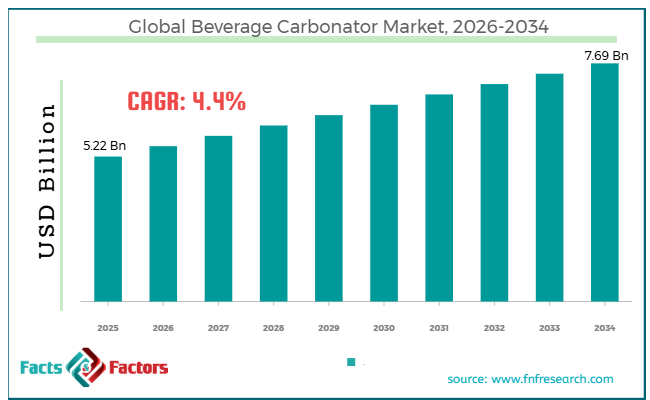
[227+ Pages Report] According to Facts & Factors, the global beverage carbonator market size was worth around USD 5.22 billion in 2025 and is predicted to grow to around USD 7.69 billion by 2034 with a compound annual growth rate (CAGR) of roughly 4.4% between 2026 and 2034.
 Market Overview
Carbonating beverages is done with a device called a carbonator. It is available in an array of styles and designs. There are several models of soda makers with varying features and designs, depending on the manufacturer. Certain variations are manually operated, requiring the user to press a button or lever to release the CO2, while automated versions allow the user to adjust the flavorings and level of carbonation with a single button press. Certain varieties further include reusable bottles or carafes, while others allow the customer to supply their bottle.
Key Insights
- As per the analysis shared by our research analyst, the global beverage carbonator market is estimated to grow annually at a CAGR of around 4.4% over the forecast period (2026-2034).
- In terms of revenue, the global beverage carbonator market size was valued at around USD 5.22 billion in 2025 and is projected to reach USD 7.69 billion, by 2034.
- Technological advancement is expected to drive market growth over the forecast period.
- Based on the type, the Type I segment is expected to grow at the highest CAGR during the forecast period.
- Based on the application, the carbonated drinks segment is expected to capture a significant market share over the projected period.
- Based on region, North America is expected to dominate the market during the forecast period.
Growth Drivers
- Advancement in technology drives market growth
The advancement of technology is now a significant trend that is gaining popularity in the industry. Leading companies in the carbonated beverage processing equipment market are concentrating on creating cutting-edge technology. The Pro Fill V Series offers easy, reproducible filler procedures and recipe-based changeovers due to an innovative electronic HMI interface.
As a result, changeover times are also shortened, increasing total manufacturing capacity. Comparing the Pro Fill V to standard fill-to-level can fillers, the Pro Fill V provides three times the filling accuracy. The accuracy with which AI filling technology has improved has aided in market expansion.
Restraints
- High initial cost hinders market growth
The initial cost of a carbonation machine might be a significant barrier to purchasing one, particularly for start-ups or small businesses with limited resources. The cost of commercial-grade machinery used in large-scale manufacturing can be very significant.
One cost limitation, though, is the funds required to purchase and operate carbonation machines in the beverage industry. Carbonation machine prices may differ based on features, capacity, size, and reputation of the brand. The primary obstacle impeding market expansion is the expensive cost.
Opportunities
- Growing product launches offer a lucrative opportunity for market growth
The growing product launches are expected to offer a potential opportunity for market development during the forecast period. For instance, in September 2025, the newest advancement in inline carbonation technology, the NSF-certified carbonator, was introduced by Rotarex Solutions. The carbonator's key advantages include an endless carbonation capacity, flawless, long-lasting bubbles that produce the best taste, superior self-cleaning capabilities, and an extremely simple connection process. Due to its small size and flexibility in positioning, it may be easily incorporated into current manufacturing lines.
Additionally, because it operates solely mechanically, no electricity is required. This is a significant advancement in in-line carbonation technology, providing a means of enhancing the flavor and caliber of beverages while also augmenting the efficacy and productivity of beverage producers.
Challenges
- High energy consumption poses a major challenge to market expansion
Processing sales of carbonated beverages is restricted since the production process uses a lot of energy. Creating carbonated drinks involves several energy-intensive processes, including carbonation, mixing, chilling, and packaging. As the food and beverage business emphasizes sustainability and energy efficiency more, market concerns emerge. In turn, these elements restrict customer demand.
Report Scope
Report Attribute |
Details |
Market Size in 2025 |
USD 5.22 Billion |
Projected Market Size in 2034 |
USD 7.69 Billion |
CAGR Growth Rate |
4.4% CAGR |
Base Year |
2025 |
Forecast Years |
2026-2034 |
Key Market Players |
DELLA TOFFOLA GROUP, Tetra Pak, Politech-Plus, Centec, Anton Paar, CFT Packaging, GEA Wiegand, KHS GmbH, and others. |
Key Segment |
By Type, By Application, and Region |
Major Regions Covered |
North America, Europe, Asia Pacific, Latin America, and the Middle East &, Africa |
Purchase Options |
Request customized purchase options to meet your research needs. Explore purchase options |
Segmentation Analysis
The global beverage carbonator industry is segmented based on type, application and region.
Based on the type, the global beverage carbonator market is bifurcated into Type I, Type II, Type III and Type IV. The Type I segment is expected to grow at the highest CAGR during the forecast period. Type I refers to home-use beverage carbonators. Consumers are choosing healthier beverages at home as a result of growing wellness and health awareness. In keeping with the trend toward healthier lives, people can make sparkling water and other low-sugar drinks at home with carbonators.
Additionally, home carbonators make it convenient to make carbonated beverages at all times. Customers can adjust the flavor and quantity of carbonation in their beverages to suit their dietary needs and personal preferences. Thereby, driving the segment expansion over the projected period.
Based on the application, the global beverage carbonator industry is bifurcated into carbonated drinks and beer. The carbonated drinks segment is expected to capture a significant market share over the projected period. The segment expansion is attributable to the increasing health and wellness trends. Carbonated drinks with natural flavors and reduced sugar content are becoming more and more popular as people become more health conscious. Consumers can make these healthier selections at home with beverage carbonators. Customers can also adjust the ingredients and carbonation levels to suit their tastes and requirements in terms of health.
Furthermore, the growing product launches propel the market expansion. In March 2025, the top sparkling water manufacturer, SodaStream, announced the addition of the E-TERRATM and E-DUOTM to its cutting-edge lineup of sparkling water producers. The brand's efforts to offer a sustainable upgraded sparkling water experience through unique designs, cutting-edge features, and adaptable solutions at various price points will be strengthened by these advancements. Whether they are seasoned, high-end entertainers or just getting started with carbonating at home, the new models were carefully designed to give aficionados of sparkling water even more options to personalize their favorite libations.
Regional Analysis
- North America is expected to dominate the market during the forecast period
North America is expected to dominate the market during the forecast period. The region has the largest market share in terms of value. Growth is being driven by the increased presence of popular quick-service restaurants such as Subway, McDonald's, KFC, Burger King, Pizza Hut, and Dominoes in the market. Some restaurants have added soda machines to their menus so that patrons may get their drinks quickly. Beverage carbonator sales have increased as a result of the biggest producers in the region, such as The Coca-Cola Company, Pepsico Inc., and Dr Pepper, increasing their market share. The industry's growing demand for freshly delivered soda drinks is attributed to the market expansion for beverage carbonators.
Besides, the Asia Pacific is expected to grow at the highest CAGR during the forecast period due to the rise in the need for soda machines in the fast-food restaurant sector in countries such as China and India. Demand is anticipated to rise due to several causes, including the expansion of government programs, the propensity to accept low-cost commodities, and the increase in consumer buying power. An environmentally friendly technology, the automatic carbonator gets its supply from paper cups. Thus, the decline in sales of plastic bottles has led to an increase in market growth in the Asia Pacific area.
Competitive Analysis
The global beverage carbonator market is dominated by players like:
- DELLA TOFFOLA GROUP
- Tetra Pak
- Politech-Plus
- Centec
- Anton Paar
- CFT Packaging
- GEA Wiegand
- KHS GmbH
The global beverage carbonator market is segmented as follows:
By Type
- Type I
- Type II
- Type III
- Type IV
By Application
- Carbonated Drinks
- Beer
By Region
- North America
- The U.S.
- Canada
- Mexico
- Europe
- France
- The UK
- Spain
- Germany
- Italy
- Rest of Europe
- Asia Pacific
- China
- Japan
- India
- Australia
- Southeast Asia
- Rest of Asia Pacific
- The Middle East & Africa
- Saudi Arabia
- UAE
- Egypt
- Kuwait
- South Africa
- Rest of the Middle East & Africa
- Latin America
- Brazil
- Argentina
- Rest of Latin America
Industry Major Market Players
- DELLA TOFFOLA GROUP
- Tetra Pak
- Politech-Plus
- Centec
- Anton Paar
- CFT Packaging
- GEA Wiegand
- KHS GmbH
Frequently Asked Questions



Copyright © 2025 - 2026, All Rights Reserved, Facts and Factors