
Search Market Research Report
Telecom API Market Size, Share Global Analysis Report, 2026-2034

Telecom API Market Size, Share, Growth Analysis Report By Type (Messaging API, WebRTC API, Payment API, IVR API, Location API, and Others), By End-User (Enterprise Developers, Internal Telecom Developers, Partner Developers, and Long Tail Developers), and By Region - Global Industry Insights, Overview, Comprehensive Analysis, Trends, Statistical Research, Market Intelligence, Historical Data and Forecast 2026-2034
Industry Insights
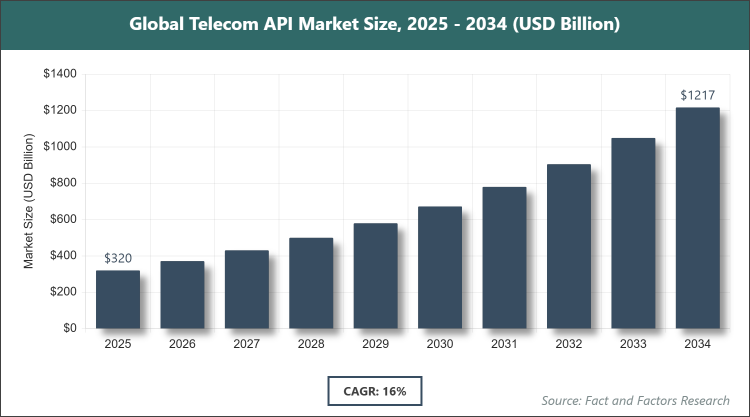
[235+ Pages Report] According to Facts & Factors, the global telecom API market size was estimated at USD 320 billion in 2025 and is expected to reach USD 1200 billion by the end of 2034. The telecom API industry is anticipated to grow by a CAGR of 16% between 2026 and 2034. The telecom API market is driven by increasing adoption of 5G networks and rising demand for cloud-based communication services.
 Market Overview
The telecom API market encompasses application programming interfaces that enable developers to integrate telecommunications capabilities such as messaging, voice, location, and payment services into applications and platforms. These APIs facilitate seamless communication between telecom networks and third-party software, supporting innovations in mobile apps, IoT devices, and enterprise solutions without requiring direct infrastructure management.
Key Insights
- As per the analysis shared by our research analyst, the global telecom API market is estimated to grow annually at a CAGR of around 16% over the forecast period (2026-2034).
- In terms of revenue, the global telecom API market size was valued at around USD 320 billion in 2025 and is projected to reach USD 1200 billion by 2034.
- The market is driven by the rapid adoption of 5G technology, increasing demand for cloud-based services, and the proliferation of IoT applications.
- Based on the type, the messaging API segment dominated the market with a share of over 30% due to its widespread use in customer engagement and real-time communication applications.
- Based on the end-user, the enterprise developers segment held the largest share of approximately 37% as enterprises increasingly integrate APIs for customized communication solutions to enhance operational efficiency.
- Based on region, North America held the dominant share of around 34%, owing to advanced telecom infrastructure, high 5G penetration, and the strong presence of key players driving innovation.
Growth Drivers
- Rising Adoption of 5G Networks
The rollout of 5G technology is a primary driver for the telecom API market, enabling low-latency and high-speed connectivity that supports advanced applications like augmented reality and autonomous vehicles. This evolution allows telecom operators to expose network capabilities through APIs, fostering new revenue streams and ecosystem partnerships.
As 5G networks expand globally, developers are leveraging APIs to create innovative services that require real-time data processing and enhanced bandwidth. This trend is particularly evident in sectors like healthcare and manufacturing, where APIs integrate seamlessly with edge computing to deliver efficient solutions.
Restraints
- Security and Privacy Concerns
Increasing cyber threats and data breaches pose significant restraints, as APIs expose sensitive telecom data to potential vulnerabilities. Regulatory compliance requirements, such as GDPR, add complexity to API deployment and management.
These concerns can slow market adoption, as enterprises hesitate to integrate APIs without robust security measures. Telecom providers must invest in advanced encryption and authentication protocols to mitigate risks, which can increase operational costs and delay time-to-market for new services.
Opportunities
- Expansion of CPaaS Platforms
The growth of Communication Platform as a Service (CPaaS) presents opportunities for telecom APIs, allowing developers to build scalable communication tools without heavy infrastructure investments. This model supports rapid innovation in areas like omnichannel customer service.
As businesses shift to digital-first strategies, CPaaS integration via APIs enables customized solutions for industries such as e-commerce and finance. Emerging markets in Asia Pacific offer untapped potential, where rising smartphone penetration drives demand for accessible API-based services.
Challenges
- Integration with Legacy Systems
Compatibility issues with existing legacy telecom infrastructure hinder seamless API adoption, requiring significant upgrades and technical expertise. This challenge is amplified in regions with outdated networks, leading to fragmented implementations.
Overcoming these barriers demands collaborative efforts between operators and developers to standardize APIs. Without addressing integration complexities, the market may face slowed growth in enterprise sectors reliant on hybrid environments.
Report Scope
Report Attribute |
Details |
Market Size 2025 |
USD 320 Billion |
Projected Market Size in 2034 |
USD 1200 Billion |
CAGR Growth Rate |
16% CAGR |
Base Year |
2025 |
Forecast Years |
2026-2034 |
Key Market Players |
AT&T Inc., Twilio Inc., Telefónica SA, Verizon Communications Inc., Ericsson, Vodafone Group, Infobip Ltd, Sinch AB, Deutsche Telekom AG, Orange SA, Huawei Technologies Co. Ltd., Nokia Corporation, and Others. |
Key Segment |
By Type, By End-User, and By Region |
Major Regions Covered |
North America, Europe, Asia Pacific, Latin America, and the Middle East & Africa |
Purchase Options |
Request customized purchase options to meet your research needs. Explore purchase options |
Market Segmentation
The telecom API market is segmented by type, end-user, and region.
Based on Type Segment, the telecom API market is divided into messaging API, WebRTC API, payment API, IVR API, location API, and others. The messaging API segment emerged as the most dominant, capturing over 30% market share, primarily due to its essential role in enabling SMS, MMS, and RCS functionalities that support instant customer interactions and marketing campaigns. This dominance drives the market by facilitating cost-effective, scalable communication channels that enhance user engagement across mobile and web platforms. The location API follows as the second most dominant, with around 25% share, driven by its integration in navigation and logistics apps, which improves operational efficiency and location-based services, thereby contributing to overall market expansion through data-driven insights.
Based on End-User Segment, the telecom API market is divided into enterprise developers, internal telecom developers, partner developers, and long tail developers. Enterprise developers dominate with approximately 37% share, as they utilize APIs to customize enterprise-grade solutions for CRM and collaboration tools, dominating due to high demand for tailored integrations that boost productivity. This segment drives market growth by enabling large-scale deployments that generate substantial revenue for API providers. Partner developers hold the second-largest share at about 28%, leveraging APIs for collaborative ecosystems like app marketplaces, which dominate through strategic alliances that expand reach and innovation, helping propel the market via diversified applications and partnerships.
Recent Developments
- In October 2025, GSMA launched Open Gateway in Germany, enabling mobile operators to expose standardized network APIs, fostering new business models while ensuring security and privacy compliance.
- In October 2025, Google Cloud partnered with telecom operators like Deutsche Telekom and Verizon to provide Firebase developers access to phone-number verification APIs, accelerating AI-driven transformations in telecommunications.
- In September 2025, CAMARA Project released its first major Meta-Release with 25 vetted APIs, including stable versions for location verification and SIM swap, advancing interoperability in the telecom API ecosystem.
- In February 2025, Aduna, a venture by Ericsson and U.S. operators AT&T, T-Mobile, and Verizon, announced standardized network APIs for number verification and SIM swap to enhance innovation in financial services and identity verification.
Regional Analysis
- North America to dominate the global market
North America leads the telecom API market, driven by robust infrastructure and early 5G adoption in the United States, which serves as the dominating country. The region's tech-savvy ecosystem supports rapid API integration in enterprises, fostering innovation in cloud services and IoT applications. Strong regulatory frameworks ensure secure data handling, while partnerships between operators and hyperscalers like AWS enhance scalability and developer access.
Europe follows with steady growth, led by Germany as the dominating country, emphasizing GDPR-compliant APIs and sustainable digital initiatives. The focus on interoperable networks through GSMA collaborations enables cross-border services, supporting sectors like automotive and healthcare with reliable, low-latency APIs that align with the region's emphasis on privacy and technological standardization.
Asia Pacific emerges as the fastest-growing region, with China dominating due to massive mobile subscriber bases and aggressive 5G expansions. Government-backed digital transformations in countries like India and Japan propel API adoption for e-commerce and smart cities, leveraging affordable connectivity to drive inclusive growth and innovation in emerging tech ecosystems.
Latin America shows promising potential, dominated by Brazil, where increasing smartphone penetration and fintech integrations fuel API demand. Investments in network upgrades address connectivity gaps, enabling APIs to support financial inclusion and remote services in diverse economies, gradually bridging the digital divide.
The Middle East & Africa region, led by the UAE, focuses on smart city projects and diversified economies beyond oil. Advanced 5G rollouts in Gulf countries facilitate API-driven solutions for tourism and logistics, while Africa’s mobile-first approach in nations like South Africa promotes affordable APIs for financial and health services.
Competitive Analysis
The global telecom API market is dominated by players:
- AT&T Inc.
- Twilio Inc.
- Telefónica SA
- Verizon Communications Inc.
- Ericsson
- Vodafone Group
- Infobip Ltd
- Sinch AB
- Deutsche Telekom AG
- Orange SA
- Huawei Technologies Co. Ltd.
- Nokia Corporation
The global telecom API market is segmented as follows:
By Type
- Messaging API
- WebRTC API
- Payment API
- IVR API
- Location API
- Others
By End-User
- Enterprise Developers
- Internal Telecom Developers
- Partner Developers
- Long Tail Developers
By Region
- North America
- The U.S.
- Canada
- Mexico
- Europe
- France
- The UK
- Spain
- Germany
- Italy
- Rest of Europe
- Asia Pacific
- China
- Japan
- India
- Australia
- Southeast Asia
- Rest of Asia Pacific
- The Middle East & Africa
- Saudi Arabia
- UAE
- Egypt
- Kuwait
- South Africa
- Rest of the Middle East & Africa
- Latin America
- Brazil
- Argentina
- Rest of Latin America
Table of Content
Industry Major Market Players
The global telecom API market is dominated by players:
- AT&T Inc.
- Twilio Inc.
- Telefónica SA
- Verizon Communications Inc.
- Ericsson
- Vodafone Group
- Infobip Ltd
- Sinch AB
- Deutsche Telekom AG
- Orange SA
- Huawei Technologies Co. Ltd.
- Nokia Corporation



Copyright © 2025 - 2026, All Rights Reserved, Facts and Factors