
Search Market Research Report
Polyester Polyol Market Size, Share Global Analysis Report, 2026-2034

Polyester Polyol Market Size, Share, Growth Analysis Report By Type (Aliphatic Polyester Polyols, Aromatic Polyester Polyols, and Others), By Application (Flexible Foam, Rigid Foam, CASE (Coatings, Adhesives, Sealants, Elastomers), and Others), By End-User (Construction, Automotive, Furniture, and Others), and By Region - Global Industry Insights, Overview, Comprehensive Analysis, Trends, Statistical Research, Market Intelligence, Historical Data and Forecast 2026-2034
Industry Insights
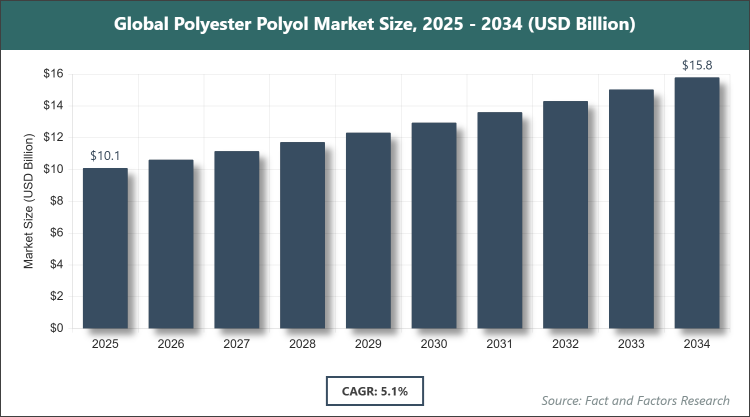
[232+ Pages Report] According to Facts & Factors, the global polyester polyol market size was estimated at USD 10.1 billion in 2025 and is expected to reach USD 16.6 billion by the end of 2034. The polyester polyol industry is anticipated to grow by a CAGR of 5.1% between 2026 and 2034. The polyester polyol Market is driven by increasing demand for polyurethane in the construction and automotive sectors.
 Market Overview
Polyester polyol refers to a class of polymers characterized by multiple hydroxyl groups, synthesized through the reaction of dicarboxylic acids or anhydrides with diols or polyols, resulting in versatile compounds essential for producing polyurethanes and other materials used across various industries for their durability and flexibility properties.
Key Insights
- As per the analysis shared by our research analyst, the polyester polyol market is estimated to grow annually at a CAGR of around 5.1% over the forecast period (2026-2034).
- In terms of revenue, the polyester polyol market size was valued at around USD 10.1 billion in 2025 and is projected to reach USD 16.6 billion by 2034.
- The market is driven by expanding applications in construction and automotive industries alongside the development of bio-based alternatives.
- Based on the type, aromatic polyester polyols dominated the market with a share of 60% due to their superior mechanical strength and chemical resistance preferred in industrial coatings and adhesives.
- Based on the application, CASE (Coatings, Adhesives, Sealants, Elastomers) dominated the market with a share of 35% due to exceptional durability and weather resistance meeting industrial requirements.
- Based on the end-user, construction dominated the market with a share of 40% due to extensive use in insulating foams for energy-efficient buildings.
- Based on the region, Asia Pacific dominated the market with a share of 44% due to rapid industrialization and a strong manufacturing presence.
Growth Drivers
- Increasing Demand from Construction and Automotive Sectors
The polyester polyol market is experiencing significant expansion primarily due to rising requirements in the construction industry for high-performance insulation materials and in the automotive sector for lightweight components that enhance fuel efficiency. These polymers provide essential properties such as thermal resistance and mechanical strength, making them indispensable in modern building designs and vehicle manufacturing processes that prioritize energy conservation and durability.
Furthermore, technological advancements in formulation techniques have enabled the development of specialized grades that meet stringent performance standards while addressing environmental concerns through improved recyclability and reduced emissions during production.
Restraints
- Volatility in Raw Material Prices
A major constraint affecting the polyester polyol market is the fluctuation in prices of essential raw materials like adipic acid and phthalic anhydride, which are derived from petroleum sources and subject to global supply chain disruptions. This price instability impacts production costs and profit margins for manufacturers, potentially leading to delayed investments in capacity expansion.
Additionally, dependency on fossil fuel-based inputs creates vulnerability to geopolitical events and market speculations that can cause sudden cost escalations, challenging smaller producers and affecting overall market stability.
Opportunities
- Development of Bio-Based Polyester Polyols
The shift towards sustainable materials presents substantial opportunities in the polyester polyol market through the advancement of bio-based alternatives derived from renewable resources like plant oils and recycled materials. These eco-friendly options align with growing regulatory pressures and consumer preferences for green products across various applications.
Moreover, innovation in bio-based formulations is opening new market segments in industries seeking to reduce carbon footprints while maintaining performance characteristics, potentially creating premium pricing opportunities and expanding market reach.
Challenges
- Stringent Environmental Regulations
The polyester polyol market faces significant hurdles from increasingly strict environmental regulations concerning volatile organic compound emissions and chemical usage in production processes. Compliance requires substantial investments in new technologies and process modifications, which can strain resources for many manufacturers.
In addition, navigating varying regulatory frameworks across different regions complicates global operations and supply chains, potentially limiting market expansion in certain areas while increasing operational complexities for international players.
Report Scope
Report Attribute |
Details |
Market Size 2025 |
USD 10.1 Billion |
Projected Market Size in 2034 |
USD 16.6 Billion |
CAGR Growth Rate |
5.1% CAGR |
Base Year |
2025 |
Forecast Years |
2026-2034 |
Key Market Players |
BASF SE, Covestro AG, Huntsman Corporation, Stepan Company, Evonik Industries AG, DIC Corporation, Arkema, Dow Inc., Mitsui Chemicals, Wanhua Chemical, and Others. |
Key Segment |
By Type, By Application, By End-User, and By Region |
Major Regions Covered |
North America, Europe, Asia Pacific, Latin America, and the Middle East & Africa |
Purchase Options |
Request customized purchase options to meet your research needs. Explore purchase options |
Market Segmentation
The polyester polyol market is segmented by type, application, end-user, and region.
Based on Type Segment, the polyester polyol market is divided into aliphatic polyester polyols, aromatic polyester polyols, and others. The most dominant segment is aromatic polyester polyols, which excel due to their enhanced mechanical properties and compatibility with various isocyanates, driving market growth through widespread adoption in high-performance applications. The second most dominant is aliphatic polyester polyols, valued for their superior UV resistance and flexibility, contributing to market expansion in outdoor and flexible material uses.
Based on Application Segment, the polyester polyol market is divided into flexible foam, rigid foam, CASE (coatings, adhesives, sealants, elastomers), and others. The most dominant segment is CASE, leading because of its versatility in providing durable protective layers and bonding solutions across industries, fueling overall market progression. The second most dominant is rigid foam, prominent for its excellent insulation properties that support energy-efficient construction practices and drive sector advancement.
Based on End-User Segment, the polyester polyol market is divided into construction, automotive, furniture, and others. The most dominant segment is construction, prevailing owing to the need for robust insulation and structural materials in building projects, propelling market development. The second most dominant is automotive, significant for enabling lightweight and resilient components that improve vehicle performance and efficiency, boosting industry growth.
Recent Developments
- In May 2025, Huntsman expanded its Conroe, Texas facility with a new E-GRADE purification unit, enhancing production capabilities for specialized polyester polyol applications in high-tech sectors.
- In August 2024, BASF formed a strategic alliance with Renewable Energy Group to develop bio-based feedstocks, aiming to replace fossil inputs in polyester polyol production and support sustainability goals.
- In October 2025, Reju announced a new chemical recycling plant in Germany to convert used polyester into high-quality polyols, advancing circular economy practices in the market.
Regional Analysis
- Asia Pacific to dominate the global market
Asia Pacific leads the polyester polyol market due to its robust manufacturing infrastructure and rapid urbanization, with China as the dominating country fostering extensive industrial growth and innovation in polyurethane applications. The region's cost-effective production and expanding consumer base further solidify its position.
North America maintains a strong market presence through advanced technological capabilities and stringent quality standards, with the United States dominating via its focus on high-performance materials and sustainable practices in key industries like automotive and construction.
Europe emphasizes innovation in eco-friendly solutions and regulatory compliance, led by Germany as the dominating country with its chemical expertise and commitment to green manufacturing processes across various applications.
Latin America shows emerging potential through increasing industrial activities and resource availability, with Brazil dominating the region by leveraging its growing construction sector and automotive manufacturing base.
The Middle East & Africa region is developing steadily with investments in infrastructure, dominated by Saudi Arabia through its expanding chemical industry and diversification efforts beyond oil-based economies.
Competitive Analysis
The global polyester polyol market is dominated by players:
- BASF SE
- Covestro AG
- Huntsman Corporation
- Stepan Company
- Evonik Industries AG
- DIC Corporation
- Arkema
- Dow Inc.
- Mitsui Chemicals
- Wanhua Chemical
The global polyester polyol market is segmented as follows:
By Type
- Aliphatic Polyester Polyols
- Aromatic Polyester Polyols
- Others
By Application
- Flexible Foam
- Rigid Foam
- CASE (Coatings, Adhesives, Sealants, Elastomers)
- Others
By End-User
- Construction
- Automotive
- Furniture
- Others
By Region
- North America
- The U.S.
- Canada
- Mexico
- Europe
- France
- The UK
- Spain
- Germany
- Italy
- Rest of Europe
- Asia Pacific
- China
- Japan
- India
- Australia
- Southeast Asia
- Rest of Asia Pacific
- The Middle East & Africa
- Saudi Arabia
- UAE
- Egypt
- Kuwait
- South Africa
- Rest of the Middle East & Africa
- Latin America
- Brazil
- Argentina
- Rest of Latin America
Table of Content
Industry Major Market Players
The global polyester polyol market is dominated by players:
- BASF SE
- Covestro AG
- Huntsman Corporation
- Stepan Company
- Evonik Industries AG
- DIC Corporation
- Arkema
- Dow Inc.
- Mitsui Chemicals
- Wanhua Chemical



Copyright © 2025 - 2026, All Rights Reserved, Facts and Factors