
Search Market Research Report
Land Mobile Radio (LMR) System Market Size, Share Global Analysis Report, 2026-2034-

Land Mobile Radio (LMR) System Market Size, Share, Growth Analysis Report By Technology (Analog, Digital (Terrestrial Trunked Radio, Project 25, Digital Mobile Radio, and Others)), By Medium (Handheld, Vehicle-mounted, and Fixed Base), By Frequency (25–174 MHZ (VHF), 200–512 MHZ (UHF), and 700 MHZ & Above (SHF)), By End-Use (Government & Public Safety, Energy & Utilities, Military & Defense, Transportation & Logistics, Mining & Construction, and Others), and By Region - Global Industry Insights, Overview, Comprehensive Analysis, Trends, Statistical Research, Market Intelligence, Historical Data and Forecast 2026-2034-
Industry Insights
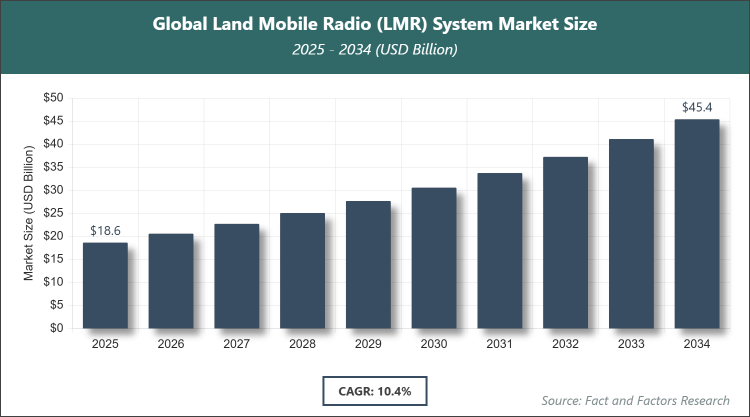
[220+ Pages Report] According to Facts & Factors, the global land mobile radio (LMR) system market size was estimated at USD 18.64 billion in 2025 and is expected to reach USD 45.18 billion by the end of 2034. The land mobile radio (LMR) system industry is anticipated to grow by a CAGR of 10.40% between 2026 and 2034. The land mobile radio (LMR) system Market is driven by growing adoption and improvement in critical communication operations.
 Market Overview
The land mobile radio (LMR) system market encompasses wireless communication technologies designed for terrestrial use over limited geographic areas, primarily facilitating voice and data transmission between portable, mobile, and fixed devices. These systems are essential for mission-critical communications in sectors requiring reliable, secure, and instantaneous connectivity, such as public safety operations, industrial coordination, and emergency response scenarios. LMR systems operate on dedicated frequency bands and support features like push-to-talk functionality, group calling, and encryption, distinguishing them from consumer cellular networks by prioritizing durability in harsh environments and independence from public infrastructure. The market includes hardware like radios, base stations, and repeaters, alongside software for network management, reflecting a blend of analog and evolving digital standards that enhance spectral efficiency and interoperability.
Key Insights
- As per the analysis shared by our research analyst, the global land mobile radio (LMR) system market is estimated to grow annually at a CAGR of around 10.40% over the forecast period (2026-2034)
- In terms of revenue, the global land mobile radio (LMR) system market size was valued at around USD 18.64 billion in 2025 and is projected to reach USD 45.18 billion, by 2034.
- The market is driven by growing adoption and improvement in critical communication operations, heightened needs for better emergency communications, and increasing acceptance in transportation and utilities for safety and efficiency.
- Based on the Technology, the Analog segment dominated the market in 2025 with 56.65% and is expected to continue leading due to its lower cost and simplicity, making it appealing for small and medium-sized enterprises in various applications.
- Based on the Medium, the Handheld segment dominated the market in 2025 with 44.57% and is anticipated to maintain dominance owing to its portability, enabling reliable and instantaneous communication for emergency responders, security personnel, and field operations in dynamic environments.
- Based on the Frequency, the 25–174 MHZ (VHF) segment dominated the market in 2025 with 43.39% and is projected to hold the lead because of its effectiveness in long-distance communication, particularly in rural and suburban regions suited for agriculture, forestry, and public safety in remote areas.
- Based on the End-Use, the Government & Public Safety segment dominated the market in 2025 with 28.2% and is expected to remain prominent due to the critical need for secure, resilient communication in harsh conditions, independent of commercial networks, amid rising global security threats and natural disasters.
- Asia Pacific dominated the global market in 2025 with 40.60% share and is poised to continue leading owing to rapid urbanization, smart city initiatives, and government investments in enhancing public safety networks and integrating with advanced broadband technologies.
Growth Drivers
- Growing Adoption in Critical Communication Operations
The increasing reliance on land mobile radio systems for mission-critical communications is a primary driver, as these technologies provide robust, real-time connectivity essential for coordinating responses in high-stakes scenarios like disaster management and law enforcement. With global incidents of natural calamities and security threats on the rise, organizations are prioritizing systems that ensure uninterrupted operation even in network-congested or infrastructure-damaged environments, fostering widespread adoption across public and private sectors.
Furthermore, advancements in LMR integration with emerging technologies such as IoT and AI are enhancing operational efficiency, allowing for predictive maintenance and automated alerts that reduce downtime and improve decision-making. This evolution not only extends the lifecycle of existing infrastructure but also attracts investments from industries seeking to modernize their communication frameworks, thereby accelerating market expansion.
- Need for Digital Mobile Technology
The shift toward digital LMR systems is propelled by their superior spectral efficiency, enabling more users to operate within limited frequency bands while supporting advanced features like data transmission and encryption. This addresses the limitations of analog systems, such as noise interference and limited capacity, making digital solutions ideal for densely populated urban areas and complex industrial operations where clear, secure communication is paramount.
In addition, the compatibility of digital standards like TETRA and P25 with broadband networks facilitates hybrid models that combine voice reliability with high-speed data, supporting applications from remote monitoring to video streaming. This versatility drives uptake in sectors like transportation, where real-time data exchange enhances safety and efficiency, contributing significantly to overall market growth.
- Rising Acceptance in Transportation and Utilities
The transportation sector's growing adoption of LMR systems stems from the need for seamless coordination in logistics, rail, and aviation, where timely communication prevents accidents and optimizes routes. Utilities benefit similarly, using LMR for grid management and outage response, ensuring quick restoration and minimizing disruptions in essential services.
Moreover, regulatory mandates for enhanced safety protocols in these industries are compelling investments in reliable communication tools, with LMR's durability in extreme conditions proving invaluable. This trend is amplified by infrastructure development in emerging economies, where expanding networks require robust systems to support economic growth and public welfare.
Restraints
- Interoperability and Integration Issues
A major restraint is the challenge of achieving seamless interoperability among diverse LMR systems, particularly in multi-agency environments where legacy analog setups clash with modern digital protocols, leading to communication gaps during emergencies.
This issue is compounded by the lack of universal standards, resulting in fragmented networks that hinder effective collaboration and increase operational risks. Addressing it requires substantial upgrades and training, which can deter smaller organizations due to resource constraints.
- High Deployment Costs
The elevated costs associated with implementing advanced LMR infrastructure, including hardware, software, and spectrum licensing, pose a significant barrier, especially for budget-limited entities in developing regions.
Additionally, ongoing maintenance and the need for specialized personnel further escalate expenses, potentially slowing adoption rates. This financial hurdle is particularly acute amid economic uncertainties, where prioritizing essential investments becomes challenging.
Opportunities
- Adoption in Transportation and Utility Sectors
Opportunities abound in the transportation and utilities sectors, where LMR systems can enhance safety through real-time monitoring and coordinated responses, capitalizing on the push for smarter infrastructure.
Cloud-based LMR implementations offer scalable, cost-effective alternatives to traditional setups, enabling remote management and reducing capital expenditure. This shift appeals to organizations seeking flexibility and efficiency in expanding their networks.
- Cloud-Based Implementations
The integration of cloud technologies provides avenues for innovation, such as centralized data analytics and over-the-air updates, improving system resilience and user experience.
Furthermore, this approach facilitates hybrid models with LTE/5G, opening new markets in smart cities and industrial IoT, where seamless connectivity drives operational advancements.
Challenges
- Interoperability in Emergencies
Ensuring interoperability during crises remains a challenge, as disparate systems often fail to connect, complicating joint operations among agencies and potentially delaying responses.
Legacy system integration exacerbates this, requiring complex bridging solutions that may not always perform reliably under stress, highlighting the need for standardized frameworks.
- Supply Chain Disruptions from Tariffs
Reciprocal tariffs disrupt supply chains, increasing costs and delaying procurements, which affects timely upgrades and expansions in critical sectors.
This geopolitical factor can lead to higher budgets and innovation slowdowns, challenging market players to adapt through localization or alternative sourcing strategies.
Report Scope
Report Attribute |
Details |
Market Size 2025 |
USD 18.64 Billion |
Projected Market Size in 2034 |
USD 45.18 Billion |
CAGR Growth Rate |
10.40% CAGR |
Base Year |
2025 |
Forecast Years |
2026-2034 |
Key Market Players |
Motorola Solutions, Inc. (U.S.), L3Harris Technologies, Inc. (U.S.), Anritsu (Japan), Hytera Communications Corporation Limited (China), Triple C Communications, Inc. (U.S.), Airbus S.A.S. (France), Thales Group (France), JVCKenwood Corporation (Japan), Cartel Communication Systems (Canada), Tait Communications (New Zealand), Icom Incorporated (Japan), Sepura Limited (U.K.), Simoco Wireless Solutions (U.K.), Codan Communications (Australia), RELM Wireless Corporation (U.S.), Radioshop Communications Ltd. (U.K.), Rohill Engineering B.V. (Netherlands), DAMM Cellular Systems A/S (Denmark), Sepcom Communications Ltd. (Israel), Tetra Ireland Communications Ltd. (Ireland), and Others. |
Key Segment |
By Technology, By Medium, By Frequency, By End-Use, and By Region |
Major Regions Covered |
North America, Europe, Asia Pacific, Latin America, and the Middle East & Africa |
Purchase Options |
Request customized purchase options to meet your research needs. Explore purchase options |
Market Segmentation
The land mobile radio (LMR) system market is segmented by technology, medium, frequency, end-use, and region.
Based on Technology Segment, the land mobile radio (LMR) system market is divided into Analog, and Digital (Terrestrial Trunked Radio, Project 25, Digital Mobile Radio, and Others). The most dominant segment is Analog, which holds the largest share due to its affordability and ease of use, making it suitable for organizations with basic communication needs and limited budgets; it drives the market by enabling widespread access in emerging regions and small-scale operations. The second most dominant is Digital, which is gaining traction for its advanced features like better audio quality and data capabilities, helping to propel market growth through improved efficiency and integration with modern networks in high-demand sectors.
Based on Medium Segment, the land mobile radio (LMR) system market is divided into Handheld, Vehicle-mounted, and Fixed Base. The most dominant segment is Handheld, commanding the leading position owing to its mobility and versatility for on-the-go users in fieldwork and emergencies, driving the market by supporting dynamic applications in public safety and construction. The second most dominant is Vehicle-mounted, valued for its robustness in mobile environments like transportation fleets, contributing to market expansion by ensuring reliable connectivity for logistics and defense operations.
Based on Frequency Segment, the land mobile radio (LMR) system market is divided into 25–174 MHZ (VHF), 200–512 MHZ (UHF), and 700 MHZ & Above (SHF). The most dominant segment is 25–174 MHZ (VHF), leading due to its superior range in open terrains, essential for rural public safety and agriculture, thus boosting market growth through broad coverage needs. The second most dominant is 200–512 MHZ (UHF), preferred for urban penetration and indoor use, aiding market development in densely populated areas and commercial settings.
Based on End-Use Segment, the land mobile radio (LMR) system market is divided into Government & Public Safety, Energy & Utilities, Military & Defense, Transportation & Logistics, Mining & Construction, and Others. The most dominant segment is Government & Public Safety, holding the top share for its critical role in emergency coordination and security, driving the market via regulatory demands and disaster preparedness. The second most dominant is Military & Defense, crucial for tactical communications in operations, fueling growth through defense modernization and global security investments.
Recent Developments
- In September 2025, Nokia and Motorola Solutions announced a strategic collaboration to develop a next-generation containerized tactical communications network for U.K. defense agencies, integrating TETRA infrastructure with 5G capabilities to enhance secure and flexible field communications.
- In January 2025, L3Harris Technologies secured a contract to upgrade the New York State Thruway Authority's network with a P25 Phase 2 system, deploying 1,300 XL-200 radios and Two47 base stations to improve reliability and coverage for transportation safety.
- In August 2024, Tait Communications took full control of New Zealand's USD 1.4 billion public safety LMR project, transitioning from a partnership with Kordia to independently manage the nationwide network for emergency services.
- In May 2024, Motorola Solutions launched DIMETRA Connect and the MXP660 TETRA radio, enabling seamless switching between LMR and broadband networks to support mission-critical operations with enhanced data and voice integration.
- In May 2024, Thales Defense and Security Inc. expanded its radio manufacturing facility in Maryland, aligning with the U.S. Army's reevaluation of communication strategies to bolster domestic production and supply chain resilience.
- In February 2025, the Victorian government awarded a 10-year, USD 330 million contract to Motorola Solutions for upgrading the Metropolitan Mobile Radio network, aiming to enhance emergency services' communication efficiency in Australia.
Regional Analysis
- Asia Pacific to dominate the global market
Asia Pacific leads the land mobile radio system market due to rapid urbanization and smart city developments that demand robust communication infrastructures for public safety and emergency management. Governments in the region are heavily investing in modernizing networks to handle increasing population densities and natural disaster risks, with China emerging as the dominating country through its extensive adoption in industrial and urban sectors. This focus on integrating LMR with advanced technologies like 5G ensures seamless operations in diverse terrains, from megacities to remote areas, fostering regional growth through enhanced connectivity and response capabilities.
North America exhibits strong growth in the land mobile radio system market, driven by stringent emergency preparedness regulations and the adoption of innovative communication tools in smart setups. The United States dominates this region with its emphasis on public safety and defense modernization, where agencies prioritize reliable systems for interoperability during crises. Investments in hybrid LMR-broadband solutions support critical sectors like transportation and utilities, ensuring resilient networks that withstand disruptions and enable efficient coordination across vast geographies.
Europe maintains a significant position in the land mobile radio system market, supported by collaborative efforts in public safety and infrastructure security across member states. Germany stands out as the dominating country, leveraging advanced engineering in defense and emergency services to deploy sophisticated LMR networks. The region's focus on standardization and integration with EU-wide communication protocols enhances cross-border operations, particularly in addressing migration and terrorism threats, while promoting sustainable technologies for long-term reliability.
Latin America is experiencing steady expansion in the land mobile radio system market, fueled by modernization initiatives in public safety and critical infrastructure amid economic development. Brazil dominates the region with its large-scale investments in transportation security and disaster response systems, adapting LMR for tropical and urban challenges. This growth is bolstered by partnerships with global players to upgrade legacy networks, improving coordination in mining and energy sectors while addressing regional vulnerabilities like natural calamities.
The Middle East & Africa region shows moderate progress in the land mobile radio system market, driven by security needs in oil-rich economies and infrastructure projects. Saudi Arabia emerges as the dominating country through its Vision 2030 initiatives, emphasizing LMR for defense and public safety in arid environments. Investments in hybrid systems support rapid urbanization and event management, while addressing challenges like spectrum management to ensure reliable communication in remote and conflict-prone areas.
Competitive Analysis
The global land mobile radio (LMR) system market is dominated by players:
- Motorola Solutions, Inc. (U.S.)
- L3Harris Technologies, Inc. (U.S.)
- Anritsu (Japan)
- Hytera Communications Corporation Limited (China)
- Triple C Communications, Inc. (U.S.)
- Airbus S.A.S. (France)
- Thales Group (France)
- JVCKenwood Corporation (Japan)
- Cartel Communication Systems (Canada)
- Tait Communications (New Zealand)
- Icom Incorporated (Japan)
- Sepura Limited (U.K.)
- Simoco Wireless Solutions (U.K.)
- Codan Communications (Australia)
- RELM Wireless Corporation (U.S.)
- Radioshop Communications Ltd. (U.K.)
- Rohill Engineering B.V. (Netherlands)
- DAMM Cellular Systems A/S (Denmark)
- Sepcom Communications Ltd. (Israel)
- Tetra Ireland Communications Ltd. (Ireland)
The global land mobile radio (LMR) system market is segmented as follows:
By Technology
-
Analog
-
Digital
- Terrestrial Trunked Radio
- Project 25
- Digital Mobile Radio
- Others
By Medium
- Handheld
- Vehicle-mounted
- Fixed Base
By Frequency
- 25–174 MHZ (VHF)
- 200–512 MHZ (UHF)
- 700 MHZ & Above (SHF)
By End-Use
- Government & Public Safety
- Energy & Utilities
- Military & Defense
- Transportation & Logistics
- Mining & Construction
- Others
By Region
- North America
- The U.S.
- Canada
- Mexico
- Europe
- France
- The UK
- Spain
- Germany
- Italy
- Rest of Europe
- Asia Pacific
- China
- Japan
- India
- Australia
- Southeast Asia
- Rest of Asia Pacific
- The Middle East & Africa
- Saudi Arabia
- UAE
- Egypt
- Kuwait
- South Africa
- Rest of the Middle East & Africa
- Latin America
- Brazil
- Argentina
- Rest of Latin America
Table of Content
Industry Major Market Players
The global land mobile radio (LMR) system market is dominated by players:
- Motorola Solutions, Inc. (U.S.)
- L3Harris Technologies, Inc. (U.S.)
- Anritsu (Japan)
- Hytera Communications Corporation Limited (China)
- Triple C Communications, Inc. (U.S.)
- Airbus S.A.S. (France)
- Thales Group (France)
- JVCKenwood Corporation (Japan)
- Cartel Communication Systems (Canada)
- Tait Communications (New Zealand)
- Icom Incorporated (Japan)
- Sepura Limited (U.K.)
- Simoco Wireless Solutions (U.K.)
- Codan Communications (Australia)
- RELM Wireless Corporation (U.S.)
- Radioshop Communications Ltd. (U.K.)
- Rohill Engineering B.V. (Netherlands)
- DAMM Cellular Systems A/S (Denmark)
- Sepcom Communications Ltd. (Israel)
- Tetra Ireland Communications Ltd. (Ireland)



Copyright © 2025 - 2026, All Rights Reserved, Facts and Factors