
Search Market Research Report
Chlorophyll Extract Market Size, Share Global Analysis Report, 2026-2034

Chlorophyll Extract Market Size, Share, Growth Analysis Report By Form (Powder, Liquid, Capsules, Tablets, and Others), By Application (Food and Beverages, Supplements, Pharmaceuticals, Cosmetics, Personal Care, and Others), By Distribution Channel (Business-to-business, Online Retail, and Offline Retail), and By Region - Global Industry Insights, Overview, Comprehensive Analysis, Trends, Statistical Research, Market Intelligence, Historical Data and Forecast 2026-2034
Industry Insights
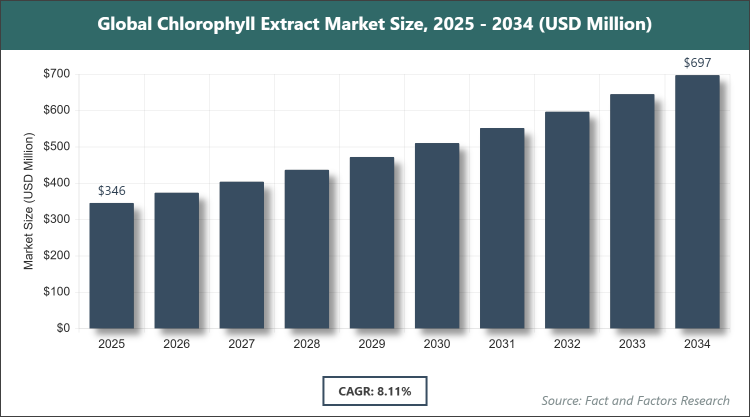
[242+ Pages Report] According to Facts & Factors, the global Chlorophyll Extract market size was estimated at USD 345.67 million in 2025 and is expected to reach USD 697.34 million by the end of 2034. The Chlorophyll Extract industry is anticipated to grow by a CAGR of 8.11% between 2026 and 2034. The Chlorophyll Extract Market is driven by increasing demand for natural and plant-based health supplements.
 Market Overview
Chlorophyll extract refers to a natural pigment derived from green plants and algae, primarily through processes like solvent extraction or water-based methods, which captures the green coloring agent responsible for photosynthesis in vegetation. This extract is utilized across various industries for its antioxidant, detoxifying, and anti-inflammatory properties, serving as a functional ingredient in products that promote health benefits such as improved digestion, wound healing, and odor control without synthetic additives. It encompasses forms obtained from sources like alfalfa, spinach, or spirulina, emphasizing its role in natural coloration and nutritional enhancement in consumables and topical applications.
Key Insights
- As per the analysis shared by our research analyst, the global Chlorophyll Extract Market is estimated to grow annually at a CAGR of around 8.11% over the forecast period (2026-2034).
- In terms of revenue, the global Chlorophyll Extract Market size was valued at around USD 345.67 million in 2025 and is projected to reach USD 697.34 million by 2034.
- The Chlorophyll Extract market is driven by rising consumer preference for natural ingredients in food and supplements.
- Based on the form, the powder segment dominated the market in 2025 with a share of 55% due to its versatility, stability, and ease of incorporation into supplements and cosmetics.
- Based on the application, the food and beverages segment dominated the market in 2025 with a share of 40%, owing to increasing demand for natural colorants and functional additives in processed foods.
- Based on the distribution channel, the business-to-business segment dominated the market in 2025 with a share of 60% because of efficient supply chains and bulk procurement by manufacturers.
- North America dominated the global market in 2025 with a share of 35% attributed to high health awareness and preference for clean-label products.
Growth Drivers
- Rising Health and Wellness Awareness
The growing consumer focus on preventive healthcare and natural remedies has boosted the incorporation of chlorophyll extract in daily diets, leveraging its benefits for detoxification and immune support. This trend is amplified by social media influence and endorsements from wellness influencers, driving demand in supplements and functional beverages.
Additionally, advancements in extraction technologies have improved product purity and bioavailability, enabling broader applications in pharmaceuticals and personal care. As lifestyles emphasize holistic well-being, collaborations between producers and health brands further propel market expansion through innovative formulations.
Restraints
- Regulatory Uncertainty and Standardization Issues
Inconsistent regulations across regions regarding labeling and safety standards hinder market growth, creating barriers for international trade and consumer trust. This lack of uniformity leads to challenges in quality assurance, potentially resulting in product recalls or restricted market access.
Moreover, variations in raw material quality due to environmental factors affect consistency, deterring investment in large-scale production. Economic disparities in developing regions exacerbate these issues, limiting adoption among price-sensitive consumers.
Opportunities
- Demand for Natural Food Colorants
The shift away from synthetic dyes in the food industry opens avenues for chlorophyll extract as a clean-label alternative, aligning with eco-friendly trends and regulatory pushes for natural ingredients. Innovations in stable formulations enhance its appeal in beverages and confectionery, fostering partnerships with major food corporations.
Furthermore, expanding e-commerce platforms facilitate direct-to-consumer sales, tapping into global markets with rising disposable incomes. As sustainability becomes a priority, opportunities arise for certified organic extracts, catering to vegan and environmentally conscious demographics.
Challenges
- Competition from Synthetic Alternatives
Cheaper artificial colorants and stabilizers pose threats by offering superior shelf-life and consistency, challenging the premium positioning of natural chlorophyll extracts. This competition intensifies in cost-driven markets, where manufacturers prioritize economics over natural benefits.
In addition, supply chain vulnerabilities from seasonal harvesting and climate impacts disrupt availability, leading to price volatility. Overcoming these requires ongoing R&D investments to match synthetic performance while maintaining natural integrity.
Report Scope
Report Attribute |
Details |
Market Size 2025 |
USD 345.67 Million |
Projected Market Size in 2034 |
USD 697.34 Million |
CAGR Growth Rate |
8.11% CAGR |
Base Year |
2025 |
Forecast Years |
2026-2034 |
Key Market Players |
British Chlorophyll, Global Essence, Fengming Chlorophyll Co. Ltd, Knowde, Hansen, Natural Health Products (INT) Ltd, Merck Group (Sigma-Aldrich), Sensient Colors, Pioneer Herbals, Xi'an Sost Biotech Co. Ltd., and Others. |
Key Segment |
By Form, By Application, By Distribution Channel, and By Region |
Major Regions Covered |
North America, Europe, Asia Pacific, Latin America, and the Middle East & Africa |
Purchase Options |
Request customized purchase options to meet your research needs. Explore purchase options |
Market Segmentation
The Chlorophyll Extract market is segmented by form, application, distribution channel, and region.
Based on Form Segment, the Chlorophyll Extract market is divided into powder, liquid, capsules, tablets, and others. The most dominant segment is powder, which leads due to its long shelf life, ease of blending into various products, and cost-effectiveness in manufacturing, driving market growth by enabling widespread use in supplements and cosmetics for enhanced nutritional profiles. The second most dominant is liquid, preferred for its quick absorption and versatility in beverages, contributing to expansion through convenient consumption formats that appeal to health-focused consumers.
Based on Application Segment, the Chlorophyll Extract market is divided into food and beverages, supplements, pharmaceuticals, cosmetics, personal care, and others. The most dominant segment is food and beverages, dominating because of the surge in demand for natural green colorants amid clean-label trends, propelling market growth via fortification in everyday consumables like juices and snacks. The second most dominant is supplements, gaining prominence for targeted health benefits like detoxification, boosting the market by addressing wellness needs in capsule and tablet forms.
Based on the Distribution Channel Segment, the Chlorophyll Extract market is divided into business-to-business, online retail, and offline retail. The most dominant segment is business-to-business, leading owing to bulk transactions and supply chain efficiencies for manufacturers, driving overall market advancement through scalable production and distribution. The second most dominant is online retail, expanding access via e-commerce platforms, contributing to growth by reaching tech-savvy consumers seeking convenient purchases.
Recent Developments
- In March 2023, Herbalife Nutrition incorporated chlorophyll extract into its dietary supplements to enhance detoxification benefits and appeal to health-conscious consumers.
- In January 2023, Sensient Technologies Corporation acquired assets from Flavor Solutions, Inc., strengthening its portfolio of natural colors and flavors, including chlorophyll-based options.
Regional Analysis
- North America to dominate the global market
North America leads the chlorophyll extract landscape, primarily driven by the United States, where a strong emphasis on wellness and natural products fuels innovation in supplements and functional foods. The region's advanced retail infrastructure and high disposable incomes enable widespread adoption of clean-label items. Regulatory support for natural additives, coupled with robust R&D from universities and companies, accelerates product development. Canada's complementary focus on organic sourcing enhances regional synergies, ensuring sustained dominance through consumer education and market penetration.
Europe demonstrates solid growth in chlorophyll extract, led by Germany with its expertise in natural ingredient processing and strict EU regulations promoting plant-based alternatives. The continent's commitment to sustainability drives integration in cosmetics and pharmaceuticals, addressing eco-conscious demands. Countries like the UK invest in health campaigns, while France innovates in food applications. Scandinavian nations contribute through nutritional research, fostering a unified market that balances heritage with contemporary health trends.
Asia Pacific experiences rapid expansion in chlorophyll extract, dominated by China through urbanization and rising nutraceutical demand amid health awareness campaigns. The region's abundant agricultural resources support cost-effective production, enabling exports and local consumption. India's traditional herbal practices blend with modern supplements, while Japan's precision in formulation refines applications. Southeast Asian countries like Indonesia leverage local flora, positioning Asia Pacific as a vibrant hub for market growth.
Latin America progresses steadily in chlorophyll extract adoption, with Brazil at the forefront via its biodiversity and growing food processing sector. The region addresses wellness needs through fortified beverages, supported by trade pacts enhancing ingredient access. Mexico's proximity to North American markets facilitates collaborations, while Argentina emphasizes export potential. Overall, Latin America's focus on natural remedies drives integration in diverse consumer goods.
The Middle East & Africa region advances in chlorophyll extract, guided by the United Arab Emirates with its modern wellness hubs and expatriate-driven demand for health products. Resource-rich nations invest in diversification towards natural ingredients, utilizing local plants for supplements. South Africa's agro-processing leads African initiatives, tackling lifestyle diseases through policy support. Regional partnerships improve supply chains, promoting gradual uptake in hospitality and retail sectors.
Competitive Analysis
The global Chlorophyll Extract market is dominated by players:
- British Chlorophyll
- Global Essence
- Fengming Chlorophyll Co. Ltd
- Knowde
- Hansen
- Natural Health Products (INT) Ltd
- Merck Group (Sigma-Aldrich)
- Sensient Colors
- Pioneer Herbals
- Xi an Sost Biotech Co. Ltd.
The global Chlorophyll Extract market is segmented as follows:
By Form
- Powder
- Liquid
- Capsules
- Tablets
- Others
By Application
- Food and Beverages
- Supplements
- Pharmaceuticals
- Cosmetics
- Personal Care
- Others
By Distribution Channel
- Business-to-business
- Online Retail
- Offline Retail
By Region
- North America
- The U.S.
- Canada
- Mexico
- Europe
- France
- The UK
- Spain
- Germany
- Italy
- Rest of Europe
- Asia Pacific
- China
- Japan
- India
- Australia
- Southeast Asia
- Rest of Asia Pacific
- The Middle East & Africa
- Saudi Arabia
- UAE
- Egypt
- Kuwait
- South Africa
- Rest of the Middle East & Africa
- Latin America
- Brazil
- Argentina
- Rest of Latin America
Table of Content
Industry Major Market Players
- British Chlorophyll
- Global Essence
- Fengming Chlorophyll Co. Ltd
- Knowde
- Hansen
- Natural Health Products (INT) Ltd
- Merck Group (Sigma-Aldrich)
- Sensient Colors
- Pioneer Herbals
- Xi an Sost Biotech Co. Ltd.



Copyright © 2025 - 2026, All Rights Reserved, Facts and Factors