
Search Market Research Report
Brush Cutters Market Size, Share Global Analysis Report, 2025 - 2034

Brush Cutters Market Size, Share, Growth Analysis Report By Type (Corded Brush Cutter and Cordless Brush Cutter), By End-User (Commercial and Residential), And By Region - Global Industry Insights, Overview, Comprehensive Analysis, Trends, Statistical Research, Market Intelligence, Historical Data and Forecast 2025 - 2034
Industry Insights
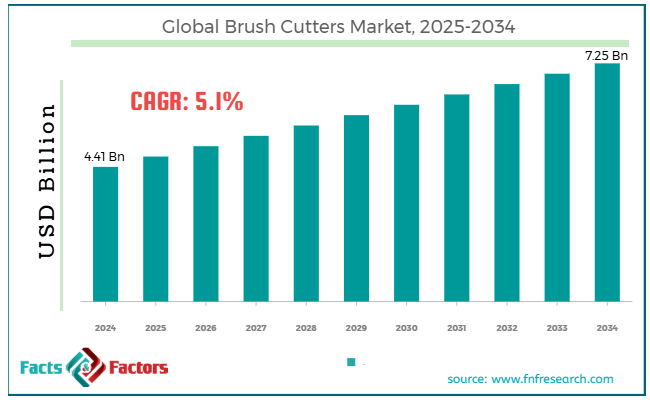
[227+ Pages Report] According to Facts & Factors, the global brush cutters market size was worth around USD 4.41 billion in 2024 and is predicted to grow to around USD 7.25 billion by 2034 with a compound annual growth rate (CAGR) of roughly 5.1% between 2025 and 2034.
 Market Overview
To get rid of dense vegetation including tiny trees, weeds, brush, and tall grass, use a brush cutter, a multipurpose and strong gardening and landscaping tool. A powerful motor, a lengthy shaft, and a cutting head with many attachments, like blades or trimmer heads, are usually its components. Both residential and business settings frequently employ brush cutters, which are vital for maintaining overgrown regions. The brush cutters market is being driven by several factors such as urbanization and infrastructural development, increasing agricultural activities, technological advancements, increasing demand for garden and lawn care, increasing government and municipal initiatives and many others.
Key Insights
- As per the analysis shared by our research analyst, the global brush cutters market is estimated to grow annually at a CAGR of around 5.1% over the forecast period (2025-2034).
- In terms of revenue, the global brush cutters market size was valued at around USD 4.41 billion in 2024 and is projected to reach USD 7.25 billion, by 2034.
- Technological advancement is expected to drive market growth over the forecast period.
- Based on the type, the cordless brush cutter segment is expected to grow at the highest CAGR during the forecast period.
- Based on the end-user, the commercial segment is expected to capture a significant market share over the projected period.
- Based on region, North America is expected to dominate the market during the forecast period.
Growth Drivers
- DIY gardening is becoming more and more popular among residential end users driving market growth
In residential environments, the popularity of do-it-yourself (DIY) projects, especially those that involve household tasks like gardening, plumbing, and carpeting, is growing quickly. This development is mostly ascribed to the high expense of using outside agencies for the aforementioned tasks as well as bloggers' and vloggers' promotion of do-it-yourself abilities on various digital channels. An increasing number of people are engaging in do-it-yourself home renovation projects, particularly gardening, which is encouraged by the variety of instruments available for garden maintenance. The need for brush cutters is also being driven by the introduction of multifunctional and ergonomic models, which make it easier for people to use and adopt them.
Since residential consumers are becoming more and more interested in garden improvement equipment, the brush cutter market is likely to rise at a faster rate during the forecast period due in large part to the growing trend of do-it-yourself gardening activities worldwide.
Restraints
- Switch to sports turf and artificial grass hinders market growth
Turf made of artificial grass has grown in favor recently. The rubber matting used to make artificial lawns is porous, allowing for quick drainage while maintaining its color and structure for more than ten years. Unlike real grass, artificial grass turf doesn't need to be watered, fertilized, or mowed.
As a result, many people choose artificial grass turfs as a more affordable option. The MEA countries are witnessing a notable surge in the usage of artificial grass turfs, mainly due to the growing consumer interest in landscaping and water saving. In Europe, artificial turf installations are likewise accelerating; more than 4,000 sporting fields in the region currently have artificial turf installed.
However, the installation of per square foot of artificial grass turf costs USD 5 - USD 20. However, after instalment, it does not need much maintenance. Professionally laid natural grass costs 14-60 cents per square foot, but it has other expenses related to mowing, fertilizers, and water. Therefore, such factors will hinder the growth of the market during the forecast period.
Opportunities
- The introduction of cordless brush cutters offers a lucrative opportunity for market growth
The growing need for cordless gardening equipment is one of the key trends in the brush cutter industry worldwide. The industry is expanding due to the need for residential and commercial properties to have better aesthetic appeal. Properties are thought to appreciate by around 12% when landscaping is done. The demand for lawn care services is increased by unfavorable weather conditions such as dry summers, floods, and heavy snowfall. This leads to a rise in the requirement for cordless garden and lawn tools, such as brush cutters.
The expensive cost of cordless devices, however, limits the market; with increased competition over the next five years, it is expected that the unit price will drop. The reduction in costs will positively impact the rise in the need for cordless brush cutters. Consequently, during the forecast period, these factors will have a major impact on the growth of the brush cutter market.
Challenges
- Technical limitation poses a major challenge to market expansion
Although battery-powered brush cutters are less harmful to the environment than their gasoline-powered counterparts, they frequently have shorter battery lives and lower power outputs. This may limit their ability to do demanding jobs effectively. Furthermore, it's critical to guarantee brush cutters' robustness and reliability under varied operating circumstances. Inadequate functionality or frequent malfunctions may discourage customers.
Report Scope
Report Attribute |
Details |
Market Size in 2024 |
USD 4.41 Billion |
Projected Market Size in 2034 |
USD 7.25 Billion |
CAGR Growth Rate |
5.1% CAGR |
Base Year |
2024 |
Forecast Years |
2025-2034 |
Key Market Players |
Stanley Black and Decker Inc., Husqvarna AB, ANDREAS STIHL AG and Co. KG, Alfred Karcher SE and Co KG, Briggs and Stratton LLC, Deere and Co., Emak Spa, Globgro AB, Honda India Power Products Ltd., KisanKraft Ltd., Makita Power Tools India Pvt. Ltd., MTD Products India Pvt. Ltd., Oregon Tool Inc., Robert Bosch GmbH, The Toro Co., TRUYARD, Wild Badger Power, YAMABIKO CORP., Trapp, Mitox, and others. |
Key Segment |
By Type, By End-User, and Region |
Major Regions Covered |
North America, Europe, Asia Pacific, Latin America, and the Middle East &, Africa |
Purchase Options |
Request customized purchase options to meet your research needs. Explore purchase options |
Segmentation Analysis
The global brush cutters industry is segmented based on type, end-user and region.
Based on the type, the global brush cutters market is bifurcated into Corded brush cutters and cordless brush cutters. The cordless brush cutter segment is expected to grow at the highest CAGR during the forecast period. The performance, run time, and charging speed of cordless brush cutters have all increased dramatically with the introduction of lithium-ion batteries. These tools are now more competitive with their gasoline-powered equivalents thanks to improved battery life and power output. Technological developments in batteries have resulted in designs that are lighter and more portable, improving user comfort and lowering exhaustion after extended usage.
Moreover, the popularity of do-it-yourself landscaping projects and home gardening has increased demand for effective and user-friendly instruments like cordless brush cutters. Homeowners are looking for easy-to-maintain yard and garden management solutions.
Based on the end-user, the global brush cutters industry is bifurcated into commercial and residential. The commercial segment is expected to capture a significant market share over the projected period. The increasing need for landscaping services to maintain parks, green spaces, and public areas is a result of rapid urbanization. Brush cutters are among the effective instruments that landscaping companies need to meet this demand. Commercial-grade brush cutters are necessary since continuing landscaping and vegetation management are also required for infrastructure projects, commercial developments, and housing complexes. Thereby, driving the segment growth.
Regional Analysis
- North America is expected to dominate the market during the forecast period
North America is expected to dominate the market during the forecast period. The introduction of cutting-edge and creative products, the rising popularity of cordless brush cutters, the expanding demand for brush cutters, and the growing usage of online platforms for purchasing equipment for home improvement are the key drivers driving the growth of the market in the area. The need for brush cutters in the residential market is also being fueled by the rising number of independent homes in North America, particularly in the US and Canada. Because there are more and more people building homes and businesses, there is an increasing need for brush cutters in North America.
Commercial construction projects include building hotels and resorts, retail centers, office buildings, and public areas like gardens and parks. Building single-family homes, apartment buildings, and multi-story residential complexes are also included in the category of residential construction. Depending on the size of the property, these units have lawns, gardens, or courtyards; therefore, garden renovation items are needed for their upkeep. Thus, over the projection period, the demand for brush cutters in the area will be driven by the expansion of the residential building industry, particularly single-family dwelling units in North America.
Competitive Analysis
The global brush cutters market is dominated by players like:
- Stanley Black and Decker Inc.
- Husqvarna AB
- ANDREAS STIHL AG and Co. KG
- Alfred Karcher SE and Co KG
- Briggs and Stratton LLC
- Deere and Co.
- Emak Spa
- Globgro AB
- Honda India Power Products Ltd.
- KisanKraft Ltd.
- Makita Power Tools India Pvt. Ltd.
- MTD Products India Pvt. Ltd.
- Oregon Tool Inc.
- Robert Bosch GmbH
- The Toro Co.
- TRUYARD
- Wild Badger Power
- YAMABIKO CORP.
- Trapp
- Mitox
The global brush cutters market is segmented as follows:
By Type
- Corded Brush Cutter
- Cordless Brush Cutter
By End-User
- Commercial
- Residential
By Region
- North America
- The U.S.
- Canada
- Mexico
- Europe
- France
- The UK
- Spain
- Germany
- Italy
- Rest of Europe
- Asia Pacific
- China
- Japan
- India
- Australia
- Southeast Asia
- Rest of Asia Pacific
- The Middle East & Africa
- Saudi Arabia
- UAE
- Egypt
- Kuwait
- South Africa
- Rest of the Middle East & Africa
- Latin America
- Brazil
- Argentina
- Rest of Latin America
Table of Content
Industry Major Market Players
- Stanley Black and Decker Inc.
- Husqvarna AB
- ANDREAS STIHL AG and Co. KG
- Alfred Karcher SE and Co KG
- Briggs and Stratton LLC
- Deere and Co.
- Emak Spa
- Globgro AB
- Honda India Power Products Ltd.
- KisanKraft Ltd.
- Makita Power Tools India Pvt. Ltd.
- MTD Products India Pvt. Ltd.
- Oregon Tool Inc.
- Robert Bosch GmbH
- The Toro Co.
- TRUYARD
- Wild Badger Power
- YAMABIKO CORP.
- Trapp
- Mitox



Copyright © 2025 - 2026, All Rights Reserved, Facts and Factors