
Search Market Research Report
A2P SMS Market Size, Share Global Analysis Report, 2026-2034

A2P SMS Market Size, Share, Growth Analysis Report By Deployment (Cloud, On-premises, and Others), By Application (Pushed Content Services, Customer Relationship Management Services, Promotional and Marketing Services, Interactive Services, and Others), By End-User (BFSI, Retail and E-commerce, Healthcare, IT and Telecom, Media and Entertainment, Travel and Tourism, and Others), and By Region - Global Industry Insights, Overview, Comprehensive Analysis, Trends, Statistical Research, Market Intelligence, Historical Data and Forecast 2026-2034
Industry Insights
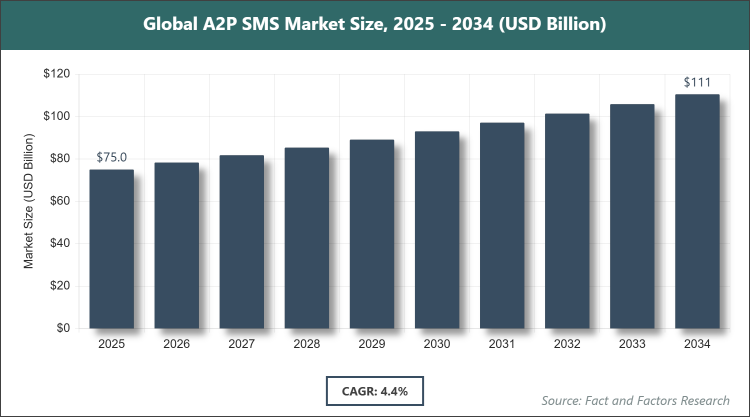
[226+ Pages Report] According to Facts & Factors, the global A2P SMS market size was estimated at USD 75 billion in 2025 and is expected to reach USD 110 billion by the end of 2034. The A2P SMS industry is anticipated to grow by a CAGR of 4.4% between 2026 and 2034. The A2P SMS Market is driven by increasing demand for reliable and instant business-to-consumer communication channels.
 Market Overview
A2P SMS, or Application-to-Person Short Message Service, refers to the automated delivery of text messages from software applications to mobile users. This market includes platforms and services that allow businesses to send notifications, promotional messages, authentication codes, and alerts directly to consumers' mobile devices. It plays a crucial role in enhancing customer engagement, enabling secure transactions, and facilitating real-time communication across various sectors without relying on internet connectivity.
Key Insights
- As per the analysis shared by our research analyst, the global A2P SMS market is estimated to grow annually at a CAGR of around 4.4% over the forecast period (2026-2034).
- In terms of revenue, the global A2P SMS market size was valued at around USD 75 billion in 2025 and is projected to reach USD 110 billion by 2034.
- The market is driven by rising mobile penetration and the need for secure authentication.
- Based on the deployment, the cloud segment dominated with 60% share, due to its scalability and cost-effectiveness.
- Based on the application, the CRM services segment dominated with 30% share, as it enables personalized customer interactions.
- Based on the end-user, the BFSI segment dominated with 35% share, owing to high demand for transaction alerts and OTPs.
- Based on region, Asia Pacific dominated with 40% share, attributed to large population and rapid digitalization in countries like China and India.
Growth Drivers
- Increasing Mobile Penetration Worldwide
The proliferation of smartphones and mobile devices globally has significantly boosted the A2P SMS market. With billions of active mobile users, businesses leverage SMS for its universal reach and high open rates, ensuring messages are delivered instantly without requiring data connectivity.
The expansion of mobile networks in emerging economies further amplifies this growth, as more consumers gain access to mobile services. This trend enables industries to adopt A2P SMS for mass communication, enhancing operational efficiency and customer satisfaction through timely updates and interactions.
- Rise in E-commerce and Online Transactions
The surge in online shopping and digital payments has heightened the demand for secure verification methods, where A2P SMS plays a pivotal role in sending one-time passwords (OTPs) and transaction confirmations.
This driver is supported by the need for fraud prevention and seamless user experiences, making A2P SMS indispensable for e-commerce platforms. As digital transactions continue to rise, the market benefits from increased volume of authentication messages, driving revenue for service providers.
Restraints
- Competition from OTT Messaging Apps
Over-the-top (OTT) platforms like WhatsApp and Telegram offer richer features at lower costs, posing a threat to traditional A2P SMS by diverting traffic to internet-based messaging.
This shift is particularly evident in regions with high internet penetration, where businesses prefer multimedia capabilities over plain text. The restraint limits market expansion as consumers and enterprises migrate to more versatile and cost-effective alternatives.
- Regulatory Compliance and Privacy Concerns
Stringent regulations on data privacy and anti-spam laws require businesses to obtain explicit consent for messaging, complicating A2P SMS deployment and increasing operational costs.
Non-compliance can lead to hefty fines and reputational damage, deterring smaller players from entering the market. These challenges slow down adoption rates and necessitate investments in compliance technologies.
Opportunities
- Integration with Emerging Technologies like AI
Incorporating AI into A2P SMS platforms enables personalized and automated messaging, opening new avenues for targeted marketing and customer service enhancements.
This opportunity allows providers to offer advanced analytics and chatbots via SMS, improving engagement metrics. As AI evolves, it presents a chance for market players to differentiate their services and capture additional revenue streams.
- Expansion in Developing Markets
Rapid urbanization and digital transformation in developing regions provide untapped potential for A2P SMS adoption, especially in sectors like healthcare and education.
With improving infrastructure, businesses can expand their reach to underserved populations. This growth avenue is fueled by government initiatives promoting digital inclusion, creating a fertile ground for market penetration.
Challenges
- SMS Fraud and Spam Issues
The prevalence of phishing and spam messages erodes consumer trust, leading to higher opt-out rates and regulatory scrutiny on A2P SMS channels.
Addressing this requires robust security measures, which increase costs for providers. The challenge persists as fraudsters evolve tactics, demanding continuous innovation in fraud detection.
- Declining SMS Prices
Intense competition among providers has led to price erosion, squeezing profit margins and making it difficult to sustain investments in technology upgrades.
This pressure affects smaller operators more severely, potentially leading to market consolidation. Balancing affordability with quality service remains a key hurdle for sustained growth.
Report Scope
Report Attribute |
Details |
Market Size 2025 |
USD 75 Billion |
Projected Market Size in 2034 |
USD 110 Billion |
CAGR Growth Rate |
4.4% CAGR |
Base Year |
2025 |
Forecast Years |
2026-2034 |
Key Market Players |
Twilio Inc., Sinch AB, Infobip Ltd., Vonage Holdings Corp., Tata Communications, Route Mobile Ltd., AT&T Inc., Orange S.A., Genesys, and Others. |
Key Segment |
By Deployment, By Application, By End-User, and By Region |
Major Regions Covered |
North America, Europe, Asia Pacific, Latin America, and the Middle East & Africa |
Purchase Options |
Request customized purchase options to meet your research needs. Explore purchase options |
Market Segmentation
The A2P SMS market is segmented by deployment, application, end-user, and region.
Based on Deployment Segment, the A2P SMS market is divided into cloud, on-premises, and others. The cloud segment is the most dominant, holding a significant market share due to its flexibility, lower upfront costs, and ease of integration with existing systems, which allows businesses to scale messaging operations efficiently. The on-premises segment follows as the second most dominant, preferred by organizations requiring high data security and control over their infrastructure, particularly in regulated industries where compliance is critical. This deployment helps drive the market by enabling customized solutions that ensure data sovereignty and reduce latency in message delivery.
Based on Application Segment, the A2P SMS market is divided into pushed content services, customer relationship management services, promotional and marketing services, interactive services, and others. The customer relationship management services segment is the most dominant, as it facilitates personalized communication and customer retention through timely notifications and feedback mechanisms, driving loyalty and revenue growth. The promotional and marketing services segment is the second most dominant, utilized for targeted campaigns that boost brand visibility and sales conversions. These applications contribute to market expansion by enhancing customer engagement and providing measurable ROI through analytics on message effectiveness.
Based on End-User Segment, the A2P SMS market is divided into BFSI, retail and e-commerce, healthcare, IT and telecom, media and entertainment, travel and tourism, and others. The BFSI segment is the most dominant, relying heavily on A2P SMS for secure transaction alerts, fraud notifications, and authentication, which builds trust and complies with financial regulations. The retail and e-commerce segment is the second most dominant, using SMS for order confirmations, promotions, and delivery updates to improve customer experience and reduce cart abandonment. These end-users propel the market by integrating SMS into core operations, ensuring reliable communication that supports business continuity and growth.
Recent Developments
- In January 2025, Infobip and Telekom Business Europe launched an AI-enabled omnichannel suite spanning SMS, RCS, and WhatsApp to unify enterprise outreach.
- In January 2025, Business Telecommunications Services, Inc. (BTS) was appointed the international A2P SMS aggregator for BBIX, Inc., ensuring secure delivery amid rising fraud threats.
- In March 2025, Globe Teleservices Pte. Ltd. (GTS) signed a three-year contract with CelcomDigi to deploy advanced A2P SMS firewalls and international traffic solutions.
- In October 2024, iBASIS signed a strategic partnership with Claro Peru to deploy its end-to-end A2P messaging monetisation solution.
Regional Analysis
- Asia Pacific to dominate the global market
The Asia Pacific region dominates the A2P SMS market, primarily driven by its vast population and high mobile subscription rates, with China and India leading as dominating countries. The rapid adoption of digital services, coupled with expanding e-commerce and fintech sectors, fuels demand for reliable messaging solutions. Government initiatives promoting digital economies further enhance market growth, making the region a hub for innovation in mobile communications.
North America exhibits strong growth in the A2P SMS market, with the United States as the dominating country due to advanced technological infrastructure and widespread use in industries like finance and retail. The region's focus on data security and regulatory compliance drives adoption, while integration with emerging technologies like AI enhances messaging efficiency and personalization.
Europe maintains a significant share in the A2P SMS market, led by countries such as the United Kingdom and Germany, where stringent privacy laws like GDPR influence messaging practices. The emphasis on customer-centric communication in sectors like healthcare and banking supports steady growth, with innovations in omnichannel strategies contributing to market evolution.
Latin America is emerging in the A2P SMS market, with Brazil as a key dominating country, benefiting from increasing mobile penetration and digital transformation efforts. The region's growing e-commerce and financial inclusion initiatives drive demand for SMS in authentication and notifications, fostering opportunities for market expansion.
The Middle East & Africa region shows promising growth in the A2P SMS market, dominated by countries like the UAE and South Africa, where mobile banking and government services rely on SMS for outreach. Infrastructure improvements and rising smartphone adoption are key factors propelling the market forward in this diverse area.
Competitive Analysis
The global A2P SMS market is dominated by players:
- Twilio Inc.
- Sinch AB
- Infobip Ltd.
- Vonage Holdings Corp.
- Tata Communications
- Route Mobile Ltd.
- AT&T Inc.
- Orange S.A.
- Genesys
- And others.
The global A2P SMS market is segmented as follows:
By Deployment
- Cloud
- On-premises
- Others
By Application
- Pushed Content Services
- Customer Relationship Management Services
- Promotional and Marketing Services
- Interactive Services
- Others
By End-User
- BFSI
- Retail and E-commerce
- Healthcare
- IT and Telecom
- Media and Entertainment
- Travel and Tourism
- Others
By Region
- North America
- The U.S.
- Canada
- Mexico
- Europe
- France
- The UK
- Spain
- Germany
- Italy
- Rest of Europe
- Asia Pacific
- China
- Japan
- India
- Australia
- Southeast Asia
- Rest of Asia Pacific
- The Middle East & Africa
- Saudi Arabia
- UAE
- Egypt
- Kuwait
- South Africa
- Rest of the Middle East & Africa
- Latin America
- Brazil
- Argentina
- Rest of Latin America
Table of Content
Industry Major Market Players
The global A2P SMS market is dominated by players:
- Twilio Inc.
- Sinch AB
- Infobip Ltd.
- Vonage Holdings Corp.
- Tata Communications
- Route Mobile Ltd.
- AT&T Inc.
- Orange S.A.
- Genesys
- And others.



Copyright © 2025 - 2026, All Rights Reserved, Facts and Factors