
Search Market Research Report
Tilapia Market Size, Share Global Analysis Report, 2026-2034

Tilapia Market Size, Share, Growth Analysis Report By Species (Nile Tilapia, Blue Tilapia, Mozambique Tilapia, Wami Tilapia, and Others), By Product Type (Fresh, Frozen, Processed, and Others), By Distribution Channel (Supermarkets/Hypermarkets, Seafood Stores, Online Retail, Traditional Retail, and Others), and By Region - Global Industry Insights, Overview, Comprehensive Analysis, Trends, Statistical Research, Market Intelligence, Historical Data and Forecast 2026-2034
Industry Insights
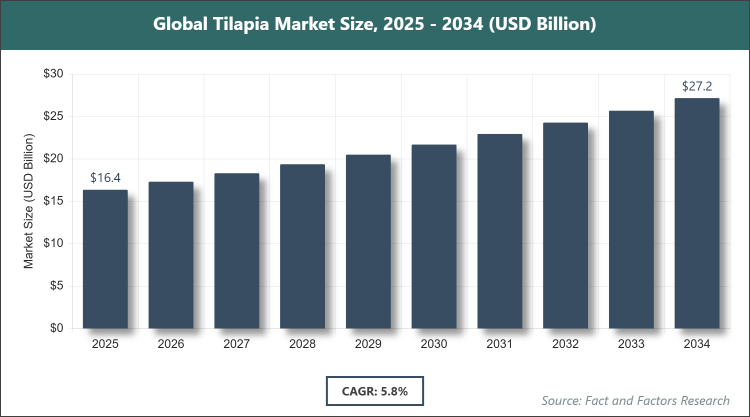
[242+ Pages Report] According to Facts & Factors, the global Tilapia market size was estimated at USD 16.36 billion in 2025 and is expected to reach USD 24.02 billion by the end of 2034. The Tilapia industry is anticipated to grow by a CAGR of 5.8% between 2026 and 2034. The Tilapia Market is driven by rising global demand for affordable and sustainable seafood protein sources.
 Market Overview
The tilapia market encompasses the cultivation, processing, and trade of tilapia, a freshwater fish species prized for its rapid growth cycle, adaptability to diverse farming environments, and neutral taste that appeals to a wide array of culinary applications, positioning it as a staple in aquaculture and a vital component of global food security without incorporating numerical data.
Key Insights
- As per the analysis shared by our research analyst, the global Tilapia market is estimated to grow annually at a CAGR of around 5.8% over the forecast period (2026-2034).
- In terms of revenue, the global Tilapia market size was valued at around USD 16.36 billion in 2025 and is projected to reach USD 24.02 billion by 2034.
- The market is driven by increasing consumer preference for high-protein, low-fat seafood options in emerging economies.
- Based on the Species, the Nile Tilapia segment dominated the market in 2025 with a share of over 41%, due to its superior growth rate, disease resistance, and high fillet yield suitable for commercial farming.
- Based on the Product Type, the Frozen segment dominated the market in 2025 with a share of over 45%, attributed to its extended shelf life, ease of transportation, and growing demand in international trade.
- Based on the Distribution Channel, the Traditional Retail segment dominated the market in 2025 with a share of over 50%, owing to its prevalence in developing regions where wet markets and local vendors facilitate direct consumer access.
- Based on the region, Asia Pacific dominated the market in 2025 with a share of around 80%, driven by extensive aquaculture infrastructure and high domestic consumption in major producing countries like China and Indonesia.
Growth Drivers
- Increasing Demand for Affordable Protein Sources
Tilapia's role as an economical and nutritious protein alternative is propelling market expansion, particularly in developing regions where population growth and urbanization heighten the need for accessible food options. Its efficient feed conversion and low production costs make it attractive for farmers, supporting scalable aquaculture practices that meet rising global seafood demands.
Technological advancements in breeding and farming techniques enhance yield and sustainability, further boosting adoption among producers and consumers seeking health-conscious choices amid dietary shifts towards lean proteins.
Restraints
- Disease Outbreaks and Biosecurity Issues
Frequent occurrences of diseases like streptococcosis in tilapia farms disrupt supply chains and increase mortality rates, leading to financial losses and reduced confidence among investors. This vulnerability necessitates costly biosecurity measures, which can strain small-scale operations in resource-limited areas.
Climate variability exacerbates these risks by affecting water quality and farm conditions, potentially limiting production in key regions and hindering overall market stability.
Opportunities
- Advancements in Sustainable Aquaculture Practices
Innovations such as recirculating aquaculture systems (RAS) offer prospects for environmentally friendly farming, reducing water usage and minimizing ecological impacts while appealing to eco-conscious consumers. These technologies enable expansion into non-traditional areas, diversifying production bases.
Certification programs for sustainable tilapia can command premium prices, opening new market segments and fostering partnerships with retailers focused on ethical sourcing.
Challenges
- Environmental Concerns and Regulatory Pressures
Intensive farming practices raise issues like water pollution and habitat degradation, attracting scrutiny from environmental groups and leading to stricter regulations that increase compliance costs. Balancing productivity with sustainability remains a hurdle for the industry.
Fluctuating feed prices, driven by commodity market volatility, challenge profit margins, especially for operators in import-dependent regions, potentially slowing growth in price-sensitive markets.
Report Scope
Report Attribute |
Details |
Market Size 2025 |
USD 16.36 Billion |
Projected Market Size in 2034 |
USD 24.02 Billion |
CAGR Growth Rate |
5.8% CAGR |
Base Year |
2025 |
Forecast Years |
2026-2034 |
Key Market Players |
Blue Ridge Aquaculture Inc., Regal Springs, Baiyang Aquatic Group, Hainan Xiangtai Fishery Co. Ltd., Ananda Aqua Exports Private Limited, Mazzetta Company LLC, Thai Union Group, Surapon Foods, Grieg Seafood, Charoen Pokphand Foods, and Others. |
Key Segment |
By Species, By Product Type, By Distribution Channel, and By Region |
Major Regions Covered |
North America, Europe, Asia Pacific, Latin America, and the Middle East & Africa |
Purchase Options |
Request customized purchase options to meet your research needs. Explore purchase options |
Market Segmentation
The Tilapia market is segmented by species, product type, distribution channel, and region.
Based on Species Segment, the Tilapia market is divided into Nile Tilapia, Blue Tilapia, Mozambique Tilapia, Wami Tilapia, and Others. The most dominant segment is Nile Tilapia, holding over 41% share, due to its fast maturation, resilience to varying water conditions, and high market acceptance which drives the market by enabling efficient large-scale production and meeting global demand for versatile seafood; the second most dominant is Blue Tilapia, valued for its tolerance to salinity and cold temperatures, contributing to market growth through expanded farming possibilities in diverse climates and enhanced supply reliability.
Based on Product Type Segment, the Tilapia market is divided into Fresh, Frozen, Processed, and Others. The most dominant segment is Frozen, with over 45% share, as it facilitates long-distance trade and year-round availability, propelling the market by reducing spoilage losses and supporting export-oriented economies; the second most dominant is Fresh, preferred for its perceived quality in local markets, aiding growth through direct sales in high-consumption areas and aligning with consumer trends for minimally processed foods.
Based on Distribution Channel Segment, the Tilapia market is divided into Supermarkets/Hypermarkets, Seafood Stores, Online Retail, Traditional Retail, and Others. The most dominant segment is Traditional Retail, capturing over 50% share, owing to its accessibility in emerging markets and cultural preference for fresh selections, fueling market progress by bridging producers and consumers in densely populated regions; the second most dominant is Supermarkets/Hypermarkets, which offers convenience and variety, advancing the market through organized retail expansion and packaged product innovations.
Recent Developments
- In May 2024, Regal Springs launched "Natural Additions," a new unit focused on utilizing tilapia by-products for value-added applications, enhancing sustainability in the industry.
- In February 2024, GenoMar introduced the GenoMar 1000 strain tailored for Brazilian farmers, featuring faster growth and disease resistance to improve farm efficiency.
- In December 2023, Thai Union Group unveiled a new line of frozen tilapia products to expand its seafood offerings and cater to evolving consumer preferences.
- In July 2023, Marubeni Corporation acquired a tilapia farming company to strengthen its integrated aquaculture operations and global supply chain.
Regional Analysis
- Asia Pacific to dominate the global market
Asia Pacific asserts dominance in the tilapia sector through its extensive aquaculture networks and innovative farming techniques that ensure high yields and quality standards. China leads as the dominating country, with its advanced hatcheries and export capabilities supplying international markets while fostering domestic consumption through diverse culinary integrations. The region's tropical climate supports year-round production, enabling cost-effective operations that attract investments and promote technological transfers for enhanced breeding programs.
North America demonstrates robust participation via its focus on sustainable practices and consumer-driven demand for healthy proteins, with the United States as the dominating country leveraging sophisticated processing facilities and retail channels. This area emphasizes traceability and eco-labeling, appealing to health-aware demographics and supporting growth in value-added products.
Europe maintains a steady presence with stringent quality regulations and a preference for certified sustainable sources, positioning Germany as the dominating country through its efficient distribution systems and research in aquaculture advancements. The continent's diverse markets encourage innovation in product forms, from fresh fillets to ready meals.
Latin America shows promising expansion fueled by natural resources and growing export orientations, with Brazil as the dominating country utilizing its vast freshwater resources for large-scale farming. This region benefits from proximity to major importers, enhancing trade efficiencies and local economic development.
The Middle East & Africa region is advancing through strategic investments in arid-adapted farming methods, with Egypt leading as the dominating country via its Nile-based production systems and regional trade hubs. This area focuses on food security initiatives, integrating tilapia into nutrition programs while exploring export potentials.
Competitive Analysis
The global Tilapia market is dominated by players:
- Blue Ridge Aquaculture Inc.
- Regal Springs
- Baiyang Aquatic Group
- Hainan Xiangtai Fishery Co. Ltd.
- Ananda Aqua Exports Private Limited
- Mazzetta Company LLC
- Thai Union Group
- Surapon Foods
- Grieg Seafood
- Charoen Pokphand Foods
The global Tilapia market is segmented as follows:
By Species
- Nile Tilapia
- Blue Tilapia
- Mozambique Tilapia
- Wami Tilapia
- Others
By Product Type
- Fresh
- Frozen
- Processed
- Others
By Distribution Channel
- Supermarkets/Hypermarkets
- Seafood Stores
- Online Retail
- Traditional Retail
- Others
By Region
- North America
- The U.S.
- Canada
- Mexico
- Europe
- France
- The UK
- Spain
- Germany
- Italy
- Rest of Europe
- Asia Pacific
- China
- Japan
- India
- Australia
- Southeast Asia
- Rest of Asia Pacific
- The Middle East & Africa
- Saudi Arabia
- UAE
- Egypt
- Kuwait
- South Africa
- Rest of the Middle East & Africa
- Latin America
- Brazil
- Argentina
- Rest of Latin America
Industry Major Market Players
- Blue Ridge Aquaculture Inc.
- Regal Springs
- Baiyang Aquatic Group
- Hainan Xiangtai Fishery Co. Ltd.
- Ananda Aqua Exports Private Limited
- Mazzetta Company LLC
- Thai Union Group
- Surapon Foods
- Grieg Seafood
- Charoen Pokphand Foods
Frequently Asked Questions



Copyright © 2025 - 2026, All Rights Reserved, Facts and Factors