
Search Market Research Report
Thiophene Market Size, Share Global Analysis Report, 2026-2034-

Thiophene Market Size, Share, Growth Analysis Report By Product Type (≥99.5%, <99.5%, and Others), By Application (Pharmaceuticals, Agrochemicals, Chemical Intermediates, and Others), By End-User (Pharmaceutical, Agrochemical, Chemical, and Others), and By Region - Global Industry Insights, Overview, Comprehensive Analysis, Trends, Statistical Research, Market Intelligence, Historical Data and Forecast 2026-2034-
Industry Insights
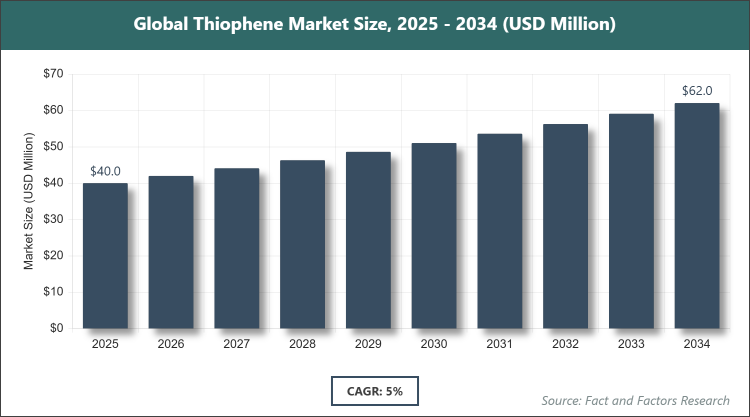
[216+ Pages Report] According to Facts & Factors, the global thiophene market size was estimated at USD 40 million in 2025 and is expected to reach USD 65 million by the end of 2034. The thiophene industry is anticipated to grow by a CAGR of 5% between 2026 and 2034. The thiophene Market is driven by increasing demand in pharmaceuticals and agrochemicals.
 Market Overview
Thiophene is a heterocyclic organic compound consisting of a five-membered ring with four carbon atoms and one sulfur atom, known for its aromatic properties and versatility in chemical synthesis. It serves as a fundamental building block in various industries, particularly in the production of pharmaceuticals, agrochemicals, and advanced materials, where its unique structure enables the creation of complex molecules with specific functional attributes.
Key Insights
- As per the analysis shared by our research analyst, the thiophene market is estimated to grow annually at a CAGR of around 5% over the forecast period (2026-2034).
- In terms of revenue, the thiophene market size was valued at around USD 40 million in 2025 and is projected to reach USD 65 million, by 2034.
- The market is driven by rising demand in pharmaceutical intermediates and agrochemical production.
- Based on the product type, the ≥99.5% segment dominated with 60% share due to stringent quality requirements in pharmaceutical and advanced materials applications.
- Based on the application, the pharmaceuticals segment dominated with 50% share owing to thiophene's essential role as a heterocyclic scaffold in active pharmaceutical ingredient development.
- Based on the end-user, the pharmaceutical segment dominated with 45% share because of its utilization in synthesizing a wide array of therapeutic agents.
- Based on region, Asia Pacific dominated with 40% share attributed to rapid industrialization and robust growth in pharmaceutical manufacturing.
Growth Drivers
- Rising investments in the pharmaceutical industry
The global thiophene market is being propelled by its critical role as a key building block in pharmaceutical synthesis, where it is extensively used in developing drugs for various therapeutic areas including oncology and anti-infectives.
Expanding pharmaceutical production, coupled with ongoing research into new drug molecules, continues to drive consistent demand for high-purity thiophene, as even minor impurities can compromise the efficacy and safety of final products.
Restraints
- Harmful environmental impact of thiophene production
Thiophene manufacturing processes often involve sulfur compounds that can lead to environmental concerns, including emissions and waste management issues, which are subject to increasingly stringent regulations worldwide.
The volatility in raw material prices, particularly petroleum-derived sources, adds to production costs and supply chain uncertainties, potentially hindering market expansion in price-sensitive regions.
Opportunities
- Advancements in organic electronics
The burgeoning field of organic electronics, including OLEDs and solar cells, presents significant growth potential for thiophene derivatives due to their excellent electrical conductivity and stability in polymer applications.
Innovation in bio-based thiophene production methods offers opportunities to align with sustainability trends, potentially opening new markets in eco-friendly chemical synthesis and reducing dependence on fossil fuel sources.
Challenges
- Stringent environmental regulations
Compliance with evolving environmental standards requires substantial investments in cleaner production technologies and waste treatment, which can strain smaller manufacturers and impact overall market profitability.
The availability of substitute compounds in certain applications poses a challenge to thiophene's market position, necessitating continuous innovation to maintain its competitive edge in key industries.
Report Scope
Report Attribute |
Details |
Market Size 2025 |
USD 40 Million |
Projected Market Size in 2034 |
USD 65 Million |
CAGR Growth Rate |
5% CAGR |
Base Year |
2025 |
Forecast Years |
2026-2034 |
Key Market Players |
PCAS, SKC, Fisher-Scientific, Hongyuan Pharmaceutical, Dongsheng Chemical, Sincere Chemicals, Yuanli Science and Technology, Jinan Fufang Chemical, Arkema Group, BASF SE, and Others. |
Key Segment |
By Product Type, By Application, By End-User, and By Region |
Major Regions Covered |
North America, Europe, Asia Pacific, Latin America, and the Middle East & Africa |
Purchase Options |
Request customized purchase options to meet your research needs. Explore purchase options |
Market Segmentation
The thiophene market is segmented by product type, application, end-user, and region.
Based on Product Type Segment, the thiophene market is divided into ≥99.5%, <99.5%, and others. The ≥99.5% segment emerges as the most dominant, commanding a significant market share due to its critical requirement in high-stakes applications like pharmaceutical synthesis where purity directly impacts product efficacy and regulatory compliance, while the <99.5% segment follows as the second most dominant, finding extensive use in less stringent applications such as certain agrochemical formulations and industrial intermediates where cost-effectiveness outweighs ultra-high purity needs. This dominance of the ≥99.5% grade drives overall market growth by enabling advanced drug development and precise chemical reactions, whereas the <99.5% variant supports broader industrial adoption by offering economical alternatives that still maintain sufficient quality for many synthesis processes, collectively contributing to the market's expansion through diversified application possibilities.
Based on Application Segment, the thiophene market is divided into pharmaceuticals, agrochemicals, chemical intermediates, and others. The pharmaceuticals segment stands out as the most dominant, holding the largest share owing to thiophene's indispensable role as a building block in creating complex drug molecules with enhanced therapeutic properties, while agrochemicals represent the second most dominant segment, driven by its use in developing effective pesticides and herbicides that improve crop protection. This pharmaceutical dominance propels market growth through continuous drug innovation and rising healthcare demands, whereas the agrochemical sector contributes by addressing global food security needs through advanced crop protection solutions, together fostering sustained market expansion across essential industries.
Based on End-User Segment, the thiophene market is divided into pharmaceutical, agrochemical, chemical, and others. The pharmaceutical end-user emerges as the most dominant, capturing the primary market share due to extensive utilization in API synthesis for various medications, while the agrochemical sector follows as the second dominant, leveraging thiophene for creating advanced crop protection agents. This pharmaceutical leadership drives market growth through ongoing research in novel therapeutics and increasing global health expenditures, whereas the agrochemical application supports expansion by meeting rising demands for efficient agricultural solutions in the face of growing population and limited arable land, collectively advancing the overall market trajectory.
Recent Developments
- In 2024, PCAS introduced a catalytic thiophene synthesis process that reduces energy consumption by 45% and increases yield by 30%, marking a significant advancement in sustainable production methods.
- SKC launched a novel thiophene-based herbicide derivative in 2024, featuring 25% enhanced target specificity and reduced environmental persistence, addressing key concerns in modern agriculture.
- Fisher-Scientific scaled up production of a high-purity thiophene derivative in 2024, which now comprises 20% of its specialty API portfolio, supporting expanded pharmaceutical applications.
Regional Analysis
- Asia Pacific to dominate the global market
Asia Pacific leads the global thiophene market, driven by China's robust pharmaceutical manufacturing base and India's growing agrochemical sector, where rapid industrialization and favorable government policies foster innovation in chemical synthesis and drug development, creating a dynamic ecosystem for thiophene applications across multiple industries.
North America maintains a strong position in the thiophene market, with the United States at the forefront due to advanced research facilities and substantial investments in biotechnology, enabling cutting-edge developments in thiophene-based therapeutics and materials science that set global standards for quality and innovation.
Europe demonstrates significant market presence, led by Germany's chemical industry expertise and France's pharmaceutical prowess, where stringent quality standards and emphasis on sustainable production methods drive the adoption of high-purity thiophene in sophisticated applications ranging from drug synthesis to advanced polymers.
Latin America shows emerging potential in the thiophene market, with Brazil's agricultural sector driving demand for thiophene-derived agrochemicals, supported by expanding chemical manufacturing capabilities that cater to both domestic needs and export markets in crop protection solutions.
The Middle East & Africa region exhibits gradual growth in thiophene adoption, primarily through South Africa's chemical industry and increasing pharmaceutical investments in the Gulf states, where diversifying economies are fostering development in specialty chemicals and basic drug manufacturing using thiophene intermediates.
Competitive Analysis
The global thiophene market is dominated by players:
- PCAS
- SKC
- Fisher-Scientific
- Hongyuan Pharmaceutical
- Dongsheng Chemical
- Sincere Chemicals
- Yuanli Science and Technology
- Jinan Fufang Chemical
- Arkema Group
- BASF SE
The global thiophene market is segmented as follows:
By Product Type
- ≥99.5%
- <99.5%
- Others
By Application
- Pharmaceuticals
- Agrochemicals
- Chemical Intermediates
- Others
By End-User
- Pharmaceutical
- Agrochemical
- Chemical
- Others
By Region
- North America
- The U.S.
- Canada
- Mexico
- Europe
- France
- The UK
- Spain
- Germany
- Italy
- Rest of Europe
- Asia Pacific
- China
- Japan
- India
- Australia
- Southeast Asia
- Rest of Asia Pacific
- The Middle East & Africa
- Saudi Arabia
- UAE
- Egypt
- Kuwait
- South Africa
- Rest of the Middle East & Africa
- Latin America
- Brazil
- Argentina
- Rest of Latin America
Industry Major Market Players
The global thiophene market is dominated by players:
- PCAS
- SKC
- Fisher-Scientific
- Hongyuan Pharmaceutical
- Dongsheng Chemical
- Sincere Chemicals
- Yuanli Science and Technology
- Jinan Fufang Chemical
- Arkema Group
- BASF SE
Frequently Asked Questions



Copyright © 2025 - 2026, All Rights Reserved, Facts and Factors