
Search Market Research Report
Palm Kernel Oil and Coconut Oil Based Natural Fatty Acids Market Size, Share Global Analysis Report, 2026-2034

Palm Kernel Oil and Coconut Oil Based Natural Fatty Acids Market Size, Share, Growth Analysis Report By Type (Fatty Acids, Fatty Alcohols, Glycerin, Surfactants, and Others), By Application (Personal Care Products, Soaps & Detergents, Food & Beverages, Industrial Applications, and Others), By End-User (Household, Commercial, Industrial, and Others), and By Region - Global Industry Insights, Overview, Comprehensive Analysis, Trends, Statistical Research, Market Intelligence, Historical Data and Forecast 2026-2034
Industry Insights
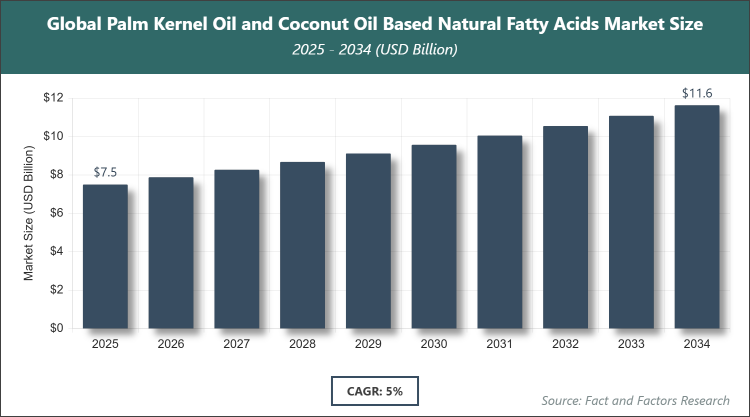
[231 Pages Report] According to Facts & Factors, the global Palm Kernel Oil and Coconut Oil-Based Natural Fatty Acids market size was estimated at USD 7.5 billion in 2025 and is expected to reach USD 11.5 billion by the end of 2034. The Palm Kernel Oil and Coconut Oil-Based Natural Fatty Acids industry is anticipated to grow by a CAGR of 5.0% between 2026 and 2034. The Palm Kernel Oil and Coconut Oil-Based Natural Fatty Acids Market is driven by surging global demand for sustainable, bio-based, and renewable ingredients in personal care, detergents, and industrial applications.
 Market Overview
The Palm Kernel Oil and Coconut Oil-Based Natural Fatty Acids market encompasses the extraction, fractionation, distillation, and commercialization of medium-chain fatty acids and their derivatives obtained from palm kernel oil and coconut oil through hydrolysis and subsequent processing. These naturally occurring saturated fatty acids, primarily lauric, myristic, caprylic, and capric acids, serve as versatile building blocks for producing surfactants, emulsifiers, emollients, and intermediates used across multiple industries. The market includes both straight-chain fatty acids and downstream derivatives such as fatty alcohols, glycerin, and soap noodles, all valued for their biodegradability, renewable sourcing, and functional properties, including excellent foaming, cleansing, and conditioning characteristics in end-use formulations.
Key Insights
- As per the analysis shared by our research analyst, the Palm Kernel Oil and Coconut Oil-Based Natural Fatty Acids market is estimated to grow annually at a CAGR of around 5.0% over the forecast period (2026-2034).
- In terms of revenue, the Palm Kernel Oil and Coconut Oil-Based Natural Fatty Acids market size was valued at around USD 7.5 billion in 2025 and is projected to reach USD 11.5 billion by 2034.
- The Palm Kernel Oil and Coconut Oil-Based Natural Fatty Acids Market is driven by rising preference for bio-based and eco-friendly raw materials in consumer products.
- Based on the Type, the Fatty Acids segment dominated the market in 2025 with a share of 58% due to its direct use as a core raw material in surfactant production and high versatility across applications.
- Based on the Application, the Personal Care Products segment dominated the market in 2025 with a share of 46%, owing to extensive utilization in soaps, shampoos, lotions, and cosmetics for superior cleansing and conditioning properties.
- Based on the End-User, the Household segment dominated the market in 2025 with a share of 52% because of massive consumption in everyday household detergents, soaps, and personal hygiene products.
- Asia Pacific dominated the global Palm Kernel Oil and Coconut Oil-Based Natural Fatty Acids market in 2025 with a share of 58%, attributed to abundant raw material availability, established oleochemical manufacturing hubs, and strong domestic demand from personal care and detergent industries.
Growth Drivers
- Rising Demand for Sustainable and Bio-Based Ingredients
Growing consumer awareness and regulatory pressure toward green chemistry have accelerated the replacement of petrochemical-derived fatty acids with renewable palm kernel and coconut oil-based alternatives in personal care and household cleaning formulations.
Expansion of the global cosmetics and toiletries industry, particularly in emerging economies, has further boosted consumption of these natural fatty acids for their excellent lathering, emulsifying, and skin-compatible properties.
Restraints
- Fluctuating Raw Material Prices and Supply Volatility
Dependence on seasonal agricultural output of palm kernel and coconut, combined with weather-related disruptions and competing uses for the parent oils, leads to price instability that affects production planning and profitability.
Stringent sustainability certifications and traceability requirements increase compliance costs for manufacturers while creating entry barriers for smaller players in the supply chain.
Opportunities
- Expansion in Specialty and Functional Applications
Increasing adoption of natural fatty acid derivatives in premium personal care, pharmaceuticals, and bio-lubricants offers high-margin growth avenues as brands seek clean-label and multifunctional ingredients.
Technological advancements in fractionation and enzymatic processing enable higher-purity products tailored for niche applications, opening new markets in food additives and animal nutrition.
Challenges
- Environmental and Land-Use Concerns
Criticism regarding palm oil-related deforestation and biodiversity loss necessitates continuous investment in RSPO-certified and traceable supply chains, raising operational complexity and costs.
Competition from other vegetable oil sources and synthetic alternatives in cost-sensitive industrial segments limits pricing power and requires ongoing innovation to maintain market share.
Report Scope
Report Attribute |
Details |
Market Size 2025 |
USD 7.5 Billion |
Projected Market Size in 2034 |
USD 11.5 Billion |
CAGR Growth Rate |
5.0% CAGR |
Base Year |
2025 |
Forecast Years |
2026-2034 |
Key Market Players |
Wilmar International Ltd., KLK OLEO, Emery Oleochemicals Group, Musim Mas Group, IOI Group, Pacific Oleochemicals Sdn. Bhd., Oleon NV, and Others. |
Key Segment |
By Type, By Application, By End-User, and By Region |
Major Regions Covered |
North America, Europe, Asia Pacific, Latin America, and the Middle East & Africa |
Purchase Options |
Request customized purchase options to meet your research needs. Explore purchase options |
Market Segmentation
The Palm Kernel Oil and Coconut Oil-Based Natural Fatty Acids market is segmented by type, application, end-user, and region.
Based on Type Segment, the Palm Kernel Oil and Coconut Oil-Based Natural Fatty Acids market is divided into fatty acids, fatty alcohols, glycerin, surfactants, and others. The most dominant segment is Fatty Acids, followed by Fatty Alcohols. Fatty Acids dominate because they serve as the primary building blocks for downstream derivatives and offer unmatched versatility in surfactant and soap manufacturing, directly fueling volume growth and enabling cost-effective customization that accelerates innovation and expands application scope across personal care and industrial sectors.
Based on Application Segment, the Palm Kernel Oil and Coconut Oil-Based Natural Fatty Acids market is divided into personal care products, soaps & detergents, food & beverages, industrial applications, and others. The most dominant segment is Personal Care Products, followed by Soaps & Detergents. Personal Care Products lead the segment due to the superior mildness, foaming ability, and skin-conditioning benefits of lauric and myristic acids, which drive premium product formulations and consumer preference for natural ingredients, thereby propelling sustained demand and encouraging manufacturers to develop specialized high-purity grades that further stimulate market expansion.
Based on End-User Segment, the Palm Kernel Oil and Coconut Oil-Based Natural Fatty Acids market is divided into household, commercial, industrial, and others. The most dominant segment is Household, followed by Industrial. Household dominates because everyday consumption of soaps, detergents, and personal hygiene products accounts for the largest share of end-use volume, supported by rising living standards and hygiene awareness in developing regions that create steady, high-volume demand and encourage scalable production efficiencies across the global supply chain.
Recent Developments
- In February 2025, KLK OLEO expanded its fatty acid fractionation capacity in Malaysia with a new sustainable production line certified under RSPO and ISCC, targeting higher-purity lauric acid for premium personal care markets.
- In July 2025, Wilmar International launched a new range of coconut oil-derived fatty alcohols with improved biodegradability profiles for use in eco-friendly surfactants across Europe and North America.
- In October 2025, Emery Oleochemicals Group announced the commercial production of bio-based glycerin from palm kernel sources at its German facility, strengthening its position in pharmaceutical and food-grade applications.
- In April 2025, Musim Mas Group received EU regulatory approval for its traceable palm kernel fatty acids portfolio, enabling expanded exports to high-regulation markets.
- In December 2025, Pacific Oleochemicals Sdn. Bhd. partnered with a leading Indian surfactant manufacturer to co-develop customized fatty acid blends for the growing South Asian detergent industry.
Regional Analysis
- Asia Pacific to dominate the global market
Asia Pacific leads the Palm Kernel Oil and Coconut Oil-Based Natural Fatty Acids market through its unparalleled access to raw material sources, mature oleochemical processing infrastructure, and rapidly expanding downstream industries in personal care and household cleaning. The region benefits from favorable government policies supporting bio-based chemicals, large-scale plantation economies, and a robust export-oriented manufacturing base that supplies global demand. Strong domestic consumption driven by population growth and rising middle-class spending on hygiene and beauty products further reinforces leadership.
North America maintains steady growth in the Palm Kernel Oil and Coconut Oil-Based Natural Fatty Acids market, supported by stringent consumer preference for clean-label and sustainable ingredients in personal care and household products. The region features sophisticated R&D capabilities that drive the development of high-performance derivatives and benefits from established distribution networks reaching both mass-market and premium brands. The United States dominates within North America through its large consumer base, strong regulatory framework favoring bio-based materials, and presence of major formulators that integrate natural fatty acids into innovative product lines for cosmetics and detergents.
Europe exhibits robust demand in the Palm Kernel Oil and Coconut Oil-Based Natural Fatty Acids market, driven by strict environmental regulations, high consumer awareness of green chemistry, and a mature cosmetics and personal care industry focused on natural formulations. The region leads inthe adoption of certified sustainable sources and supports premium pricing for traceable ingredients. Germany dominates within Europe with its advanced chemical engineering expertise, central role in specialty surfactant production, and leadership in developing multifunctional fatty acid derivatives for industrial and personal care applications across the continent.
Latin America is experiencing accelerating growth in the Palm Kernel Oil and Coconut Oil-Based Natural Fatty Acids market, fueled by expanding personal care and detergent manufacturing, improving economic conditions, and increasing preference for cost-effective natural ingredients. Rising urbanization and hygiene awareness have boosted local consumption, while export opportunities to North America enhance production incentives. Brazil dominates the region through its growing oleochemical sector, abundant agricultural resources, and strategic investments in downstream processing facilities that support both domestic needs and regional supply chains.
The Middle East & Africa region shows promising development in the Palm Kernel Oil and Coconut Oil-Based Natural Fatty Acids market, supported by rising investments in personal care manufacturing, growing population, and increasing focus on imported sustainable raw materials for local formulation. Urbanization and modern retail expansion have improved product accessibility in key markets. South Africa leads within the region with its established chemical industry, advanced import infrastructure, and role as a distribution gateway for natural fatty acid derivatives serving sub-Saharan consumer and industrial applications.
Competitive Analysis
The global Palm Kernel Oil and Coconut Oil-Based Natural Fatty Acids market is dominated by players:
- Wilmar International Ltd.
- KLK OLEO
- Emery Oleochemicals Group
- Musim Mas Group
- IOI Group
- Pacific Oleochemicals Sdn. Bhd.
- Vantage Specialty Chemicals
- Oleon NV
- Twin Rivers Technologies
- Procter & Gamble Chemicals
The global Palm Kernel Oil and Coconut Oil-Based Natural Fatty Acids market is segmented as follows:
By Type
- Fatty Acids
- Fatty Alcohols
- Glycerin
- Surfactants
- Others
By Application
- Personal Care Products
- Soaps & Detergents
- Food & Beverages
- Industrial Applications
- Others
By End-User
- Household
- Commercial
- Industrial
By Region
- North America
- The U.S.
- Canada
- Mexico
- Europe
- France
- The UK
- Spain
- Germany
- Italy
- Rest of Europe
- Asia Pacific
- China
- Japan
- India
- Australia
- Southeast Asia
- Rest of Asia Pacific
- The Middle East & Africa
- Saudi Arabia
- UAE
- Egypt
- Kuwait
- South Africa
- Rest of the Middle East & Africa
- Latin America
- Brazil
- Argentina
- Rest of Latin America
Industry Major Market Players
- Wilmar International Ltd.
- KLK OLEO
- Emery Oleochemicals Group
- Musim Mas Group
- IOI Group
- Pacific Oleochemicals Sdn. Bhd.
- Vantage Specialty Chemicals
- Oleon NV
- Twin Rivers Technologies
- Procter & Gamble Chemicals
Frequently Asked Questions



Copyright © 2025 - 2026, All Rights Reserved, Facts and Factors