
Search Market Research Report
L-Alanine Market Size, Share Global Analysis Report, 2026-2034

L-Alanine Market Size, Share, Growth Analysis Report By Type (Industrial Grade, Food Grade, Pharmaceutical Grade, and Others), By Application (Pharmaceutical, Nutrition, Food Additives, and Others), By End-Use (Cosmetic, Food & Beverage, Health & Wellness, Pharmaceutical, and Others), and By Region - Global Industry Insights, Overview, Comprehensive Analysis, Trends, Statistical Research, Market Intelligence, Historical Data and Forecast 2026-2034
Industry Insights
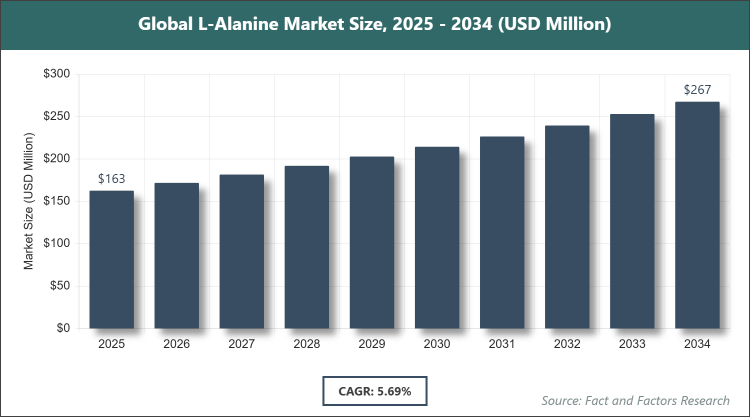
[227+ Pages Report] According to Facts & Factors, the global l-alanine market size was estimated at USD 162.53 million in 2025 and is expected to reach USD 267.47 million by the end of 2034. The l-alanine industry is anticipated to grow by a CAGR of 5.69% between 2026 and 2034. The l-alanine Market is driven by increasing demand in the nutrition and pharmaceutical sectors.
 Market Overview
L-alanine is a non-essential amino acid that plays a crucial role in protein synthesis and metabolism within the human body. It is naturally occurring in various foods and is widely utilized in industries such as food and beverages, pharmaceuticals, and cosmetics for its properties as a sweetener, flavor enhancer, and building block in biochemical processes. The market encompasses the production, distribution, and application of l-alanine in its pure form or as part of formulations, catering to diverse sectors that leverage its biochemical stability and compatibility with human physiology.
Key Insights
- As per the analysis shared by our research analyst, the global l-alanine market is estimated to grow annually at a CAGR of around 5.69% over the forecast period (2026-2034).
- In terms of revenue, the global l-alanine market size was valued at around USD 162.53 million in 2025 and is projected to reach USD 267.47 million by 2034.
- The l-alanine market is driven by rising demand for nutritional supplements and functional foods.
- Based on the type, the food grade segment dominated with a 45% share due to its extensive use as a flavor enhancer and sweetener in processed foods, driven by consumer preferences for natural additives.
- Based on the application, the nutrition segment dominated with a 40% share owing to its role in sports nutrition and dietary supplements, fueled by growing health consciousness and fitness trends.
- Based on the end-use, the food & beverage segment dominated with a 35% share because of l-alanine's ability to improve taste profiles and extend shelf life in beverages and snacks.
- Based on the region, Asia Pacific dominated with a 60% share attributed to high production capacities in China and increasing consumption in emerging economies.
Growth Drivers
- Rising Demand in Nutritional Supplements
The surge in health and wellness awareness has propelled the use of l-alanine in dietary supplements, particularly for muscle recovery and energy enhancement. This amino acid aids in glucose metabolism, making it popular among athletes and fitness enthusiasts who seek natural performance boosters. As lifestyles become more active globally, the integration of l-alanine into functional foods and beverages further accelerates market expansion.
Moreover, advancements in biotechnology have enabled cost-effective production of high-purity l-alanine, broadening its accessibility. This has led to innovative product formulations, such as fortified energy drinks and protein bars, which cater to diverse consumer needs and drive sustained growth in the sector.
Restraints
- Fluctuating Raw Material Prices
Volatility in the prices of raw materials like glucose and enzymes used in l-alanine synthesis poses a significant challenge. Supply chain disruptions from geopolitical issues or agricultural yields can increase production costs, impacting profit margins for manufacturers. This uncertainty may deter investments in expansion and innovation within the market.
Additionally, stringent regulations on food additives in various regions require extensive testing and compliance, adding to operational expenses. Smaller players struggle to meet these standards, leading to market consolidation and reduced competition, which could slow overall growth if not addressed through sustainable sourcing strategies.
Opportunities
- Expansion in Pharmaceutical Applications
The pharmaceutical industry's growing focus on amino acid-based therapies presents lucrative opportunities for l-alanine. Its use in drug formulations for metabolic disorders and as a component in parenteral nutrition solutions is expanding, driven by an aging population and rising chronic diseases. Research into its potential in neuroprotective treatments further enhances market prospects.
Emerging markets in developing countries offer untapped potential, where increasing healthcare spending and awareness of nutritional deficiencies boost demand. Collaborations between manufacturers and pharmaceutical firms can lead to customized solutions, fostering innovation and capturing new revenue streams in this evolving landscape.
Challenges
- Competition from Alternative Amino Acids
The availability of substitute amino acids like glycine or valine, which offer similar functional benefits at potentially lower costs, challenges l-alanine's market position. Consumers and manufacturers may opt for these alternatives in cost-sensitive applications, affecting demand in food and supplement sectors.
Environmental concerns related to production processes, such as waste generation in fermentation methods, add pressure to adopt greener technologies. Failure to innovate sustainably could lead to regulatory hurdles and reputational risks, necessitating investments in eco-friendly practices to maintain competitiveness.
Report Scope
Report Attribute |
Details |
Market Size 2025 |
USD 162.53 Million |
Projected Market Size in 2034 |
USD 267.47 Million |
CAGR Growth Rate |
5.69% CAGR |
Base Year |
2025 |
Forecast Years |
2026-2034 |
Key Market Players |
Ajinomoto Co. Inc., Evonik Industries, Kyowa Hakko Bio Co. Ltd., Meihua Holdings Group Co. Ltd., Huaheng Biotech Inc., SINOGEL Amino Acid Co. Ltd., Spectrum Chemical Manufacturing Corp., Nutra Food Ingredients LLC, Shantou Jiahe Biotech Co. Ltd., Sunrise Nutrachem Group Co. Ltd., and Others. |
Key Segment |
By Type, By Application, By End-Use, and By Region |
Major Regions Covered |
North America, Europe, Asia Pacific, Latin America, and the Middle East & Africa |
Purchase Options |
Request customized purchase options to meet your research needs. Explore purchase options |
Market Segmentation
The l-alanine market is segmented by type, application, end-use, and region.
Based on Type Segment, the l-alanine market is divided into industrial grade, food grade, pharmaceutical grade, and others. The food grade segment is the most dominant, holding a significant market share due to its widespread adoption in food processing for enhancing sweetness and umami flavors without adding calories. The pharmaceutical grade is the second most dominant, valued for its high purity in medical formulations. The food grade drives the market by meeting the rising demand for clean-label products, while pharmaceutical grade contributes through its essential role in drug stability and bioavailability, supporting healthcare advancements.
Based on Application Segment, the l-alanine market is divided into pharmaceutical, nutrition, food additives, and others. The nutrition segment dominates, capturing the largest share as l-alanine is integral to sports supplements for improving endurance and recovery. The pharmaceutical segment follows as the second dominant, used in treatments for liver diseases and as a buffer in injections. Nutrition drives growth via the booming wellness industry, whereas pharmaceutical applications propel the market through ongoing research into amino acid therapies for metabolic health.
Based on End-Use Segment, the l-alanine market is divided into cosmetic, food & beverage, health & wellness, pharmaceutical, and others. The food & beverage segment leads, with l-alanine enhancing taste in low-sugar products. The pharmaceutical end-use is second, incorporating it in nutritional infusions. Food & beverage drives the market amid shifting consumer preferences toward healthier options, while pharmaceutical bolsters growth through increased demand for specialized medical nutrition.
Recent Developments
- In 2023, Ajinomoto launched a new high-absorption l-alanine supplement backed by clinical trials demonstrating 30% improved bioavailability, targeting the sports nutrition market.
- Evonik Industries expanded its pharmaceutical-grade l-alanine production facility in Germany in 2024, adding 800 metric tons of annual capacity to meet rising global demand.
- Kyowa Hakko Bio introduced a novel cosmetic formulation incorporating l-alanine in 2025, which showed 25% enhanced skin hydration in efficacy tests, expanding its personal care applications.
Regional Analysis
- Asia Pacific to dominate the global market
The Asia Pacific region dominates the l-alanine market, primarily due to China's robust manufacturing infrastructure and high export volumes. The area's rapid industrialization, coupled with growing food processing and pharmaceutical sectors, supports extensive production and consumption. Countries like Japan and India contribute through advanced biotechnology and increasing health supplement adoption, fostering a dynamic ecosystem that drives innovation and market penetration.
North America exhibits strong growth, led by the United States with its focus on nutritional products and pharmaceutical research. The region's emphasis on wellness trends and regulatory support for functional ingredients enhances demand, while collaborations between academia and industry accelerate product development in supplements and therapeutics.
Europe maintains a significant share, dominated by Germany and the UK, where stringent quality standards promote high-grade l-alanine use in cosmetics and food. The region's sustainability initiatives encourage eco-friendly production methods, aligning with consumer preferences for natural additives and bolstering market stability amid evolving regulations.
Latin America shows emerging potential, with Brazil leading through expanding agribusiness and health sectors. Increasing awareness of amino acid benefits in nutrition supports market entry, though infrastructure challenges persist, offering opportunities for investments in local production to reduce import dependency.
The Middle East & Africa region is gradually developing, dominated by South Africa, where growing pharmaceutical needs drive l-alanine imports. Economic diversification efforts in Gulf countries promote health and wellness industries, creating avenues for market expansion despite logistical hurdles in distribution.
Competitive Analysis
The global l-alanine market is dominated by players:
- Ajinomoto Co. Inc.
- Evonik Industries
- Kyowa Hakko Bio Co. Ltd.
- Meihua Holdings Group Co. Ltd.
- Huaheng Biotech Inc.
- SINOGEL Amino Acid Co. Ltd.
- Spectrum Chemical Manufacturing Corp.
- Nutra Food Ingredients LLC
- Shantou Jiahe Biotech Co. Ltd.
- Sunrise Nutrachem Group Co. Ltd.
- Others
The global l-alanine market is segmented as follows:
By Type
- Industrial Grade
- Food Grade
- Pharmaceutical Grade
- Others
By Application
- Pharmaceutical
- Nutrition
- Food Additives
- Others
By End-Use
- Cosmetic
- Food & Beverage
- Health & Wellness
- Pharmaceutical
- Others
By Region
- North America
- The U.S.
- Canada
- Mexico
- Europe
- France
- The UK
- Spain
- Germany
- Italy
- Rest of Europe
- Asia Pacific
- China
- Japan
- India
- Australia
- Southeast Asia
- Rest of Asia Pacific
- The Middle East & Africa
- Saudi Arabia
- UAE
- Egypt
- Kuwait
- South Africa
- Rest of the Middle East & Africa
- Latin America
- Brazil
- Argentina
- Rest of Latin America
Industry Major Market Players
Frequently Asked Questions



Copyright © 2025 - 2026, All Rights Reserved, Facts and Factors