
Search Market Research Report
Traffic Signs Market Size, Share Global Analysis Report, 2026-2034

Traffic Signs Market Size, Share, Growth Analysis Report By Product Type (Regulatory Signs, Warning Signs, Guide Signs, Informational Signs, Temporary Signs, and Others), By Material (Aluminum, Steel, Plastic, and Others), By Application (Highways, Streets, Commercial & Residential Zones, Construction Zones, and Others), and By Region - Global Industry Insights, Overview, Comprehensive Analysis, Trends, Statistical Research, Market Intelligence, Historical Data and Forecast 2026-2034
Industry Insights
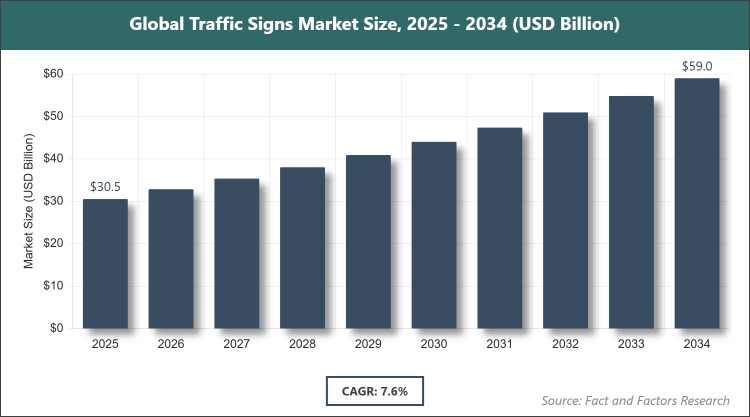
[218+ Pages Report] According to Facts & Factors, the global Traffic Signs market size was estimated at USD 30.53 billion in 2025 and is expected to reach USD 62.64 billion by the end of 2034. The Traffic Signs industry is anticipated to grow by a CAGR of 7.6% between 2026 and 2034. The Traffic Signs Market is driven by increasing investments in road infrastructure and safety measures.
 Market Overview
The traffic signs market involves the production, distribution, and installation of visual indicators used to regulate, warn, and guide road users, encompassing a range of symbols, texts, and shapes designed to enhance safety, manage flow, and provide information on roadways, without incorporating quantitative elements in this core definition.
Key Insights
- As per the analysis shared by our research analyst, the global Traffic Signs market is estimated to grow annually at a CAGR of around 7.6% over the forecast period (2026-2034).
- In terms of revenue, the global Traffic Signs market size was valued at around USD 30.53 billion in 2025 and is projected to reach USD 62.64 billion by 2034.
- The market is driven by rapid urbanization and government initiatives for road safety.
- Based on the Product Type, the Regulatory Signs segment dominated the market in 2025 with a share of over 35%, due to mandatory compliance requirements and widespread use in urban and highway settings to enforce traffic laws.
- Based on the Material, the Aluminum segment dominated the market in 2025 with a share of over 40%, attributed to its durability, corrosion resistance, and lightweight properties ideal for long-term outdoor exposure.
- Based on the Application, the Highways segment dominated the market in 2025 with a share of over 45%, owing to high-speed traffic needs for clear guidance and safety enhancements in extensive road networks.
- Based on the region, Asia Pacific dominated the market in 2025 with a share of around 34%, driven by rapid infrastructure development and urbanization in countries like China and India.
Growth Drivers
- Rapid Urbanization and Infrastructure Expansion
The surge in urban populations worldwide necessitates enhanced road networks, boosting demand for traffic signs to manage increased vehicular and pedestrian traffic effectively. Governments are investing heavily in transportation projects, integrating advanced signage to reduce accidents and improve mobility in growing cities.
Technological integrations like reflective materials and LED displays further propel growth by offering better visibility and adaptability, aligning with smart city initiatives that prioritize efficient urban planning and sustainable development.
Restraints
- High Initial Installation and Maintenance Costs
The substantial expenses associated with procuring durable materials and installing signs in remote or high-traffic areas can deter budget-constrained municipalities, limiting market penetration in developing regions. This financial barrier often leads to delayed projects or reliance on outdated infrastructure.
Ongoing maintenance requirements, including repairs from weather damage or vandalism, add to operational costs, potentially shifting priorities towards alternative traffic management solutions like digital systems.
Opportunities
- Adoption of Smart and Digital Signage Technologies
The integration of IoT and AI in traffic signs enables real-time updates and variable messaging, opening avenues for innovative products that enhance safety and efficiency in dynamic environments. This trend attracts investments from tech-savvy regions aiming for intelligent transportation systems.
Sustainability-focused innovations, such as solar-powered signs, provide opportunities to meet environmental regulations and appeal to eco-conscious stakeholders, fostering partnerships between manufacturers and governments for green infrastructure projects.
Challenges
- Environmental Regulations and Material Sustainability
Stringent policies on plastic usage and waste management challenge traditional manufacturing processes, requiring shifts to eco-friendly alternatives that may increase production costs. Compliance with varying regional standards complicates global operations for suppliers.
Climate change impacts, like extreme weather affecting sign longevity, pose reliability issues, necessitating resilient designs while balancing cost-effectiveness in a competitive market landscape.
Report Scope
Report Attribute |
Details |
Market Size 2025 |
USD 30.53 Billion |
Projected Market Size in 2034 |
USD 62.64 Billion |
CAGR Growth Rate |
7.6% CAGR |
Base Year |
2025 |
Forecast Years |
2026-2034 |
Key Market Players |
3M Company, Brady Corporation, Avery Dennison, Swarco Traffic, RoadSafe Traffic Systems Inc., Vulcan Signs, Traffic Signs and Safety Inc., Lyle Signs, Pexco, Safetran Systems Corporation, and Others. |
Key Segment |
By Product Type, By Material, By Application, and By Region |
Major Regions Covered |
North America, Europe, Asia Pacific, Latin America, and the Middle East & Africa |
Purchase Options |
Request customized purchase options to meet your research needs. Explore purchase options |
Market Segmentation
The Traffic Signs market is segmented by product type, material, application, and region.
Based on Product Type Segment, the Traffic Signs market is divided into Regulatory Signs, Warning Signs, Guide Signs, Informational Signs, Temporary Signs, and Others. The most dominant segment is Regulatory Signs, holding over 35% share, due to their essential role in enforcing traffic laws and ensuring compliance, which drives the market by reducing accidents and supporting legal frameworks in densely populated areas; the second most dominant is Warning Signs, valued for alerting drivers to hazards, contributing to growth through enhanced safety in construction and rural zones where risks are higher.
Based on Material Segment, the Traffic Signs market is divided into Aluminum, Steel, Plastic, and Others. The most dominant segment is Aluminum, with over 40% share, as its weather-resistant and lightweight nature facilitates easy installation and longevity, propelling the market by meeting demands for cost-effective, durable solutions in extensive highway projects; the second most dominant is Plastic, appreciated for its flexibility and low cost in temporary applications, aiding expansion through quick deployment in urban redevelopment and event management.
Based on Application Segment, the Traffic Signs market is divided into Highways, Streets, Commercial & Residential Zones, Construction Zones, and Others. The most dominant segment is Highways, capturing over 45% share, owing to the need for high-visibility signs in long-distance travel, fueling market progress by improving navigation and safety on major transport routes; the second most dominant is Construction Zones, where temporary signs ensure worker and driver protection, advancing the market through alignment with global infrastructure booms.
Recent Developments
- In April 2024, 3M introduced advanced reflective sheeting technology for traffic signs, enhancing nighttime visibility and durability to support safer roadways.
- In June 2024, Swarco Traffic launched solar-powered variable message signs, promoting energy efficiency and real-time traffic management in urban areas.
- In September 2023, Avery Dennison developed eco-friendly vinyl materials for signs, reducing environmental impact while maintaining high performance standards.
- In March 2023, RoadSafe Traffic Systems expanded its portfolio with smart LED signs integrated with IoT for dynamic hazard warnings.
Regional Analysis
- Asia Pacific to dominate the global market
Asia Pacific emerges as a leader in the traffic signs sector, propelled by extensive urbanization and massive infrastructure investments that demand robust signage solutions for safety and efficiency. China dominates as the key country, with its ambitious Belt and Road Initiative fostering widespread adoption of advanced signs across highways and cities. The region's focus on smart transportation systems integrates digital technologies, enhancing traffic flow and reducing congestion in populous nations.
North America showcases strong market presence through stringent safety regulations and technological innovations in signage materials. The United States leads as the dominating country, leveraging federal funding for highway upgrades and intelligent systems that incorporate LED and reflective technologies. This area emphasizes sustainability, driving demand for eco-friendly signs amid growing urban sprawl.
Europe maintains a prominent role with its emphasis on standardized regulations and high-quality infrastructure across member states. Germany stands out as the dominating country, known for its engineering excellence and integration of smart signs in efficient transport networks. The continent's commitment to reducing emissions supports the shift towards energy-efficient signage solutions.
Latin America is advancing steadily, supported by improving road networks and foreign investments in transportation projects. Brazil emerges as the dominating country, utilizing its vast geography to expand signage in urban and rural areas for better safety. This region capitalizes on economic growth to address traffic challenges effectively.
The Middle East & Africa region is progressing through strategic developments in infrastructure and tourism-driven projects. The United Arab Emirates leads as the dominating country, with visionary initiatives like smart cities incorporating cutting-edge signs for seamless mobility. This area focuses on resilient solutions suited to diverse climates.
Competitive Analysis
The global Traffic Signs market is dominated by players:
- 3M Company
- Brady Corporation
- Avery Dennison
- Swarco Traffic
- RoadSafe Traffic Systems Inc.
- Vulcan Signs
- Traffic Signs and Safety Inc.
- Lyle Signs
- Pexco
- Safetran Systems Corporation
The global Traffic Signs market is segmented as follows:
By Product Type
- Regulatory Signs
- Warning Signs
- Guide Signs
- Informational Signs
- Temporary Signs
- Others
By Material
- Aluminum
- Steel
- Plastic
- Others
By Application
- Highways
- Streets
- Commercial & Residential Zones
- Construction Zones
- Others
By Region
- North America
- The U.S.
- Canada
- Mexico
- Europe
- France
- The UK
- Spain
- Germany
- Italy
- Rest of Europe
- Asia Pacific
- China
- Japan
- India
- Australia
- Southeast Asia
- Rest of Asia Pacific
- The Middle East & Africa
- Saudi Arabia
- UAE
- Egypt
- Kuwait
- South Africa
- Rest of the Middle East & Africa
- Latin America
- Brazil
- Argentina
- Rest of Latin America
Industry Major Market Players
- 3M Company
- Brady Corporation
- Avery Dennison
- Swarco Traffic
- RoadSafe Traffic Systems Inc.
- Vulcan Signs
- Traffic Signs and Safety Inc.
- Lyle Signs
- Pexco
- Safetran Systems Corporation



Copyright © 2025 - 2026, All Rights Reserved, Facts and Factors