
Search Market Research Report
Suspension Spring Market Size, Share Global Analysis Report, 2026-2034

Suspension Spring Market Size, Share, Growth Analysis Report By Type (Coil Springs, Leaf Springs, Air Springs, Torsion Bars, and Others), By Vehicle Type (Passenger Cars, Commercial Vehicles, and Others), By End-Use (OEM, Aftermarket), and By Region - Global Industry Insights, Overview, Comprehensive Analysis, Trends, Statistical Research, Market Intelligence, Historical Data and Forecast 2026-2034
Industry Insights
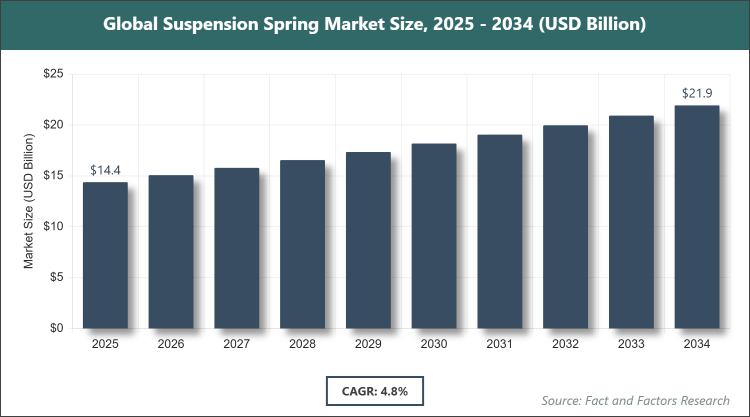
[220+ Pages Report] According to Facts & Factors, the global suspension spring market size was estimated at USD 14.38 billion in 2025 and is expected to reach USD 22.66 billion by the end of 2034. The suspension spring industry is anticipated to grow by a CAGR of 4.8% between 2026 and 2034. The suspension spring market is driven by rising automotive production and demand for enhanced vehicle comfort and handling.
 Market Overview
The suspension spring market encompasses components integral to vehicle suspension systems, designed to absorb shocks, maintain tire contact with the road, and ensure ride stability. These springs, including coil, leaf, air, and torsion types, play a crucial role in enhancing vehicle handling, comfort, and safety across passenger cars, commercial vehicles, and other applications without relying on quantitative metrics in this definitional overview.
Key Insights
- As per the analysis shared by our research analyst, the global suspension spring market is estimated to grow annually at a CAGR of around 4.8% over the forecast period (2026-2034).
- In terms of revenue, the global suspension spring market size was valued at around USD 14.38 billion in 2025 and is projected to reach USD 22.66 billion by 2034.
- The market is driven by escalating demand for improved ride quality and the surge in electric vehicle adoption.
- Based on the type, the coil spring segment dominated the market with a share of 45% due to their versatility and widespread use in passenger vehicles for superior shock absorption and durability.
- Based on the vehicle type, the passenger car segment dominated with a share of 60%, owing to high global production volumes and consumer preference for comfort-oriented suspensions.
- Based on the end-use, the OEM segment dominated with a share of 70% as manufacturers integrate advanced springs directly into new vehicle assemblies for optimized performance.
- Asia Pacific dominated the global market with a share of 48% attributed to rapid automotive manufacturing growth in countries like China and India.
Growth Drivers
- Rising Automotive Production and EV Integration
The global automotive industry's expansion, particularly in emerging economies, fuels demand for suspension springs as vehicle output increases to meet consumer needs. Electric vehicles require lightweight, efficient springs to offset battery weight and improve range, driving innovation in materials and designs.
Additionally, stringent safety regulations worldwide mandate advanced suspension systems for better stability, further propelling market growth through technological upgrades and R&D investments.
Restraints
- High Raw Material Costs and Supply Chain Volatility
Fluctuations in steel and alloy prices, key materials for springs, increase production costs and challenge profitability for manufacturers. Supply disruptions from geopolitical issues or raw material shortages can delay deliveries and hinder market expansion.
Moreover, the shift toward alternative suspension technologies like active systems in premium vehicles reduces reliance on traditional springs, limiting growth in certain segments.
Opportunities
- Advancements in Lightweight Materials
The adoption of composite and high-strength alloys offers opportunities for lighter springs that enhance fuel efficiency and performance, especially in EVs and hybrids. This trend aligns with sustainability goals and opens avenues for market players to develop eco-friendly products.
Expanding aftermarket demand in developing regions, driven by vehicle longevity and customization, provides additional growth prospects through replacement parts and upgrades.
Challenges
- Intense Competition from Alternative Technologies
Emerging air and magnetic suspension systems in luxury and autonomous vehicles pose challenges by offering superior adaptability, potentially eroding market share for conventional springs. Manufacturers must innovate to remain competitive.
Regulatory pressures on emissions and weight reduction complicate design processes, requiring significant investments in compliance and testing, which can strain smaller players.
Report Scope
Report Attribute |
Details |
Market Size 2025 |
USD 14.38 Billion |
Projected Market Size in 2034 |
USD 22.66 Billion |
CAGR Growth Rate |
4.8% CAGR |
Base Year |
2025 |
Forecast Years |
2026-2034 |
Key Market Players |
NHK Spring, Rassini, Sogefi, Mubea, Thyssenkrupp, Continental, Mitsubishi Steel, ZF Friedrichshafen AG, Tenneco Inc., KYB Corporation, and Others. |
Key Segment |
By Type, By Vehicle Type, By End-Use, and By Region |
Major Regions Covered |
North America, Europe, Asia Pacific, Latin America, and the Middle East & Africa |
Purchase Options |
Request customized purchase options to meet your research needs. Explore purchase options |
Market Segmentation
The suspension spring market is segmented by type, vehicle type, end-use, and region.
Based on Type Segment, the suspension spring market is divided into coil springs, leaf springs, air springs, torsion bars, and others. The coil springs segment is the most dominant, holding a significant market share due to its compact design, excellent energy absorption, and adaptability to various vehicle weights, which drives overall market growth by enabling smoother rides and better handling in high-volume passenger cars. The leaf springs segment is the second most dominant, valued for its robustness in heavy-load applications like commercial vehicles, contributing to market expansion through durability and cost-effectiveness in logistics and construction sectors.
Based on Vehicle Type Segment, the suspension spring market is divided into passenger cars, commercial vehicles, and others. The passenger cars segment dominates, driven by global urbanization and rising disposable incomes that boost demand for comfortable, reliable vehicles, propelling market growth via integrated advanced suspension for enhanced daily commuting. The commercial vehicles segment follows as the second dominant, fueled by e-commerce and infrastructure projects requiring sturdy springs for load-bearing, aiding market progression through improved fleet efficiency and safety.
Based on End-Use Segment, the suspension spring market is divided into OEM and aftermarket. The OEM segment leads, as automakers prioritize factory-fitted high-quality springs for optimal vehicle performance, driving market growth through large-scale procurement and innovation in new models. The aftermarket segment is second, supported by vehicle maintenance needs and customization trends, contributing to market vitality by offering replacements that extend vehicle lifespan and appeal to enthusiasts.
Recent Developments
- In August 2023, ZF Friedrichshafen AG acquired TRW Automotive to expand its product portfolio and strengthen its global position in automotive parts, including suspension springs.
- In June 2023, KYB Corporation invested USD 100 million to expand suspension spring production capacity, aiming to meet rising demand from the automotive sector.
- In September 2023, Tenneco Inc. developed new lightweight suspension springs using aluminum and carbon fiber for improved efficiency in electric vehicles.
Regional Analysis
- Asia Pacific to dominate the global market
Asia Pacific leads the suspension spring market, with China as the dominant country due to its massive automotive manufacturing base and export prowess, supported by government incentives for EVs and infrastructure development that amplify demand for advanced suspension components.
Europe follows, where Germany excels through precision engineering and luxury vehicle production, emphasizing innovative springs for superior handling amid strict emission norms and a focus on sustainable mobility.
North America, led by the United States, benefits from robust pickup truck and SUV markets, with emphasis on durable springs for off-road and commercial use, bolstered by technological advancements in autonomous driving.
Latin America, with Brazil at the forefront, grows through increasing vehicle ownership and agricultural transport needs, where cost-effective leaf springs dominate for rugged terrains.
The Middle East & Africa, spearheaded by South Africa, sees expansion via mining and logistics sectors requiring heavy-duty suspensions, aided by urbanization and foreign investments in automotive assembly.
Competitive Analysis
The global suspension spring market is dominated by players:
- NHK Spring
- Rassini
- Sogefi
- Mubea
- Thyssenkrupp
- Continental
- Mitsubishi Steel
- ZF Friedrichshafen AG
- Tenneco Inc.
- KYB Corporation
- Hendrickson
- Vibracoustic
- Lesjöfors
- Betts Spring
- Eibach
The global suspension spring market is segmented as follows:
By Type
- Coil Springs
- Leaf Springs
- Air Springs
- Torsion Bars
- Others
By Vehicle Type
- Passenger Cars
- Commercial Vehicles
- Others
By End-Use
- OEM
- Aftermarket
By Region
- North America
- The U.S.
- Canada
- Mexico
- Europe
- France
- The UK
- Spain
- Germany
- Italy
- Rest of Europe
- Asia Pacific
- China
- Japan
- India
- Australia
- Southeast Asia
- Rest of Asia Pacific
- The Middle East & Africa
- Saudi Arabia
- UAE
- Egypt
- Kuwait
- South Africa
- Rest of the Middle East & Africa
- Latin America
- Brazil
- Argentina
- Rest of Latin America
Industry Major Market Players
The global suspension spring market is dominated by players:
- NHK Spring
- Rassini
- Sogefi
- Mubea
- Thyssenkrupp
- Continental
- Mitsubishi Steel
- ZF Friedrichshafen AG
- Tenneco Inc.
- KYB Corporation
- Hendrickson
- Vibracoustic
- Lesjöfors
- Betts Spring
- Eibach



Copyright © 2025 - 2026, All Rights Reserved, Facts and Factors