
Search Market Research Report
Real Estate Software Market Size, Share Global Analysis Report, 2026-2034

Real Estate Software Market Size, Share, Growth Analysis Report By Type (Customer Relationship Management Software, Enterprise Resource Planning Software, Property Management Software, Contract Software, and Others), By Deployment (Cloud, On-premise), By Application (Residential, Commercial), By End-User (Real Estate Agents, Property Managers, Housing Associations, and Others), and By Region - Global Industry Insights, Overview, Comprehensive Analysis, Trends, Statistical Research, Market Intelligence, Historical Data and Forecast 2026-2034
Industry Insights
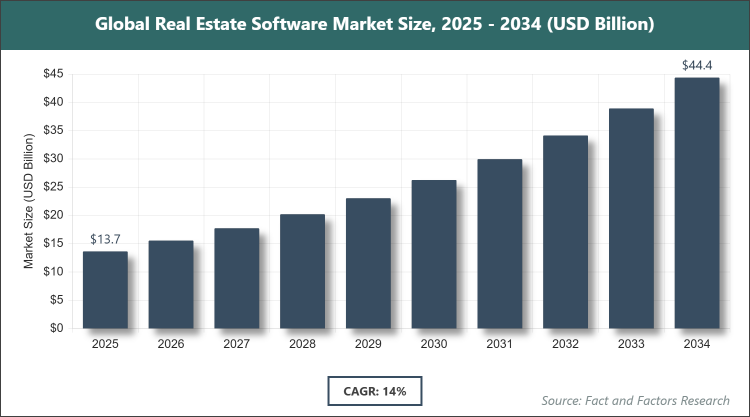
[228+ Pages Report] According to Facts & Factors, the global Real Estate Software market size was estimated at USD 13.65 billion in 2025 and is expected to reach USD 45.2 billion by the end of 2034. The Real Estate Software industry is anticipated to grow by a CAGR of 14.0% between 2026 and 2034. The Real Estate Software Market is driven by ongoing digital transformation and the adoption of cloud-based technologies.
 Market Overview
Real Estate Software refers to digital platforms and applications designed to streamline operations within the property sector, encompassing tools for property management, customer relationship management, transaction processing, and analytics that facilitate efficient handling of listings, leases, sales, and compliance. This market involves the development and deployment of solutions that integrate technologies like AI and cloud computing to enhance decision-making, automate workflows, and improve stakeholder interactions in residential, commercial, and industrial real estate without quantitative specifics.
Key Insights
- As per the analysis shared by our research analyst, the global Real Estate Software market is estimated to grow annually at a CAGR of around 14.0% over the forecast period (2026-2034).
- In terms of revenue, the global Real Estate Software market size was valued at around USD 13.65 billion in 2025 and is projected to reach USD 45.2 billion by 2034.
- The market is driven by increasing digital transformation and the adoption of AI in real estate operations.
- Based on the type, the customer relationship management software segment dominated with a 28% share due to its role in managing client interactions and improving sales efficiency.
- Based on the deployment, the cloud segment dominated with a 55% share owing to its scalability and remote accessibility features.
- Based on the application, the residential segment dominated with a 52% share because of high demand for property management in housing markets.
- Based on the end-user, the real estate agents segment dominated with a 35% share, attributed to the need for tools in transaction and client management.
- Based on the region, North America dominated with a 34% share due to advanced technological infrastructure and high adoption rates.
Growth Drivers
- Digital Transformation Initiatives
The real estate sector's shift toward automation and data-driven strategies has accelerated the adoption of software solutions that optimise property management and enhance customer experiences. This driver is supported by the integration of AI for predictive analytics, enabling better forecasting of market trends and personalised services.
Moreover, cloud-based platforms facilitate real-time collaboration among stakeholders, reducing operational delays and costs, which further propels market expansion in a competitive landscape.
Restraints
- High Implementation Costs
Significant upfront investments in software deployment and training pose barriers for small enterprises, limiting widespread adoption. This restraint is exacerbated by the need for ongoing updates to maintain compatibility with evolving technologies.
Additionally, concerns over data migration from legacy systems increase complexity and expenses, potentially slowing market penetration in cost-sensitive regions.
Opportunities
- AI and Machine Learning Integration
The incorporation of advanced analytics offers prospects for innovative applications like virtual property tours and automated valuations, attracting tech-savvy users. This opportunity aligns with growing demands for efficiency in property transactions.
Furthermore, expansion into emerging markets through affordable SaaS models can tap into untapped potential, driven by urbanisation and infrastructure growth.
Challenges
- Data Privacy and Security Issues
Rising cyber threats and regulatory compliance requirements create hurdles in safeguarding sensitive client information. This challenge necessitates robust security measures, increasing operational burdens.
In addition, integration difficulties with existing systems can lead to inefficiencies, demanding specialised expertise to resolve compatibility issues.
Report Scope
Report Attribute |
Details |
Market Size 2025 |
USD 13.65 Billion |
Projected Market Size in 2034 |
USD 45.2 Billion |
CAGR Growth Rate |
14.0% CAGR |
Base Year |
2025 |
Forecast Years |
2026-2034 |
Key Market Players |
Accruent, Altus Group Ltd., Autodesk Inc., CoStar Realty Information Inc., Microsoft Corporation, MRI Software LLC, Oracle Corporation, RealPage Inc., SAP SE, Trimble Inc., Yardi Systems Inc., and Others. |
Key Segment |
By Type, By Deployment, By Application, By End-User, and By Region |
Major Regions Covered |
North America, Europe, Asia Pacific, Latin America, and the Middle East & Africa |
Purchase Options |
Request customized purchase options to meet your research needs. Explore purchase options |
Market Segmentation
The Real Estate Software market is segmented by type, deployment, application, end-user, and region.
Based on Type Segment, the Real Estate Software market is divided into customer relationship management software, enterprise resource planning software, property management software, contract software, and others. The most dominant segment is customer relationship management software, followed by property management software as the second most dominant. Customer relationship management software dominates due to its essential function in streamlining client interactions, lead tracking, and sales processes, driving the market by enhancing efficiency and customer retention in competitive real estate environments; property management software, with tools for lease administration and maintenance, supports growth by automating operational tasks and reducing overheads for property owners.
Based on Deployment Segment, the Real Estate Software market is divided into cloud, on-premise, and others. The most dominant segment is cloud, followed by on-premise as the second most dominant. Cloud deployment leads owing to its flexibility, cost-effectiveness, and remote access capabilities that suit dynamic real estate operations, propelling market expansion through scalable solutions; on-premise, preferred for data-sensitive applications, contributes to growth by offering customized control in regulated settings.
Based on Application Segment, the Real Estate Software market is divided into residential, commercial, and others. The most dominant segment is residential, followed by commercial as the second most dominant. Residential applications dominate as they address high-volume housing needs with tools for listings and tenant management, boosting the market via increased accessibility; commercial, focusing on complex leases and analytics, drives growth by supporting large-scale property investments.
Based on End-User Segment, the Real Estate Software market is divided into real estate agents, property managers, housing associations, and others. The most dominant segment is real estate agents, followed by property managers as the second most dominant. Real estate agents lead due to their reliance on software for transactions and client engagement, enhancing market demand through improved productivity; property managers, utilizing tools for maintenance and compliance, contribute to growth by optimizing asset management.
Recent Developments
- In October 2025, MRI Software acquired a portfolio of property management solutions to enhance its service offerings across commercial and residential markets.
- In August 2025, Islamic fintech Wahed unveiled its Shariah-compliant private real-estate investment platform in the U.S., enabling fractional ownership.
- In July 2025, Measurabl launched a free software solution for measuring and reporting sustainability performance across property portfolios.
- In April 2025, ZapUp introduced a WhatsApp marketing automation platform for real estate, joining Microsoft for Startups.
Regional Analysis
- North America to Dominate the Global Market
North America dominates the Real Estate Software market, led by the United States, where advanced technological infrastructure and high digital adoption rates facilitate widespread use of CRM and cloud solutions, supported by a mature real estate sector that emphasizes efficiency and data-driven decisions amid growing urbanization.
Europe holds a significant position, with Germany leading through stringent regulations and focus on sustainable practices, integrating software for compliance and analytics in commercial properties across the EU.
Asia Pacific is rapidly expanding, dominated by China, driven by massive infrastructure projects and digital transformation initiatives that boost adoption of property management tools in emerging economies.
Latin America shows steady growth, led by Brazil, through increasing investments in real estate tech to streamline operations in residential and commercial sectors amid economic recovery.
The Middle East & Africa region is emerging, with the UAE at the forefront, leveraging smart city developments to incorporate advanced software for property valuation and management.
Competitive Analysis
The global Real Estate Software market is dominated by players:
- Accruent
- Altus Group Ltd.
- Autodesk Inc.
- CoStar Realty Information Inc.
- Microsoft Corporation
- MRI Software LLC
- Oracle Corporation
- RealPage Inc.
- SAP SE
- Trimble Inc.
- Yardi Systems Inc.
- Others
The global Real Estate Software market is segmented as follows:
By Type
- Customer Relationship Management Software
- Enterprise Resource Planning Software
- Property Management Software
- Contract Software
By Deployment
- Cloud
- On-premise
By Application
- Residential
- Commercial
By End-User
- Real Estate Agents
- Property Managers
- Housing Associations
By Region
- North America
- The U.S.
- Canada
- Mexico
- Europe
- France
- The UK
- Spain
- Germany
- Italy
- Rest of Europe
- Asia Pacific
- China
- Japan
- India
- Australia
- Southeast Asia
- Rest of Asia Pacific
- The Middle East & Africa
- Saudi Arabia
- UAE
- Egypt
- Kuwait
- South Africa
- Rest of the Middle East & Africa
- Latin America
- Brazil
- Argentina
- Rest of Latin America
Industry Major Market Players
- Accruent
- Altus Group Ltd.
- Autodesk Inc.
- CoStar Realty Information Inc.
- Microsoft Corporation
- MRI Software LLC
- Oracle Corporation
- RealPage Inc.
- SAP SE
- Trimble Inc.
- Yardi Systems Inc.
- Others



Copyright © 2025 - 2026, All Rights Reserved, Facts and Factors