
Search Market Research Report
Programmable Power Supply Market Size, Share Global Analysis Report, 2026-2034

Programmable Power Supply Market Size, Share, Growth Analysis Report By Type (Single-Output, Dual-Output, Multiple-Output, and Others), By Application (Semiconductor Fabrication, Automotive Electronics Test, Industrial Production, Universities and Laboratories, Medical Equipment, and Others), By End-User (Aerospace & Defense, Energy & Power, Telecommunications, Automotive, and Others), and By Region - Global Industry Insights, Overview, Comprehensive Analysis, Trends, Statistical Research, Market Intelligence, Historical Data and Forecast 2026-2034
Industry Insights
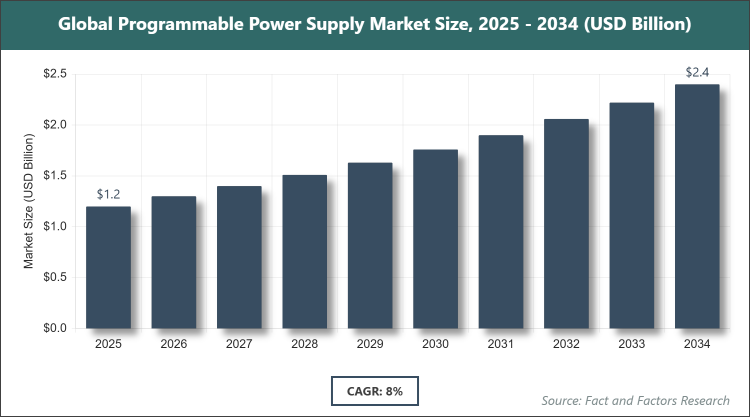
[240+ Pages Report] According to Facts & Factors, the global Programmable Power Supply market size was estimated at USD 1.2 billion in 2025 and is expected to reach USD 2.4 billion by the end of 2034. The Programmable Power Supply industry is anticipated to grow by a CAGR of 8.0% between 2026 and 2034. The Programmable Power Supply Market is driven by rising demand for precision testing in electronics and automotive sectors.
 Market Overview
Programmable Power Supplies are electronic devices that provide adjustable voltage, current, and power outputs controlled via software or interfaces, enabling precise simulation of various electrical conditions for testing and development purposes. These supplies are essential in industries requiring accurate power delivery, such as electronics manufacturing and research, where they replace fixed-output units by offering flexibility to mimic real-world scenarios, automate testing processes, and integrate with computer systems for enhanced control without specifying quantitative aspects.
Key Insights
- As per the analysis shared by our research analyst, the global Programmable Power Supply market is estimated to grow annually at a CAGR of around 8.0% over the forecast period (2026-2034).
- In terms of revenue, the global Programmable Power Supply market size was valued at around USD 1.2 billion in 2025 and is projected to reach USD 2.4 billion by 2034.
- The market is driven by technological advancements in semiconductor testing and increasing automation in manufacturing.
- Based on the type, the multiple-output segment dominated with a 45% share due to its versatility in handling multiple devices simultaneously.
- Based on the application, the semiconductor fabrication segment dominated with a 35% share owing to the need for precise power control in chip manufacturing.
- Based on the end-user, the aerospace & defense segment dominated with a 30% share because of stringent testing requirements for reliable electronics.
- Based on the region, Asia Pacific dominated with a 40% share attributed to rapid industrialization and electronics manufacturing hubs in China and India.
Growth Drivers
- Advancements in Electronics and Semiconductor Industries
The proliferation of complex electronic devices and integrated circuits necessitates programmable power supplies for accurate testing and validation, driving demand as manufacturers seek to ensure product reliability amid shrinking component sizes and higher performance standards. This growth is further amplified by the rise of 5G, IoT, and AI technologies requiring sophisticated power simulation.
Additionally, integration with automated test equipment enhances efficiency in production lines, reducing time-to-market and costs, while supporting innovation in consumer electronics and telecommunications.
Restraints
- High Initial Costs and Complexity
The elevated price of advanced programmable units limits adoption among small enterprises, compounded by the need for skilled personnel to operate and program these devices effectively. This restraint is particularly evident in emerging markets with budget constraints.
Moreover, compatibility issues with legacy systems can hinder seamless integration, necessitating additional investments in upgrades and training, thus slowing market expansion.
Opportunities
- Expansion in Renewable Energy and EV Testing
Growing investments in electric vehicles and renewable energy sources create demand for programmable supplies to test batteries, inverters, and power systems under varied conditions. This opportunity aligns with global sustainability goals.
Furthermore, emerging applications in medical devices and research laboratories offer new avenues, as precision power is crucial for sensitive equipment and experiments.
Challenges
- Regulatory Compliance and Standards Variation
Differing international standards for electrical safety and emissions complicate product development and market entry, increasing compliance costs. This challenge requires ongoing adaptation to regional regulations.
In addition, rapid technological evolution risks obsolescence, demanding continuous R&D to maintain competitiveness in a fast-paced industry.
Report Scope
Report Attribute |
Details |
Market Size 2025 |
USD 1.2 Billion |
Projected Market Size in 2034 |
USD 2.4 Billion |
CAGR Growth Rate |
8.0% CAGR |
Base Year |
2025 |
Forecast Years |
2026-2034 |
Key Market Players |
Keysight Technologies, TEKTRONIX, INC., Chroma ATE Inc., AMETEK Programmable Power, B&K Precision Corporation, Good Will Instrument Co., Ltd., EA Elektro-Automatik, Rigol Technologies, TDK-Lambda Corporation, Keithley Instruments, and Others. |
Key Segment |
By Type, By Application, By End-User, and By Region |
Major Regions Covered |
North America, Europe, Asia Pacific, Latin America, and the Middle East & Africa |
Purchase Options |
Request customized purchase options to meet your research needs. Explore purchase options |
Market Segmentation
The Programmable Power Supply market is segmented by type, application, end-user, and region.
Based on Type Segment, the Programmable Power Supply market is divided into single-output, dual-output, multiple-output, and others. The most dominant segment is multiple-output, followed by single-output as the second most dominant. Multiple-output dominates due to its ability to power several channels independently, essential for complex testing setups in R&D and manufacturing, driving the market by enabling efficient multi-device simulations that reduce equipment needs and costs; single-output, valued for its simplicity and precision in targeted applications like calibration, supports growth by catering to basic yet critical needs in laboratories and quality control.
Based on Application Segment, the Programmable Power Supply market is divided into semiconductor fabrication, automotive electronics test, industrial production, universities and laboratories, medical equipment, and others. The most dominant segment is semiconductor fabrication, followed by automotive electronics test as the second most dominant. Semiconductor fabrication leads owing to the intricate power requirements for wafer testing and IC validation, propelling market expansion through high-volume demand in the booming chip industry; automotive electronics test, with needs for simulating vehicle electrical systems, drives growth by ensuring compliance with safety standards amid EV proliferation.
Based on End-User Segment, the Programmable Power Supply market is divided into aerospace & defense, energy & power, telecommunications, automotive, and others. The most dominant segment is aerospace & defense, followed by telecommunications as the second most dominant. Aerospace & defense dominates because of rigorous reliability testing for avionics and military equipment, boosting the market via government investments and high-stakes applications; telecommunications, requiring stable power for network hardware testing, contributes to growth by supporting 5G infrastructure rollout.
Recent Developments
- In December 2025, Preen Power achieved breakthrough development across product innovation, market expansion, and industry applications, enhancing its programmable power supply offerings.
- In 2025, Keysight Technologies integrated IoT capabilities for remote monitoring in their programmable power supplies, improving operational efficiency.
- In 2025, AMETEK Programmable Power introduced new models with predictive maintenance features, targeting reduced downtime in industrial settings.
- In mid-2025, Chroma ATE launched advanced PWM AC power supplies, focusing on renewable energy testing applications.
Regional Analysis
- Asia Pacific to Dominate the Global Market
Asia Pacific dominates the Programmable Power Supply market, led by China, where massive electronics manufacturing, semiconductor foundries, and automotive production drive extensive adoption, supported by government incentives for tech innovation and a vast supply chain ecosystem that accelerates product development and cost efficiencies.
North America holds a strong position, with the United States leading through advanced R&D facilities, aerospace investments, and tech giants demanding precision power solutions, bolstered by robust intellectual property frameworks and collaborations between industry and academia.
Europe exhibits steady growth, dominated by Germany, emphasizing high-quality engineering in automotive and industrial sectors, with EU regulations promoting energy-efficient technologies that integrate programmable supplies for sustainable manufacturing practices.
Latin America is emerging, led by Brazil, through expanding industrial bases and foreign investments in electronics, addressing regional needs for reliable testing equipment to support export-oriented industries.
The Middle East & Africa region shows potential, with South Africa at the forefront, driven by mining and energy sectors adopting advanced power systems for operational reliability in challenging environments.
Competitive Analysis
The global Programmable Power Supply market is dominated by players:
- Keysight Technologies
- TEKTRONIX, INC.
- Chroma ATE Inc.
- AMETEK Programmable Power
- B&K Precision Corporation
- Good Will Instrument Co., Ltd.
- EA Elektro-Automatik
- Rigol Technologies
- TDK-Lambda Corporation
- Keithley Instruments
- Others
The global Programmable Power Supply market is segmented as follows:
By Type
- Single-Output
- Dual-Output
- Multiple-Output
By Application
- Semiconductor Fabrication
- Automotive Electronics Test
- Industrial Production
- Universities and Laboratories
- Medical Equipment
By End-User
- Aerospace & Defense
- Energy & Power
- Telecommunications
- Automotive
By Region
- North America
- The U.S.
- Canada
- Mexico
- Europe
- France
- The UK
- Spain
- Germany
- Italy
- Rest of Europe
- Asia Pacific
- China
- Japan
- India
- Australia
- Southeast Asia
- Rest of Asia Pacific
- The Middle East & Africa
- Saudi Arabia
- UAE
- Egypt
- Kuwait
- South Africa
- Rest of the Middle East & Africa
- Latin America
- Brazil
- Argentina
- Rest of Latin America
Industry Major Market Players
- Keysight Technologies
- TEKTRONIX, INC.
- Chroma ATE Inc.
- AMETEK Programmable Power
- B&K Precision Corporation
- Good Will Instrument Co., Ltd.
- EA Elektro-Automatik
- Rigol Technologies
- TDK-Lambda Corporation
- Keithley Instruments
- Others



Copyright © 2025 - 2026, All Rights Reserved, Facts and Factors