
Search Market Research Report
Phycocyanin Market Size, Share Global Analysis Report, 2026-2034

Phycocyanin Market Size, Share, Growth Analysis Report By Form (Powder, Liquid, and Others), By Grade (Phycocyanin E18, Phycocyanin E25, Phycocyanin E30, and Others), By End-use (Food and Beverages, Personal Care and Cosmetics, Pharmaceuticals, Animal Feed, and Others), and By Region - Global Industry Insights, Overview, Comprehensive Analysis, Trends, Statistical Research, Market Intelligence, Historical Data and Forecast 2026-2034
Industry Insights
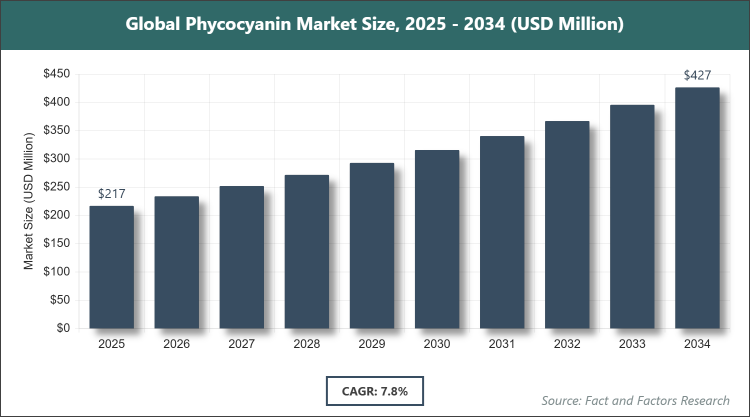
[225+ Pages Report] According to Facts & Factors, the global phycocyanin market size was estimated at USD 217 million in 2025 and is expected to reach USD 427 million by the end of 2034. The phycocyanin industry is anticipated to grow by a CAGR of 7.8% between 2026 and 2034. The phycocyanin Market is driven by increasing demand for natural food colorants.
 Market Overview
Phycocyanin is a natural pigment-protein complex derived primarily from blue-green algae such as spirulina, known for its vibrant blue color and bioactive properties. It serves as a natural colorant in food and beverages, replacing synthetic dyes, and offers health benefits including antioxidant, anti-inflammatory, and immune-boosting effects, making it valuable in nutraceuticals, cosmetics, and pharmaceuticals. The market encompasses the production, extraction, and application of phycocyanin across various industries, driven by consumer preferences for clean-label and plant-based ingredients.
Key Insights
- As per the analysis shared by our research analyst, the global phycocyanin market is estimated to grow annually at a CAGR of around 7.8% over the forecast period (2026-2034).
- In terms of revenue, the global phycocyanin market size was valued at around USD 217 Million in 2025 and is projected to reach USD 427 Million, by 2034.
- The phycocyanin market is projected to grow at a significant rate due to increasing demand for natural and clean-label products.
- Based on the form, the powder segment dominated the market with a share of 77% as it offers superior stability, ease of handling, and longer shelf life compared to liquid forms, making it ideal for incorporation into dry food products, supplements, and cosmetics.
- Based on the grade, the phycocyanin E18 segment dominated the market with a share of 57% due to its balanced purity and cost-effectiveness, suitable for a wide range of applications in food coloring and nutraceuticals where high color intensity is required without premium pricing.
- Based on the end-use, the food and beverages segment dominated the market with a share of 89% owing to the rising consumer demand for natural blue colorants in products like confectionery, dairy, and beverages, driven by regulatory restrictions on synthetic dyes.
- North America to dominate the global market with a share of 36% because of its advanced food processing industry, high consumer awareness of health benefits, and strong presence of key manufacturers focusing on clean-label innovations.
Growth Drivers
- Increasing Demand for Natural Colorants in Food and Beverages
The shift towards natural and plant-based ingredients has significantly boosted the phycocyanin market, as consumers increasingly avoid synthetic additives due to health concerns. Phycocyanin's role as a safe, vibrant blue pigment aligns with clean-label trends, enabling manufacturers to enhance product appeal without compromising on safety or quality.
This demand is further amplified by regulatory approvals in major markets like the U.S. and Europe, where phycocyanin is recognized as a natural food colorant. Its versatility in applications such as dairy, confectionery, and functional drinks supports sustained market expansion, with ongoing innovations in extraction techniques improving yield and purity to meet industry standards.
Restraints
- High Production Costs and Supply Chain Vulnerabilities
Phycocyanin extraction from algae like spirulina involves resource-intensive processes, including cultivation in controlled environments, which elevates production costs and limits scalability for smaller players. Fluctuations in raw material availability, influenced by environmental factors such as water quality and climate, can disrupt supply chains and increase prices.
These challenges are compounded by the need for specialized equipment and expertise, making it difficult to achieve cost efficiencies. As a result, higher end-product prices may deter adoption in price-sensitive markets, potentially slowing growth unless advancements in sustainable farming and biotechnology reduce dependencies on traditional sources.
Opportunities
- Expansion in Pharmaceutical and Nutraceutical Applications
Phycocyanin's antioxidant and anti-inflammatory properties present opportunities for growth in health-focused sectors, where it can be integrated into supplements and therapeutics targeting immune support and chronic disease prevention. Research highlighting its potential in cancer therapy and wound healing is attracting investments in clinical studies and product development.
This opens avenues for partnerships between algae producers and pharmaceutical firms, with emerging markets in Asia-Pacific showing promise due to rising health consciousness. Innovations in formulation, such as encapsulation for better bioavailability, could further enhance its appeal, driving premium product launches and market diversification.
Challenges
- Regulatory Hurdles and Quality Consistency Issues
Varying international regulations on natural pigments pose challenges for global market entry, requiring compliance with stringent safety and labeling standards that differ by region. Ensuring consistent quality and purity across batches is difficult due to biological variability in algae sources, potentially leading to product recalls or consumer distrust.
These issues are exacerbated by limited standardization in testing methods, which can hinder scalability and export potential. Addressing them demands investment in quality control technologies and harmonized global guidelines to build confidence among manufacturers and end-users.
Report Scope
Report Attribute |
Details |
Market Size 2025 |
USD 217 Million |
Projected Market Size in 2034 |
USD 427 Million |
CAGR Growth Rate |
7.8% CAGR |
Base Year |
2025 |
Forecast Years |
2026-2034 |
Key Market Players |
Givaudan Sense Colour, Cyanotech Corporation, AlgoSource, Bluetec Naturals Co., Ltd., DIC Corporation, Phyco-Biotech, Japan Algae Co., Ltd., Parry Nutraceuticals, and Others. |
Key Segment |
By Form, By Grade, By End-use, and By Region |
Major Regions Covered |
North America, Europe, Asia Pacific, Latin America, and the Middle East & Africa |
Purchase Options |
Request customized purchase options to meet your research needs. Explore purchase options |
Market Segmentation
The phycocyanin market is segmented by form, grade, end-use, and region.
Based on Form Segment, the phycocyanin market is divided into powder, liquid, and others. Powder is the most dominant segment, followed by liquid as the second most dominant. Powder's dominance stems from its extended shelf life, ease of transportation, and versatility in blending with dry ingredients, which drives market growth by enabling widespread use in supplements and processed foods; its stability reduces waste and supports cost-effective distribution, while liquid offers advantages in ready-to-drink applications but faces challenges in preservation.
Based on Grade Segment, the phycocyanin market is divided into phycocyanin E18, phycocyanin E25, phycocyanin E30, and others. Phycocyanin E18 is the most dominant segment, followed by phycocyanin E25 as the second most dominant. E18's dominance is due to its optimal color strength and affordability, making it a preferred choice for food coloring where vivid blue hues are essential without high costs, thus propelling market expansion through broad adoption in beverages and confectionery; E25 provides higher purity for premium applications, contributing to growth in cosmetics and pharma.
Based on End-use Segment, the phycocyanin market is divided into food and beverages, personal care and cosmetics, pharmaceuticals, animal feed, and others. Food and beverages is the most dominant segment, followed by personal care and cosmetics as the second most dominant. The food and beverages segment's dominance arises from the surge in natural colorant demand amid bans on artificial dyes, driving market growth by enhancing product aesthetics in items like yogurt and energy drinks; personal care benefits from phycocyanin's skin-nourishing properties, fostering innovation in natural beauty products.
Recent Developments
- In March 2025, DIC Corporation's U.S. subsidiary inaugurated a new facility for cultivating edible algae, advancing sustainable smart farming with an investment of approximately ¥1.2 billion to boost phycocyanin production efficiency.
- In February 2025, IIT Guwahati signed a technology transfer MoU with K.N. Bioscience (India) Pvt. Ltd. for large-scale, low-cost production of high-purity C-Phycocyanin from spirulina, enabling energy-efficient extraction and purification.
- In July 2025, a leading natural pigments company launched a high-purity phycocyanin extract tailored for functional beverages and nutraceuticals, emphasizing enhanced color stability and antioxidant benefits to meet growing clean-label demands.
- In June 2024, the U.S. FDA approved three novel phycocyanin extracts for use in food products, boosting their adoption as natural colorants in the food and beverage industry.
Regional Analysis
- North America to dominate the global market
North America dominates the phycocyanin market due to its robust food and beverage industry and high consumer preference for natural ingredients. The United States leads within the region, benefiting from advanced R&D in biotechnology and a strong focus on health supplements. This dominance is supported by favorable regulations promoting clean-label products and significant investments in algae cultivation, fostering innovation and market penetration in functional foods and cosmetics.
Europe holds a significant share in the phycocyanin market, driven by stringent regulations against synthetic dyes and a growing emphasis on sustainable sourcing. Germany and France are key contributors, with their established pharmaceutical and cosmetic sectors leveraging phycocyanin's bioactive properties. The region's commitment to organic products and environmental sustainability encourages adoption in nutraceuticals, while collaborative efforts in research enhance production techniques and expand applications.
Asia Pacific is emerging as a fast-growing region in the phycocyanin market, fueled by expanding spirulina cultivation and rising health awareness. China and India dominate, with large-scale algae farming supporting cost-effective production for exports and domestic use. The area's booming food processing and cosmetic industries capitalize on phycocyanin's natural appeal, driven by urbanization and a shift towards wellness-oriented products.
Latin America shows promising growth in the phycocyanin market, supported by abundant natural resources for algae production. Brazil leads the region, with its focus on bioeconomy initiatives and increasing demand for natural colorants in beverages. Challenges like infrastructure limitations are offset by government incentives for sustainable agriculture, positioning the area for expanded roles in global supply chains.
The Middle East & Africa region is gradually adopting phycocyanin, with potential in nutraceuticals amid rising health consciousness. South Africa and the UAE are frontrunners, exploring algae-based innovations for food security and cosmetics. Limited water resources pose challenges, but investments in arid-adapted cultivation technologies are opening opportunities for regional self-sufficiency and export.
Competitive Analysis
The global phycocyanin market is dominated by players:
- Givaudan Sense Colour
- Cyanotech Corporation
- AlgoSource
- Bluetec Naturals Co., Ltd.
- DIC Corporation
- Phyco-Biotech
- Japan Algae Co., Ltd.
- Parry Nutraceuticals
- Others
The global phycocyanin market is segmented as follows:
By Form
- Powder
- Liquid
- Others
By Grade
- Phycocyanin E18
- Phycocyanin E25
- Phycocyanin E30
- Others
By End-use
- Food and Beverages
- Personal Care and Cosmetics
- Pharmaceuticals
- Animal Feed
- Others
By Region
- North America
- The U.S.
- Canada
- Mexico
- Europe
- France
- The UK
- Spain
- Germany
- Italy
- Rest of Europe
- Asia Pacific
- China
- Japan
- India
- Australia
- Southeast Asia
- Rest of Asia Pacific
- The Middle East & Africa
- Saudi Arabia
- UAE
- Egypt
- Kuwait
- South Africa
- Rest of the Middle East & Africa
- Latin America
- Brazil
- Argentina
- Rest of Latin America
Industry Major Market Players
The global phycocyanin market is dominated by players:
- Givaudan Sense Colour
- Cyanotech Corporation
- AlgoSource
- Bluetec Naturals Co., Ltd.
- DIC Corporation
- Phyco-Biotech
- Japan Algae Co., Ltd.
- Parry Nutraceuticals
- Others



Copyright © 2025 - 2026, All Rights Reserved, Facts and Factors