
Search Market Research Report
Electric Actuator Market Size, Share Global Analysis Report, 2026-2034

Electric Actuator Market Size, Share, Growth Analysis Report By Type (Linear Electric Actuator and Rotary Electric Actuator), By Application (Industrial Automation, Automotive, Aerospace & Defense, Oil & Gas, Water & Wastewater, and Others), By End-User (Manufacturing, Energy & Utilities, Transportation, and Others), and By Region - Global Industry Insights, Overview, Comprehensive Analysis, Trends, Statistical Research, Market Intelligence, Historical Data and Forecast 2026-2034
Industry Insights
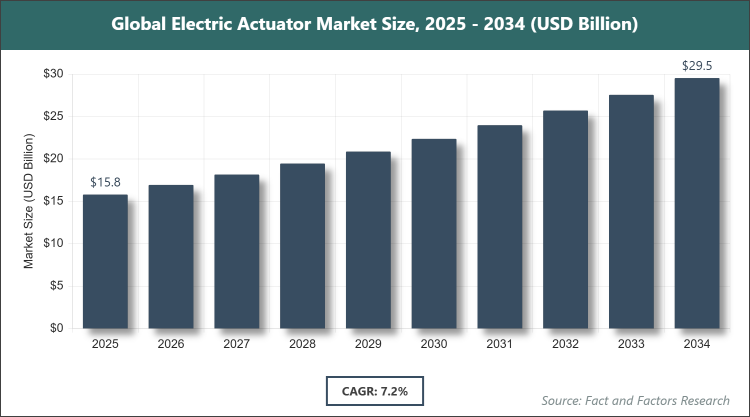
[229 + Pages Report] According to Facts & Factors, the global Electric Actuator market size was estimated at USD 15.8 billion in 2025 and is expected to reach USD 29.6 billion by the end of 2034. The Electric Actuator industry is anticipated to grow by a CAGR of 7.2% between 2026 and 2034. The Electric Actuator Market is driven by accelerating industrial automation, Industry 4.0 adoption, and demand for energy-efficient motion control solutions across manufacturing and process industries.
 Market Overview
The Electric Actuator market involves electromechanical devices that convert electrical energy into linear or rotary motion to control valves, dampers, gates, and other mechanical components with high precision and repeatability. These actuators eliminate the need for hydraulic or pneumatic systems by using electric motors, gears, and feedback sensors, offering cleaner operation, lower maintenance, superior positioning accuracy, and seamless integration with digital control systems. Widely deployed in automated production lines, process plants, vehicle systems, and infrastructure projects, electric actuators enable remote operation, real-time monitoring, and predictive maintenance through IoT connectivity, supporting the global shift toward sustainable, intelligent, and energy-efficient automation solutions.
Key Insights
- As per the analysis shared by our research analyst, the Electric Actuator market is estimated to grow annually at a CAGR of around 7.2% over the forecast period (2026-2034).
- In terms of revenue, the Electric Actuator market size was valued at around USD 15.8 billion in 2025 and is projected to reach USD 29.6 billion by 2034.
- The Electric Actuator Market is driven by the rapid adoption of Industry 4.0 and demand for precise, energy-efficient motion control.
- Based on the Type, the Linear Electric Actuator segment dominated the market in 2025 with a share of 58% due to its versatility in providing accurate straight-line motion required in valve control and material handling applications.
- Based on the Application, the Industrial Automation segment dominated the market in 2025 with a share of 42%, owing to widespread integration in smart factories and process optimization initiatives.
- Based on the End-User, the Manufacturing segment dominated the market in 2025 with a share of 46% because ofthe continuous need for high-precision actuation in assembly lines and robotics.
- Asia Pacific dominated the global Electric Actuator market in 2025 with a share of 38%, attributed to massive manufacturing expansion, government pushes for automation, and the strong presence of electronics and automotive industries in China and India.
Growth Drivers
- Industry 4.0 and Smart Manufacturing Adoption
The transition to connected factories requires actuators with digital interfaces, sensors, and IIoT compatibility for real-time data exchange and predictive maintenance, driving the replacement of legacy pneumatic and hydraulic systems.
Rising labor costs and the need for consistent quality in high-volume production further accelerate the deployment of electric actuators across automotive, electronics, and consumer goods manufacturing.
Restraints
- High Initial Cost Compared to Pneumatic Alternatives
Advanced electric actuators with integrated controls and feedback systems carry a higher upfront investment, deterring small and medium enterprises in cost-sensitive regions.
Perceived complexity in retrofitting existing infrastructure and longer payback periods in low-utilization applications slow broader market penetration.
Opportunities
- Growth in Electric Vehicles and Renewable Energy Infrastructure
Expanding EV production demands precise linear and rotary actuators for battery handling, seat adjustment, and charging systems, while solar tracking and wind turbine pitch control create new high-volume opportunities.
Government incentives for green infrastructure and hydrogen projects further boost demand for reliable, low-maintenance electric actuation solutions.
Challenges
- Technical Integration and Cybersecurity Risks
Seamless integration of electric actuators with diverse PLCs and SCADA systems requires specialized engineering expertise that remains limited in many regions.
Increasing connectivity raises cybersecurity vulnerabilities in critical infrastructure applications, necessitating additional investment in secure communication protocols.
Report Scope
Report Attribute |
Details |
Market Size 2025 |
USD 15.8 Billion |
Projected Market Size in 2034 |
USD 29.6 Billion |
CAGR Growth Rate |
7.2% CAGR |
Base Year |
2025 |
Forecast Years |
2026-2034 |
Key Market Players |
Emerson Electric Co., Rotork plc, ABB Ltd., AUMA Riester GmbH & Co. KG, Flowserve Corporation, Curtiss-Wright Corporation, Moog Inc., SKF, Parker Hannifin Corporation, SMC Corporation, and Others. |
Key Segment |
By Type, By Application, By End-User, and By Region |
Major Regions Covered |
North America, Europe, Asia Pacific, Latin America, and the Middle East & Africa |
Purchase Options |
Request customized purchase options to meet your research needs. Explore purchase options |
Market Segmentation
The Electric Actuator market is segmented by type, application, end-user, and region.
Based on Type Segment, the Electric Actuator market is divided into linear electric actuator and rotary electric actuator. The most dominant segment is the Linear Electric Actuator, driven by extensive use in valve positioning and push-pull mechanisms. The second most dominant is the Rotary Electric Actuator, essential for quarter-turn and multi-turn operations. Linear Electric Actuator dominates due to its superior precision in linear displacement control required across process industries and automation lines, helping drive market growth by enabling compact designs, energy savings, and easy integration with modern control architectures that reduce overall system complexity.
Based on Application Segment, the Electric Actuator market is divided into industrial automation, automotive, aerospace & defense, oil & gas, water & wastewater, and others. The most dominant segment is Industrial Automation, fueled by smart factory initiatives worldwide. The second most dominant is Automotive, supported by vehicle electrification trends. Industrial Automation leads because it addresses core requirements for speed, accuracy, and repeatability in modern production environments, propelling market expansion through higher productivity gains and reduced downtime in high-volume manufacturing facilities.
Based on End-User Segment, the electric actuator market is divided into manufacturing, energy & utilities, transportation, and others. The most dominant segment is Manufacturing, owing to heavy reliance on automated machinery and robotics. The second most dominant is Energy & Utilities, driven by valve and damper control needs. Manufacturing dominates due to its scale of operations and continuous push for operational excellence, driving market growth by generating steady demand for durable, high-cycle actuators that support 24/7 production reliability and digital transformation goals.
Recent Developments
- In January 2025, Emerson Electric Co. launched the ASCO Series 148/149 motorized actuators specifically engineered for industrial fuel oil burner safety shutoff applications.
- In March 2025, Rotork expanded its IQ3 Pro electric actuator range with enhanced EtherNet/IP connectivity through collaboration with Rockwell Automation.
- In May 2025, AUMA Riester introduced the new SA/SAR series with improved diagnostics and IIoT-ready features for water and wastewater treatment plants.
- In July 2025, Curtiss-Wright Corporation released an expanded hygienic version of its Exlar electric actuators featuring FDA-approved materials for food and pharmaceutical processing.
- In September 2025, ABB Ltd. unveiled compact electric actuators with integrated condition monitoring for predictive maintenance in oil & gas pipeline infrastructure.
Regional Analysis
- Asia Pacific to dominate the global market
Asia Pacific commands the Electric Actuator market through its position as the global manufacturing powerhouse, supported by massive investments in automation across China, India, Japan, and South Korea. The region benefits from favorable government policies promoting smart manufacturing and rapid infrastructure development. China dominates within the Asia Pacific, leveraging its extensive electronics, automotive, and heavy machinery sectors along with state-backed Industry 4.0 programs that prioritize domestic production of high-precision electric actuators, fostering technology localization and export competitiveness.
North America holds a substantial share in the Electric Actuator market, underpinned by technological leadership in aerospace, defense, and advanced automation. Strong focus on R&D and stringent performance standards drive the adoption of premium intelligent actuators. The United States leads the region, with its robust semiconductor and EV supply chains demanding ultra-reliable motion control solutions, supported by reshoring initiatives and defense modernization programs that sustain consistent demand for sophisticated electric actuation systems.
Europe exhibits steady growth in the Electric Actuator market, driven by strict energy efficiency regulations and emphasis on sustainable industrial practices. Collaborative innovation ecosystems accelerate the development of next-generation actuators. Germany dominates, capitalizing on its world-class engineering heritage and leadership in automotive and machinery manufacturing, where electric actuators are integral to precision robotics and green energy applications under ambitious decarbonization targets.
Latin America is experiencing a gradual expansion in the Electric Actuator market, supported by growing oil & gas activities and infrastructure modernization projects. Brazil leads, with its expanding industrial base and water management initiatives adopting electric actuators for improved efficiency and remote operability in challenging environments.
The Middle East & Africa region shows promising uptake in the Electric Actuator market, fueled by diversification away from oil dependency and large-scale infrastructure projects. The United Arab Emirates dominates, implementing smart-city and industrial automation strategies that incorporate advanced electric actuators for water desalination, power generation, and automated facilities.
Competitive Analysis
The global Electric Actuator market is dominated by players:
- Emerson Electric Co.
- Rotork plc
- ABB Ltd.
- AUMA Riester GmbH & Co. KG
- Flowserve Corporation
- Curtiss-Wright Corporation
- Moog Inc.
- SKF (Ewellix)
- Parker Hannifin Corporation
- SMC Corporation
The global Electric Actuator market is segmented as follows:
By Type
- Linear Electric Actuator
- Rotary Electric Actuator
By Application
- Industrial Automation
- Automotive
- Aerospace & Defense
- Oil & Gas
- Water & Wastewater
By End-User
- Manufacturing
- Energy & Utilities
- Transportation
- Others
By Region
- North America
- The U.S.
- Canada
- Mexico
- Europe
- France
- The UK
- Spain
- Germany
- Italy
- Rest of Europe
- Asia Pacific
- China
- Japan
- India
- Australia
- Southeast Asia
- Rest of Asia Pacific
- The Middle East & Africa
- Saudi Arabia
- UAE
- Egypt
- Kuwait
- South Africa
- Rest of the Middle East & Africa
- Latin America
- Brazil
- Argentina
- Rest of Latin America
Industry Major Market Players
- Emerson Electric Co.
- Rotork plc
- ABB Ltd.
- AUMA Riester GmbH & Co. KG
- Flowserve Corporation
- Curtiss-Wright Corporation
- Moog Inc.
- SKF (Ewellix)
- Parker Hannifin Corporation
- SMC Corporation



Copyright © 2025 - 2026, All Rights Reserved, Facts and Factors