
Search Market Research Report
E-Passport and E-Visa Market Size, Share Global Analysis Report, 2026-2034

E-Passport and E-Visa Market Size, Share, Growth Analysis Report By Type (E-Passport and E-Visa), By Application (Leisure Travel, Business Travel, Foreign Affairs, and Others), By End-User (Government, Individuals, and Others), and By Region - Global Industry Insights, Overview, Comprehensive Analysis, Trends, Statistical Research, Market Intelligence, Historical Data and Forecast 2026-2034
Industry Insights
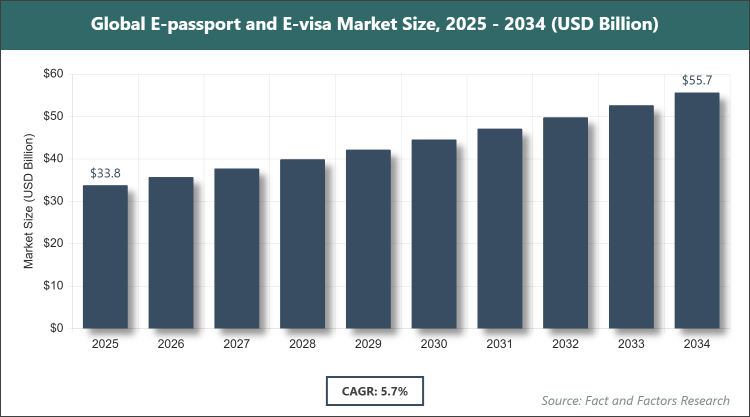
[238+ Pages Report] According to Facts & Factors, the global e-passport and e-visa market size was estimated at USD 33.8 billion in 2025 and is expected to reach USD 57.9 billion by the end of 2034. The e-passport and e-visa industry is anticipated to grow by a CAGR of 5.7% between 2026 and 2034. The e-passport and e-visa Market is driven by increasing international travel and heightened security concerns.
 Market Overview
The e-passport and e-visa market encompasses digital solutions designed to enhance border security, streamline immigration processes, and facilitate seamless international travel. E-passports, also known as biometric passports, integrate electronic chips containing personal data, biometrics like fingerprints or facial recognition, and security features to prevent forgery and identity theft. E-visas, on the other hand, are electronic authorizations issued online, eliminating the need for physical stamps or labels in passports and enabling faster application and approval via digital platforms. This market integrates advanced technologies such as RFID, biometrics, and secure software systems to support governments in managing cross-border movements efficiently while addressing global mobility demands.
Key Insights
- As per the analysis shared by our research analyst, the global e-passport and e-visa market is estimated to grow annually at a CAGR of around 5.7% over the forecast period (2026-2034).
- In terms of revenue, the global e-passport and e-visa market size was valued at around USD 33.8 Billion in 2025 and is projected to reach USD 57.9 Billion, by 2034.
- The e-passport and e-visa market is driven by rising concerns over border security and identity fraud, coupled with the surge in international tourism and business travel.
- Based on the type, the E-Passport segment dominated with a 65% share due to its widespread adoption for enhanced document security and biometric integration.
- Based on the application, the Leisure Travel segment dominated with a 60% share owing to the post-pandemic recovery in global tourism and simplified visa processes.
- Based on the end-user, the Government segment dominated with a 55% share because of its role in issuing, regulating, and implementing secure travel documentation systems.
- Europe dominated the global market with a 35% share, attributed to advanced digital infrastructure, unified EU regulations, and high adoption of biometric technologies.
Growth Drivers
-
Increasing Border Security Concerns
The escalating need for robust border control mechanisms has propelled the adoption of e-passports and e-visas worldwide. Governments are investing in these technologies to combat identity fraud, terrorism, and illegal immigration, as they offer tamper-proof features like embedded chips and biometric verification. This shift not only enhances national security but also improves the accuracy of traveler identification at checkpoints.
Moreover, the integration of AI and machine learning in verification processes further strengthens these systems, reducing human error and speeding up processing times. As international threats evolve, the demand for such advanced solutions continues to rise, driving market expansion across developed and emerging economies.
- Surge in International Travel and Tourism
The recovery of global travel post-pandemic has significantly boosted the e-passport and e-visa market. With more people engaging in leisure and business trips, there is a pressing need for efficient, contactless immigration procedures. E-visas, in particular, simplify applications by allowing online submissions, reducing wait times at embassies and enabling faster approvals.
This trend is supported by airline and tourism industries advocating for digital solutions to handle increased passenger volumes. Additionally, partnerships between governments and tech firms are facilitating seamless integration, making travel more accessible and contributing to economic growth through tourism revenue.
- Technological Advancements in Biometrics and RFID
Innovations in biometric technologies, such as facial recognition and fingerprint scanning, are key drivers for the market. These advancements ensure higher security levels and user convenience, encouraging widespread implementation. RFID chips in e-passports allow for quick data reading, minimizing queues at borders and enhancing the overall travel experience.
Furthermore, ongoing R&D in secure data encryption and cloud-based systems is addressing interoperability issues between countries. This technological progress not only meets regulatory standards but also builds public trust in digital travel documents, fostering greater market penetration.
Restraints
- High Implementation Costs
The substantial initial investment required for infrastructure upgrades poses a significant barrier to market growth. Developing countries, in particular, face challenges in funding the transition to electronic systems, including hardware procurement and training for personnel. This financial burden can delay widespread adoption and limit market expansion in resource-constrained regions.
Additionally, maintenance and cybersecurity measures add to ongoing expenses, deterring smaller governments from fully embracing these technologies. While long-term benefits like efficiency gains exist, the upfront costs remain a deterrent, impacting the pace of global rollout.
- Privacy and Data Security Concerns
Growing apprehensions over data breaches and misuse of personal information restrain market progress. With e-passports storing sensitive biometric data, vulnerabilities to hacking could lead to identity theft or surveillance issues. Public skepticism and regulatory scrutiny further complicate implementation, as compliance with data protection laws like GDPR becomes essential.
These concerns necessitate robust security protocols, which can increase complexity and costs. Until trust is fully established through transparent practices and advanced encryption, hesitation from both governments and citizens may slow adoption rates.
Opportunities
- Expansion in Emerging Markets
Rapid urbanization and economic growth in Asia-Pacific and Latin America present lucrative opportunities for market players. These regions are witnessing increased international connectivity, prompting governments to modernize immigration systems. Investments in digital infrastructure could accelerate e-passport and e-visa adoption, tapping into untapped potential.
Collaborations with local tech firms can facilitate customized solutions, addressing specific regional needs. As these economies integrate into global trade, the demand for efficient travel documentation will surge, creating avenues for innovation and revenue growth.
- Integration with Smart City Initiatives
The alignment of e-passport and e-visa systems with smart city projects offers new growth prospects. Urban areas are leveraging IoT and AI for seamless services, where digital travel documents can integrate with public transport and security networks. This holistic approach enhances user experience and operational efficiency.
Such integrations could attract investments from tech giants, fostering partnerships that drive market evolution. As cities prioritize sustainability and connectivity, these opportunities will likely expand the application's scope beyond traditional borders.
Challenges
- Interoperability Issues Between Systems
The lack of standardized protocols across countries hinders seamless global implementation. Differences in technology stacks can cause compatibility problems at international borders, leading to delays and frustrations for travelers. Achieving universal standards requires international cooperation, which is often slow due to varying priorities.
This challenge affects market confidence and adoption, as inconsistencies undermine the benefits of digital systems. Ongoing efforts by organizations like ICAO aim to address this, but progress remains gradual.
- Regulatory and Compliance Hurdles
Navigating diverse regulatory landscapes poses ongoing challenges for market participants. Each country has unique requirements for data handling and security, complicating global operations. Compliance with evolving laws demands continuous adaptation, increasing operational complexities and costs.
These hurdles can delay product launches and expansions, impacting competitiveness. Strengthening international agreements could mitigate this, but until then, companies must invest in legal expertise to manage risks effectively.
Report Scope
Report Attribute |
Details |
Market Size 2025 |
USD 33.8 Billion |
Projected Market Size in 2034 |
USD 57.9 Billion |
CAGR Growth Rate |
5.7% CAGR |
Base Year |
2025 |
Forecast Years |
2026-2034 |
Key Market Players |
Thales Group, IDEMIA, Veridos GmbH, Gemalto, Entrust Corporation, HID Global Corporation, Giesecke+Devrient GmbH, De La Rue Plc, Muehlbauer GmbH & Co., Infineon Technologies AG, and Others. |
Key Segment |
By Type, By Application, By End-User, and By Region |
Major Regions Covered |
North America, Europe, Asia Pacific, Latin America, and the Middle East & Africa |
Purchase Options |
Request customized purchase options to meet your research needs. Explore purchase options |
Market Segmentation
The e-passport and e-visa market is segmented by type, application, end-user, and region.
Based on Type Segment, the e-passport and e-visa market is divided into E-Passport, E-Visa. The most dominant segment is E-Passport, which holds the largest share due to its mandatory adoption by many governments for secure international travel and its integration of advanced biometrics that prevent counterfeiting. The second most dominant is E-Visa, driven by the convenience of online processing that reduces administrative burdens and accelerates approvals, thereby boosting global mobility and tourism recovery.
Based on Application Segment, the e-passport and e-visa market is divided into Leisure Travel, Business Travel, Foreign Affairs, and Others. The most dominant segment is Leisure Travel, accounting for the majority as it caters to the booming tourism industry where quick and secure visa processes enhance traveler experiences and encourage repeat visits. The second most dominant is Business Travel, which benefits from streamlined e-visas that facilitate corporate movements, reduce downtime, and support economic activities like conferences and trade deals.
Based on End-User Segment, the e-passport and e-visa market is divided into Government, Individuals, and Others. The most dominant segment is Government, leading due to its central role in policy-making, issuance, and enforcement of secure documentation that ensures national security and efficient border management. The second most dominant is Individuals, as they directly benefit from user-friendly digital applications that simplify personal travel planning and reduce processing times.
Recent Developments
- In 2025, the European Union announced the expansion of its ETIAS (European Travel Information and Authorization System), integrating advanced biometric checks for e-visas to enhance security for non-EU travelers entering the Schengen area.
- In early 2026, India launched an upgraded e-visa platform with AI-driven processing, reducing approval times to under 48 hours and incorporating facial recognition for seamless integration with e-passports.
- Thales Group partnered with the U.S. Department of Homeland Security in 2025 to deploy next-generation e-passport chips featuring enhanced encryption, aiming to combat identity fraud at borders.
Regional Analysis
-
Europe to dominate the global market
Europe maintains its leadership in the e-passport and e-visa market, driven by sophisticated digital frameworks and collaborative policies across member states. The region's emphasis on unified standards, such as those set by the EU, facilitates seamless cross-border travel. Germany stands out as the dominating country, with its advanced manufacturing capabilities and early adoption of biometric technologies ensuring efficient implementation. Investments in cybersecurity further bolster confidence, while initiatives like the EU Digital Identity Wallet integrate e-passports into everyday services, promoting innovation and accessibility.
North America exhibits strong growth, supported by robust technological infrastructure and stringent security measures. The United States dominates this region, leveraging partnerships with tech firms to enhance e-visa systems and border automation. Canada's contributions through programs like ETA complement this, focusing on efficient processing for international visitors. The emphasis on data privacy and AI integration addresses emerging threats, making the region a hub for pilot projects that influence global standards.
Asia Pacific is emerging rapidly, fueled by economic expansion and increasing outbound tourism. China leads as the dominating country, with massive investments in smart borders and e-visa platforms that handle high volumes of travelers. India's digital initiatives, such as Aadhaar-linked biometrics, accelerate adoption, while Japan's focus on precision technology ensures reliability. The region's diverse needs drive customized solutions, positioning it for significant future contributions.
Latin America shows promising potential, with efforts to modernize immigration amid growing tourism. Brazil dominates, implementing e-visas to attract visitors and integrating biometrics for security. Mexico's collaborations with North American partners enhance interoperability, reducing processing delays. Challenges like infrastructure gaps are being addressed through international aid, paving the way for broader digital adoption.
The Middle East & Africa region is advancing steadily, prioritizing security in high-traffic hubs. The United Arab Emirates dominates, with Dubai's smart city integrations exemplifying e-visa efficiency for global events. South Africa's biometric systems support regional travel, while investments from Gulf states in technology partnerships drive progress. Despite varying development levels, the focus on tourism and trade fosters gradual market maturation.
Competitive Analysis
The global e-passport and e-visa market is dominated by players:
- Thales Group
- IDEMIA
- Veridos GmbH
- Gemalto
- Entrust Corporation
- HID Global Corporation
- Giesecke+Devrient GmbH
- De La Rue Plc
- Muehlbauer GmbH & Co.
- Infineon Technologies AG
The global e-passport and e-visa market is segmented as follows:
By Type
- E-Passport
- E-Visa
By Application
- Leisure Travel
- Business Travel
- Foreign Affairs
- Others
By End-User
- Government
- Individuals
- Others
By Region
- North America
- The U.S.
- Canada
- Mexico
- Europe
- France
- The UK
- Spain
- Germany
- Italy
- Rest of Europe
- Asia Pacific
- China
- Japan
- India
- Australia
- Southeast Asia
- Rest of Asia Pacific
- The Middle East & Africa
- Saudi Arabia
- UAE
- Egypt
- Kuwait
- South Africa
- Rest of the Middle East & Africa
- Latin America
- Brazil
- Argentina
- Rest of Latin America
Industry Major Market Players
The global e-passport and e-visa market is dominated by players:
- Thales Group
- IDEMIA
- Veridos GmbH
- Gemalto
- Entrust Corporation
- HID Global Corporation
- Giesecke+Devrient GmbH
- De La Rue Plc
- Muehlbauer GmbH & Co.
- Infineon Technologies AG



Copyright © 2025 - 2026, All Rights Reserved, Facts and Factors