
Search Market Research Report
Composite Hose Market Size, Share Global Analysis Report, 2026-2034

Composite Hose Market Size, Share, Growth Analysis Report By Type (Chemical Composite Hose, Oil Composite Hose, Cryogenic Composite Hose, and Others), By Application (Chemical Transfer, Oil & Gas Transfer, Food & Beverage, Pharmaceutical, and Others), By End-User (Marine, Industrial, Automotive, Agriculture, and Others), and By Region - Global Industry Insights, Overview, Comprehensive Analysis, Trends, Statistical Research, Market Intelligence, Historical Data and Forecast 2026-2034
Industry Insights
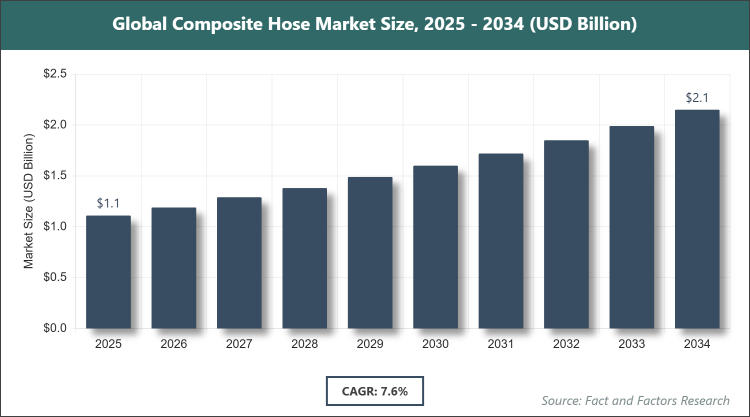
[220+ Pages Report] According to Facts & Factors, the global Composite Hose market size was estimated at USD 1.11 billion in 2025 and is expected to reach USD 2.15 billion by the end of 2034. The Composite Hose industry is anticipated to grow by a CAGR of 7.6% between 2026 and 2034. The Composite Hose Market is driven by increasing demand for safe and efficient fluid transfer in the chemical and oil industries.
 Market Overview
The composite hose market encompasses the production, distribution, and application of flexible hoses constructed from multiple layers of thermoplastic films, fabrics, and helical wires, designed for the safe transfer of hazardous fluids such as chemicals, oils, and gases in demanding environments. These hoses offer superior resistance to corrosion, abrasion, and extreme temperatures compared to traditional rubber or metal hoses, making them essential in industries requiring lightweight, durable, and kink-resistant solutions for fluid handling. The market focuses on innovations in material compositions to enhance safety, compliance with stringent regulations, and customization for specific applications, while addressing sustainability through recyclable components and reduced environmental impact in manufacturing processes.
Key Insights
- As per the analysis shared by our research analyst, the global Composite Hose market is estimated to grow annually at a CAGR of around 7.6% over the forecast period (2026-2034).
- In terms of revenue, the global Composite Hose market size was valued at around USD 1.11 billion in 2025 and is projected to reach USD 2.15 billion by 2034.
- The Composite Hose market is projected to witness significant growth due to expanding chemical and petrochemical industries requiring robust fluid transfer solutions.
- Based on the Type, the Chemical Composite Hose segment accounted for the largest market share of 45% due to its high resistance to corrosive substances in chemical handling.
- Based on the Application, the Chemical Transfer segment dominated the market with the highest share, owing to stringent safety regulations in hazardous material transport.
- Based on the End-User, the Industrial segment held the leading position with a substantial share because of widespread use in manufacturing and processing plants.
- Based on the region, the Asia Pacific region captured around 35% market share, driven by rapid industrialization and growth in the oil & gas sectors.
Growth Drivers
- Expanding Chemical and Petrochemical Industries
The surge in chemical production and transportation globally is propelling demand for composite hoses, valued for their chemical resistance and flexibility in handling aggressive fluids without degradation. This growth is fueled by industrial expansion in emerging economies, where infrastructure projects require reliable transfer systems. Innovations in hose design, such as multi-layer reinforcements, enhance durability and safety, reducing leakage risks.
Additionally, regulatory mandates for safer handling of hazardous materials encourage adoption, fostering partnerships between manufacturers and end-users. This driver sustains market momentum by aligning with industrial safety priorities, expanding applications in refineries and storage terminals.
Restraints
- High Initial Costs
The premium pricing of composite hoses due to advanced materials and manufacturing processes limits adoption in cost-sensitive sectors, particularly small enterprises. Volatility in raw material prices, like thermoplastics, further escalates expenses. Competition from cheaper alternatives like rubber hoses hinders penetration.
Moreover, limited awareness in developing regions delays uptake. These factors constrain growth, necessitating value demonstrations and financing options to overcome barriers.
Opportunities
- Advancements in Sustainable Materials
Development of eco-friendly composite hoses using recyclable polymers offers differentiation, appealing to green initiatives in industries. Government incentives for sustainable practices accelerate innovation. This trend opens markets in renewable energy fluid transfer.
Furthermore, R&D collaborations yield lighter, more efficient designs. This opportunity enhances competitiveness, driving adoption in environmentally regulated sectors.
Challenges
- Stringent Regulatory Compliance
Varying international standards for hose safety and performance require extensive testing, increasing time-to-market and costs. Evolving environmental regulations add complexity. Supply chain disruptions affect compliance timelines.
In addition, technical limitations in extreme conditions challenge reliability. These issues demand adaptive strategies and global harmonization efforts.
Report Scope
Report Attribute |
Details |
Market Size 2025 |
USD 1.11 Billion |
Projected Market Size in 2034 |
USD 2.15 Billion |
CAGR Growth Rate |
7.6% CAGR |
Base Year |
2025 |
Forecast Years |
2026-2034 |
Key Market Players |
Trelleborg AB, Alfagomma S.p.A., Bridgestone Corporation, Parker Hannifin Corporation, Semperit AG Holding, Novaflex Group, Gutteling B.V., Flextral, Dantec Ltd., United Flexible Inc., and Others. |
Key Segment |
By Type, By Application, By End-User, and By Region |
Major Regions Covered |
North America, Europe, Asia Pacific, Latin America, and the Middle East & Africa |
Purchase Options |
Request customized purchase options to meet your research needs. Explore purchase options |
Market Segmentation
The Composite Hose market is segmented by type, application, end-user, and region.
Based on Type Segment, the Composite Hose market is divided into Chemical Composite Hose, Oil Composite Hose, Cryogenic Composite Hose, and others. The most dominant segment is Chemical Composite Hose, which holds the largest share due to its specialized construction for corrosive chemicals, driving the market by ensuring safe transfer in high-risk environments; the second most dominant is Oil Composite Hose, essential for petroleum handling, contributing to market growth through durability in oil & gas operations.
Based on Application Segment, the Composite Hose market is divided into Chemical Transfer, Oil & Gas Transfer, Food & Beverage, Pharmaceutical, and others. The most dominant segment is Chemical Transfer, commanding the highest share because of regulatory needs for secure handling, which drives the market by reducing accident risks; the second most dominant is Oil & Gas Transfer, used for efficient fluid movement, propelling market expansion via energy sector demands.
Based on the end-user segment, the Composite Hose market is divided into Marine, Industrial, Automotive, Agriculture, and others. The most dominant segment is Industrial, holding the biggest share due to broad applications in manufacturing, driving the market by supporting diverse fluid systems; the second most dominant is Marine, for ship-to-shore transfers, contributing to market growth amid global trade increases.
Recent Developments
- In 2024, Trelleborg expanded its composite hose line with enhanced cryogenic capabilities, targeting LNG transfer applications.
- In 2025, Parker Hannifin introduced sustainable composite hoses made from recycled materials, aligning with environmental regulations.
Regional Analysis
- Asia Pacific to dominate the global market
Asia Pacific leads the composite hose market, dominated by China through its massive industrial base and export-driven chemical sector that fuels demand for durable transfer solutions. Rapid infrastructure development enhances adoption in oil & gas, while government policies promote safety standards. China's dominance stems from low-cost manufacturing and supply chain integration.
North America exhibits strength with technological innovations, led by the United States via stringent regulations and energy sector growth. Investments in shale gas drive hose advancements. The U.S. leads through R&D ecosystems and compliance frameworks.
Europe maintains focus on sustainability, with Germany dominating via engineering expertise in high-performance hoses. EU green deals encourage eco-friendly designs. Germany's position strengthens from export markets.
Latin America grows with resource extraction, led by Brazil through oil industry expansions. Foreign investments bolster infrastructure. Brazil's dominance arises from natural resources.
The Middle East & Africa advances via energy hubs, with Saudi Arabia dominating through petrochemical diversification. Vision 2030 supports industrial growth. Saudi Arabia's lead comes from strategic investments.
Competitive Analysis
The global Composite Hose market is dominated by players:
- Trelleborg AB
- Alfagomma S.p.A.
- Bridgestone Corporation
- Parker Hannifin Corporation
- Semperit AG Holding
- Novaflex Group
- Gutteling B.V.
- Flextral
- Dantec Ltd.
- United Flexible Inc.
The global Composite Hose market is segmented as follows:
By Type
- Chemical Composite Hose
- Oil Composite Hose
- Cryogenic Composite Hose
- Others
By Application
- Chemical Transfer
- Oil & Gas Transfer
- Food & Beverage
- Pharmaceutical
- Others
By End-User
- Marine
- Industrial
- Automotive
- Agriculture
- Others
By Region
- North America
- The U.S.
- Canada
- Mexico
- Europe
- France
- The UK
- Spain
- Germany
- Italy
- Rest of Europe
- Asia Pacific
- China
- Japan
- India
- Australia
- Southeast Asia
- Rest of Asia Pacific
- The Middle East & Africa
- Saudi Arabia
- UAE
- Egypt
- Kuwait
- South Africa
- Rest of the Middle East & Africa
- Latin America
- Brazil
- Argentina
- Rest of Latin America
Industry Major Market Players
- Trelleborg AB
- Alfagomma S.p.A.
- Bridgestone Corporation
- Parker Hannifin Corporation
- Semperit AG Holding
- Novaflex Group
- Gutteling B.V.
- Flextral
- Dantec Ltd.
- United Flexible Inc



Copyright © 2025 - 2026, All Rights Reserved, Facts and Factors