
Search Market Research Report
Calcium Aluminate Cement Market Size, Share Global Analysis Report, 2026-2034

Calcium Aluminate Cement Market Size, Share, Growth Analysis Report By Type (CAC 40, CAC 50, CAC 60, CAC 70, Others), By Application (Durability and Strength, High-Heat Resistance, Chemical Resistance, Others), By End-User (Construction, Oil and Gas, Refractory, Water and Wastewater Treatment, Others), and By Region - Global Industry Insights, Overview, Comprehensive Analysis, Trends, Statistical Research, Market Intelligence, Historical Data and Forecast 2026-2034
Industry Insights
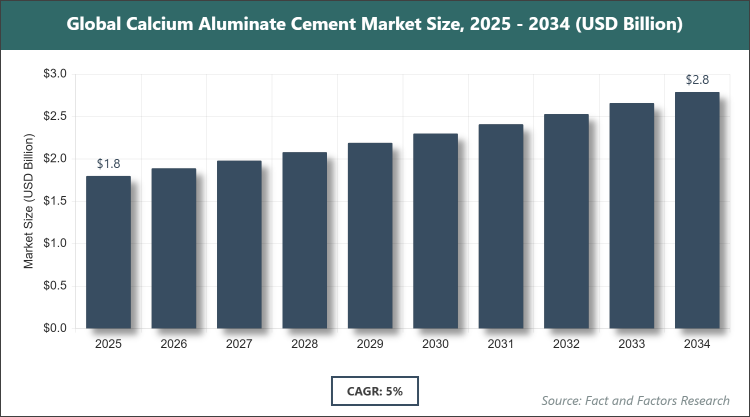
[250+ Pages Report] According to Facts & Factors, the global Calcium Aluminate Cement market size was estimated at USD 1.8 billion in 2025 and is expected to reach USD 2.8 billion by 2034, growing at a CAGR of 5.0% from 2026 to 2034. Calcium Aluminate Cement Market is driven by growing demand in refractory applications and construction sector.
 Market Overview
Calcium aluminate cement is a specialized hydraulic binder produced by fusing or sintering limestone and alumina-rich materials at high temperatures, resulting in a clinker that is ground into a fine powder known for its rapid setting, high early strength, and exceptional resistance to heat, chemicals, and corrosion, making it suitable for applications where ordinary Portland cement would fail, such as in refractory castables, sewage systems, and industrial flooring. This cement type stands out due to its unique mineralogical composition, primarily consisting of calcium aluminates rather than silicates, which enables quick hydration and hardening even in adverse conditions, facilitating its use in emergency repairs, high-temperature environments, and aggressive chemical settings without the typical limitations associated with conventional cements.
Key Insights
- The Calcium Aluminate Cement market was valued at USD 1.8 Billion in 2025 and is projected to reach USD 2.8 Billion by the end of 2034.
- The market is expected to grow at a CAGR of 5.0% between 2026 and 2034.
- The Calcium Aluminate Cement market is driven by growing demand in refractory applications and construction sector.
- Based on the Type segment, the CAC 40 subsegment dominated the market in 2025 with a share of 41.4% because of its optimal balance of rapid setting and cost-effectiveness for general construction and repair works.
- Based on the Application segment, the Durability and Strength subsegment dominated the market in 2025 with a share of 50.0% because of its critical role in infrastructure projects requiring long-lasting performance under heavy loads.
- Based on the End-User segment, the Refractory subsegment dominated the market in 2025 with a share of 55.2% because of high demand in steel and cement industries for heat-resistant linings.
- Asia Pacific held the largest market share of 49.7% in 2025 due to rapid industrialization, infrastructure development, and major steel production in countries like China and India.
Growth Drivers
- Growing Demand in Refractory Applications
The expansion of steel, cement, and petrochemical industries has heightened the need for high-temperature resistant materials, where calcium aluminate cement excels in forming durable refractory castables and linings that withstand extreme conditions.
This driver is amplified by global industrialization trends, particularly in emerging economies, leading to increased investments in furnace and kiln constructions that rely on CAC for enhanced thermal stability and reduced downtime.
- Rising Infrastructure and Construction Activities
Urbanization and government-funded projects for roads, bridges, and wastewater systems drive demand for rapid-setting cements like CAC, which enable faster project completion and superior performance in corrosive environments. This is supported by sustainability initiatives favoring materials with lower carbon footprints and better longevity, positioning CAC as a preferred choice in modern construction practices.
- Advancements in Product Innovation
Development of low-cement and ultra-low cement formulations improves workability and strength, attracting applications in specialized sectors like mining and oil & gas. These innovations foster market growth by addressing environmental concerns through reduced clinker content and enhanced efficiency, appealing to eco-conscious industries.
Restraints
- High Production Costs Compared to Alternatives
The energy-intensive manufacturing process and reliance on high-purity raw materials like bauxite elevate costs, making CAC less competitive against Portland cement in price-sensitive markets. This restraint limits widespread adoption, particularly in developing regions where budget constraints prioritize affordable options, impacting overall market penetration.
- Availability of Substitutes
Alternatives like slag cement and fly ash offer similar properties at lower costs, diverting demand from CAC in non-specialized applications. This challenge intensifies competition, requiring CAC producers to differentiate through performance advantages, but potentially eroding market share in general construction.
Opportunities
- Expansion in Emerging Markets
Rapid urbanization in Asia-Pacific and Latin America presents opportunities for CAC in infrastructure and industrial projects, where durable materials are essential. This can be leveraged through localized production and partnerships, tapping into government initiatives for sustainable development.
- Sustainability-Focused Innovations
Shifting to circular economy practices, such as using recycled alumina, offers opportunities to meet regulatory demands for low-emission cements. This aligns with global green building trends, enabling premium pricing and entry into high-value segments like eco-friendly refractories.
Challenges
- Environmental Regulations on Emissions
Stringent CO2 emission standards challenge energy-heavy production, necessitating investments in cleaner technologies. This increases operational costs, potentially delaying expansions in regulated regions like Europe.
- Supply Chain Vulnerabilities
Dependence on bauxite imports exposes the market to geopolitical risks and price fluctuations. This requires diversified sourcing, straining smaller manufacturers and affecting supply stability.
Report Scope
Report Attribute |
Details |
Market Size in 2025 |
USD 1.8 Billion |
Projected Market Size in 2034 |
USD 2.8 Billion |
CAGR Growth Rate |
5.0% CAGR |
Base Year |
2025 |
Forecast Years |
2026-2034 |
Key Market Players |
Almatis GmbH, Buzzi Unicem, Calucem GmbH, Cementos Molins, Cementos Portland Valderrivas, Holcim Group, Imerys Aluminates, JK Cement, Kerneos, Rheinfelden Distler, Shree Cement, Siam Cement Group, Sinai Cement, Taiwan Cement Corporation, Union Cement Company, and Others. |
Key Segment |
By Type, By Application, By End-User, and By Region |
Major Regions Covered |
North America, Europe, Asia Pacific, Latin America, and the Middle East &, Africa |
Purchase Options |
Request customized purchase options to meet your research needs. Explore purchase options |
Market Segmentation
The Calcium Aluminate Cement market is segmented by type, application, end-user, and region.
Based on Type Segment, The Calcium Aluminate Cement market is divided into CAC 40, CAC 50, CAC 60, CAC 70, and Others. The most dominant segment is CAC 40, holding 41.4% share, due to its cost-effective rapid setting suitable for repairs and additives, driving market growth by enabling efficient construction timelines; the second most dominant is CAC 50, contributing through balanced strength for general use, supporting expansion in infrastructure.
Based on Application Segment, The Calcium Aluminate Cement market is divided into Durability and Strength, High-Heat Resistance, Chemical Resistance, and Others. The most dominant segment is Durability and Strength, with 50.0% share, owing to demand in load-bearing structures, propelling growth amid urbanization; the second most dominant is High-Heat Resistance, aiding in refractory applications for industrial efficiency.
Based on End-User Segment, The Calcium Aluminate Cement market is divided into Construction, Oil and Gas, Refractory, Water and Wastewater Treatment, and Others. The most dominant segment is Refractory, capturing 55.2% share, because of essential use in high-temperature industries, fueling growth with steel production; the second most dominant is Construction, boosting market through infrastructure projects.
Recent Developments
- In November 2023, Refratechnik opened a new greenfield plant in India for high-alumina monolithic production, enhancing supply for refractory needs.
- In November 2021, Cementos Molins acquired Calucem, becoming the second-largest CAC producer globally, strengthening sustainable construction offerings.
- In June 2021, Imerys launched a calcium aluminate plant in Visakhapatnam, India, with USD 43.54 million investment to meet regional demand.
Regional Analysis
- Asia Pacific to dominate the global market
Asia Pacific dominates the Calcium Aluminate Cement market with a 49.7% share, driven by industrialization and infrastructure booms; China leads, with steel and cement sectors in Shanghai consuming high volumes, supported by government policies on urban development.
North America shows steady growth, focused on renewal; the United States dominates, with infrastructure acts funding wastewater and bridges in California, emphasizing durable materials.
Europe prioritizes sustainability; Germany leads, with EU regulations in Munich promoting low-emission CAC for petrochemicals.
Latin America emerges with mining; Brazil dominates, using CAC in Amazon dams around Sao Paulo for corrosion resistance.
Middle East and Africa develop with projects; Saudi Arabia leads in the Middle East, with Vision 2030 initiatives in Riyadh for oil linings.
Competitive Analysis
The global Calcium Aluminate Cement market is dominated by players:
- Almatis GmbH
- Buzzi Unicem
- Calucem GmbH
- Cementos Molins
- Cementos Portland Valderrivas
- Holcim Group
- Imerys Aluminates
- JK Cement
- Kerneos
- Rheinfelden Distler
- Shree Cement
- Siam Cement Group
- Sinai Cement
- Taiwan Cement Corporation
- Union Cement Company
The global Calcium Aluminate Cement market is segmented as follows:
By Type
- CAC 40
- CAC 50
- CAC 60
- CAC 70
- Others
By Application
- Durability and Strength
- High-Heat Resistance
- Chemical Resistance
- Others
By End-User
- Construction
- Oil and Gas
- Refractory
- Water and Wastewater Treatment
- Others
By Region
- North America
- The U.S.
- Canada
- Mexico
- Europe
- France
- The UK
- Spain
- Germany
- Italy
- Rest of Europe
- Asia Pacific
- China
- Japan
- India
- Australia
- Southeast Asia
- Rest of Asia Pacific
- The Middle East & Africa
- Saudi Arabia
- UAE
- Egypt
- Kuwait
- South Africa
- Rest of the Middle East & Africa
- Latin America
- Brazil
- Argentina
- Rest of Latin America
Industry Major Market Players
Frequently Asked Questions



Copyright © 2025 - 2026, All Rights Reserved, Facts and Factors