
Search Market Research Report
Colostrum Market Size, Share Global Analysis Report, 2026-2034

Colostrum Market Size, Share, Growth Analysis Report By Form (Powder, Capsules, Liquid, and Others), By Application (Nutritional Supplements, Infant Formula, Cosmetics, Pharmaceuticals, and Others), By Distribution Channel (Online Retail, Offline Retail, and Others), and By Region - Global Industry Insights, Overview, Comprehensive Analysis, Trends, Statistical Research, Market Intelligence, Historical Data and Forecast 2026-2034
Industry Insights
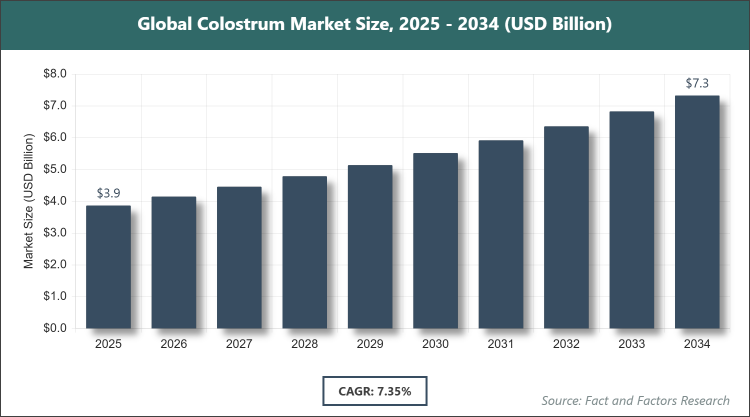
[235+ Pages Report] According to Facts & Factors, the global Colostrum market size was estimated at USD 3.87 billion in 2025 and is expected to reach USD 7.34 billion by the end of 2034. The Colostrum industry is anticipated to grow by a CAGR of 7.35% between 2026 and 2034. The Colostrum Market is driven by rising demand for immune-boosting supplements and natural health products.
 Market Overview
The colostrum market involves the production, processing, and distribution of colostrum, the nutrient-rich first milk produced by mammals shortly after birth, valued for its high concentrations of antibodies, growth factors, and bioactive compounds that support immune function and gut health. This market caters to applications in dietary supplements, infant nutrition, cosmetics, and pharmaceuticals, where colostrum is formulated into powders, capsules, or liquids to enhance bioavailability and efficacy. It emphasizes sustainable sourcing from bovine or other animal origins, adhering to quality standards for purity and potency, while addressing consumer preferences for organic and ethically produced variants in a landscape focused on preventive wellness and natural remedies.
Key Insights
- As per the analysis shared by our research analyst, the global Colostrum market is estimated to grow annually at a CAGR of around 7.35% over the forecast period (2026-2034).
- In terms of revenue, the global Colostrum market size was valued at around USD 3.87 billion in 2025 and is projected to reach USD 7.34 billion by 2034.
- The Colostrum market is projected to witness significant growth due to increasing awareness of immune health and expanding applications in functional foods.
- Based on the Form, the Powder segment accounted for the largest market share of 50% due to its stability, ease of storage, and versatility in formulations.
- Based on the Application, the Nutritional Supplements segment dominated the market with the highest share, owing to rising consumer demand for natural immune boosters.
- Based on the Distribution Channel, the Online Retail segment held the leading position with a substantial share because of convenience and wider product accessibility.
- Based on the region, the Asia Pacific region captured around 40% market share, driven by rapid urbanization and growing health consciousness in emerging economies.
Growth Drivers
- Rising Awareness of Immune Health
The increasing focus on preventive healthcare, amplified by global health crises, is driving demand for colostrum as a natural source of immunoglobulins and bioactive peptides that enhance immune response and gut integrity. This trend is particularly evident in aging populations seeking supplements for overall wellness, with clinical studies supporting colostrum's efficacy in reducing infection risks. Innovations in encapsulation technologies improve shelf life and bioavailability, making it appealing for daily use.
Furthermore, endorsements from health professionals and influencers boost consumer trust, expanding market reach through e-commerce. This driver sustains growth by aligning with holistic health movements, encouraging product diversification into functional beverages and snacks.
Restraints
- High Production Costs
The labor-intensive collection process and need for rapid processing to preserve bioactivity elevate costs, limiting affordability in price-sensitive markets. Supply chain dependencies on dairy farming face challenges from seasonal variations and ethical concerns. Regulatory hurdles for quality assurance add expenses.
Additionally, competition from synthetic alternatives undercuts demand. These factors constrain expansion, necessitating efficient sourcing and scale economies to improve accessibility.
Opportunities
- Expansion in Functional Foods
Integrating colostrum into everyday products like yogurts and energy bars offers growth in the functional food sector, targeting health-conscious consumers. Emerging markets with rising disposable incomes present untapped potential. R&D in plant-based analogs could attract vegan demographics.
Moreover, partnerships with food giants facilitate innovation. This opportunity drives premium positioning and market diversification.
Challenges
- Regulatory and Ethical Issues
Varying global standards for colostrum sourcing and labeling complicate compliance, while animal welfare concerns deter some consumers. Supply volatility from environmental factors affects consistency. Misinformation on benefits hinders trust.
Furthermore, counterfeit products erode market integrity. These challenges require transparency and advocacy to sustain credibility.
Report Scope
Report Attribute |
Details |
Market Size 2025 |
USD 3.87 Billion |
Projected Market Size in 2034 |
USD 7.34 Billion |
CAGR Growth Rate |
7.35% CAGR |
Base Year |
2025 |
Forecast Years |
2026-2034 |
Key Market Players |
Pantheryx Inc., Colostrum BioTec GmbH, Biodane Pharma A/S, Ingredia Nutritional, Biotaris B.V., Cuprem Inc., Good Health NZ Products Ltd., Sterling Technology, APS BioGroup, La Belle Inc., and Others. |
Key Segment |
By Form, By Application, By Distribution Channel, and By Region |
Major Regions Covered |
North America, Europe, Asia Pacific, Latin America, and the Middle East & Africa |
Purchase Options |
Request customized purchase options to meet your research needs. Explore purchase options |
Market Segmentation
The Colostrum market is segmented by form, application, distribution channel, and region.
Based on Form Segment, the Colostrum market is divided into Powder, Capsules, Liquid, and others. The most dominant segment is Powder, which holds the largest share due to its long shelf life and ease of incorporation into supplements, driving the market by enabling global distribution and formulation versatility; the second most dominant is Capsules, preferred for convenient dosing, contributing to market growth through targeted health applications.
Based on Application Segment, the Colostrum market is divided into Nutritional Supplements, Infant Formula, Cosmetics, Pharmaceuticals, and others. The most dominant segment is Nutritional Supplements, commanding the highest share because of growing demand for immune support, which drives the market by addressing wellness trends; the second most dominant is Infant Formula, used for neonatal nutrition, propelling market expansion via pediatric health focus.
Based on the Distribution Channel Segment, the Colostrum market is divided into Online Retail, Offline Retail, and others. The most dominant segment is Online Retail, holding the biggest share due to accessibility and variety, driving the market by facilitating direct-to-consumer sales; the second most dominant is Offline Retail, through pharmacies and stores, contributing to market growth via immediate availability.
Recent Developments
- In 2025, a major player launched an organic bovine colostrum powder line, targeting the premium supplement market amid rising demand for clean-label products.
- In early 2026, partnerships formed for colostrum-based infant formulas, enhancing nutritional profiles in emerging markets.
Regional Analysis
- Asia Pacific to dominate the global market
Asia Pacific emerges as the leading region in the colostrum market, with China as the dominant country through its vast consumer base and rapid adoption of health supplements driven by urbanization and wellness awareness. The region's focus on traditional medicine integrates colostrum for immune enhancement, while government support for dairy industries ensures supply. E-commerce growth facilitates access, boosting sales. China's dominance stems from manufacturing scale and export capabilities.
North America shows strong performance with advanced R&D, led by the United States via innovative formulations and high disposable incomes supporting premium products. Regulatory frameworks ensure quality, fostering trust. The U.S. excels through consumer trends toward natural remedies.
Europe maintains maturity with emphasis on organic sourcing, dominated by Germany through strict standards and export prowess. EU policies promote sustainable farming, enhancing appeal. Germany's lead arises from health-conscious demographics.
Latin America grows with dairy heritage, led by Brazil via expanding supplement markets. Urban health trends drive demand. Brazil's position strengthens from agricultural resources.
The Middle East & Africa advances through wellness initiatives, with Saudi Arabia dominating via investments in health sectors. Economic diversification supports imports. Saudi Arabia's lead comes from policy-driven expansions.
Competitive Analysis
The global Colostrum market is dominated by players:
- Pantheryx Inc.
- Colostrum BioTec GmbH
- Biodane Pharma A/S
- Ingredia Nutritional
- Biotaris B.V.
- Cuprem Inc.
- Good Health NZ Products Ltd.
- Sterling Technology
- APS BioGroup
- La Belle Inc.
The global Colostrum market is segmented as follows:
By Form
- Powder
- Capsules
- Liquid
- Others
By Application
- Nutritional Supplements
- Infant Formula
- Cosmetics
- Pharmaceuticals
- Others
By Distribution Channel
- Online Retail
- Offline Retail
- Others
By Region
- North America
- The U.S.
- Canada
- Mexico
- Europe
- France
- The UK
- Spain
- Germany
- Italy
- Rest of Europe
- Asia Pacific
- China
- Japan
- India
- Australia
- Southeast Asia
- Rest of Asia Pacific
- The Middle East & Africa
- Saudi Arabia
- UAE
- Egypt
- Kuwait
- South Africa
- Rest of the Middle East & Africa
- Latin America
- Brazil
- Argentina
- Rest of Latin America
Industry Major Market Players
- Pantheryx Inc.
- Colostrum BioTec GmbH
- Biodane Pharma A/S
- Ingredia Nutritional
- Biotaris B.V.
- Cuprem Inc.
- Good Health NZ Products Ltd.
- Sterling Technology
- APS BioGroup
- La Belle Inc



Copyright © 2025 - 2026, All Rights Reserved, Facts and Factors