
Search Market Research Report
2-Pyrrolidone Market Size, Share Global Analysis Report, 2026-2034

2-Pyrrolidone Market Size, Share, Growth Analysis Report By Grade (Technical Grade, Pharma Grade, Lab Grade), By Application (Plasticizers, Solvent, Decolorant, and Others), By End-User Industry (Pharmaceutical, Cosmetics, Printing Inks, Chemicals, and Others), and By Region - Global Industry Insights, Overview, Comprehensive Analysis, Trends, Statistical Research, Market Intelligence, Historical Data and Forecast 2026-2034
Industry Insights
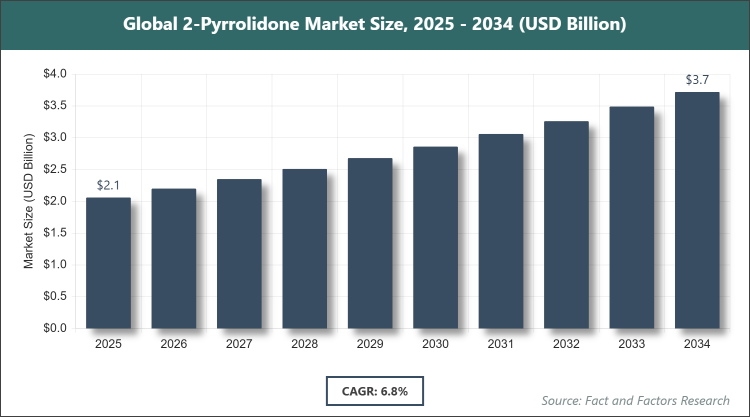
[235+ Pages Report] According to Facts & Factors, the global 2-pyrrolidone market size was estimated at USD 2.06 billion in 2025 and is expected to reach USD 3.92 billion by the end of 2034. The 2-pyrrolidone industry is anticipated to grow by a CAGR of 6.8% between 2026 and 2034. The 2-Pyrrolidone Market is driven by increasing demand in pharmaceutical and agrochemical sectors.
 Market Overview
2-Pyrrolidone is a colorless, water-soluble organic compound with the chemical formula C4H7NO, classified as a lactam derived from gamma-aminobutyric acid. It functions primarily as a versatile solvent and chemical intermediate in various industrial processes, offering high solvency, low toxicity, and a high boiling point. The market for 2-pyrrolidone involves its production, supply chain, and utilization across diverse sectors, where it plays a crucial role in enhancing product formulations, facilitating chemical reactions, and improving process efficiencies without relying on quantitative metrics.
Key Insights
- As per the analysis shared by our research analyst, the global 2-pyrrolidone market is estimated to grow annually at a CAGR of around 6.8% over the forecast period (2026-2034).
- In terms of revenue, the global 2-pyrrolidone market size was valued at around USD 2.06 Billion in 2025 and is projected to reach USD 3.92 Billion, by 2034.
- The 2-pyrrolidone market is driven by rising demand from pharmaceutical, electronics, personal care, and agrochemical industries.
- Based on the grade, the technical grade segment accounted for the largest share in the market in 2025 with around 45% due to its widespread use in industrial applications requiring cost-effective solvency and stability.
- Based on the application, the plasticizers segment accounted for the largest share in the market in 2025 with around 35% as it enhances flexibility and durability in polymers and resins, supporting growth in manufacturing sectors.
- Based on the end-user industry, the pharmaceutical segment accounted for the largest share in the market in 2025 with around 40% owing to its role as a key intermediate in drug synthesis and formulation processes.
- The Asia Pacific region accounted for the largest share in the market in 2025 with around 40% because of its robust chemicals industry, affordable labor, and favorable government policies attracting manufacturers, particularly in China and India.
Growth Drivers
- Rising Demand from Pharmaceutical and Agrochemical Industries
The pharmaceutical sector's expansion significantly boosts the 2-pyrrolidone market, as the compound serves as an essential solvent and intermediate in drug manufacturing, including derivatives like povidone and ethosuximide. This demand stems from global health initiatives and increasing prevalence of chronic diseases, prompting higher production of medications and formulations where 2-pyrrolidone ensures effective dissolution and stability.
Furthermore, in agrochemicals, 2-pyrrolidone acts as a solvent in pesticide formulations, aiding in efficient crop protection amid rising food security needs. Technological advancements in synthesis processes have made production more efficient, reducing costs and enabling broader adoption across these industries, thereby sustaining market growth.
- Increasing Research on Nicotine and Mental Health Applications
Ongoing studies on nicotine derivatives, such as cotinine, position 2-pyrrolidone as a vital component in biomarker development for tobacco exposure and addiction management. With global efforts to combat smoking addiction, including additions to essential medicines lists by health organizations, this research drives demand for 2-pyrrolidone in biopharmaceutical innovations.
Additionally, explorations into its potential for treating mental health conditions like Alzheimer's and schizophrenia open new avenues, as cotinine shows promise in cognitive enhancement. This interdisciplinary application not only diversifies market usage but also attracts investments in R&D, fostering long-term growth through expanded therapeutic possibilities.
Restraints
- Health and Safety Concerns Associated with Derivatives
Exposure to 2-pyrrolidone and its derivatives can cause skin and eye irritation, respiratory issues, and allergic reactions, limiting its handling in sensitive environments. Regulatory bodies impose strict guidelines on usage, increasing compliance costs for manufacturers and potentially slowing market penetration in health-conscious regions.
Moreover, side effects from related compounds like 1-methyl-2-pyrrolidone, including nausea and headaches, raise public and occupational safety alarms. These concerns necessitate advanced protective measures and alternative explorations, which can deter small-scale adopters and impact overall market expansion.
Opportunities
- Expansion in N-Methylpyrrolidone (NMP) Production for Petrochemicals
2-Pyrrolidone's role as a precursor in NMP synthesis offers opportunities in petrochemical processes, such as hydrocarbon extraction and refining. With rising energy demands, investments in large-scale NMP facilities enhance 2-pyrrolidone consumption, particularly in paints, coatings, and asphalt modification.
Price adjustments by major players reflect market dynamics, creating avenues for suppliers to capitalize on demand surges. This integration strengthens supply chains and supports sustainable practices in industrial solvents, positioning 2-pyrrolidone for growth in emerging economies.
- Growth in Cosmetics and Personal Care Applications
The cosmetics industry's surge, driven by consumer preferences for premium products, utilizes 2-pyrrolidone as a solvent in skincare and haircare formulations. Its ability to improve product texture and stability aligns with trends toward natural and effective ingredients, boosting demand in global markets.
Economic growth in developing regions increases disposable incomes, further propelling cosmetics consumption. This sector's expansion provides 2-pyrrolidone manufacturers with diversification opportunities beyond traditional industries.
Challenges
- Complex Regulatory Compliance and Statutory Protocols
Navigating diverse international regulations for 2-pyrrolidone production and distribution poses significant hurdles, requiring extensive documentation and adherence to environmental standards. Delays in approvals can disrupt supply chains and increase operational complexities for global players.
High initial investments for compliant facilities exacerbate entry barriers for new entrants. These challenges demand strategic planning and collaborations to mitigate risks and ensure seamless market operations.
- High Initial Investment Costs for Production Infrastructure
Establishing production plants for 2-pyrrolidone involves substantial capital for equipment and technology, limiting scalability for smaller firms. Infrastructure deficiencies in transportation and storage add to costs, particularly in remote areas.
Economic fluctuations can delay projects, affecting market supply. Overcoming these requires innovative financing and partnerships to sustain growth.
Report Scope
Report Attribute |
Details |
Market Size 2025 |
USD 2.06 Billion |
Projected Market Size in 2034 |
USD 3.92 Billion |
CAGR Growth Rate |
6.8% CAGR |
Base Year |
2025 |
Forecast Years |
2026-2034 |
Key Market Players |
Mitsubishi Chemical Corporation, LyondellBasell Industries N.V., Eastman Chemical Company, Zhejiang Realsun Chemical Co. Ltd., Merck KGaA, Shandong Xinhua Pharmaceutical Co. Ltd., BASF SE, Nanjing Jinlong Chemical Co. Ltd., Hefei Tengchao Chemical Material Co. Ltd., Ashland Global Holdings Inc., Hefei TNJ Chemical Industry Co. Ltd., Solvay S.A., Anhui Leafchem Co. Ltd., and Others. |
Key Segment |
By Grade, By Application, By End-User Industry, and By Region |
Major Regions Covered |
North America, Europe, Asia Pacific, Latin America, and the Middle East & Africa |
Purchase Options |
Request customized purchase options to meet your research needs. Explore purchase options |
Market Segmentation
The 2-pyrrolidone market is segmented by grade, application, end-user industry, and region.
Based on Grade Segment, the 2-pyrrolidone market is divided into technical grade, pharma grade, lab grade. The most dominant segment is technical grade, while the second most dominant is pharma grade. Technical grade dominates due to its cost-effectiveness and versatility in industrial solvents and chemical processes, driving market growth by enabling large-scale applications in manufacturing and petrochemicals; pharma grade follows as it meets stringent purity standards for drug synthesis, contributing to expansion through rising healthcare demands and precise formulations that enhance therapeutic efficacy.
Based on Application Segment, the 2-pyrrolidone market is divided into plasticizers, solvent, decolorant, others. The most dominant segment is plasticizers, while the second most dominant is solvent. Plasticizers lead as they improve polymer flexibility and durability, propelling market growth in plastics and resins industries amid increasing construction and automotive needs; solvent ranks second by facilitating efficient chemical reactions and dissolutions, supporting expansion in paints, inks, and cleaning agents through enhanced performance and environmental compatibility.
Based on End-User Industry Segment, the 2-pyrrolidone market is divided into pharmaceutical, cosmetics, printing inks, chemicals, others. The most dominant segment is pharmaceutical, while the second most dominant is cosmetics. Pharmaceutical dominates owing to its critical role in drug intermediates and formulations, fueling market growth via global health advancements and chronic disease management; cosmetics follows by utilizing its solvency for stable product textures, driving expansion through consumer trends toward premium personal care items and rising disposable incomes in emerging markets.
Recent Developments
- In December 2022, BASF announced price increases for N-methylpyrrolidone (NMP), a derivative of 2-pyrrolidone, in European and North American markets due to rising raw material costs and market conditions, impacting supply chains and encouraging efficiency improvements in production.
- In March 2023, Pharmax NA Inc. launched high-purity 2-pyrrolidone for pharmaceutical manufacturing, emphasizing EP-grade quality from FDA-approved labs to support drug formulation and industrial applications, highlighting a commitment to regulatory compliance and quality enhancement.
- In 2023, Abtonsmart Chemicals (Group) Co., Ltd. introduced new production methods for N-methyl-2-pyrrolidone (NMP), derived from 2-pyrrolidone, focusing on efficiency and sustainability to expand market reach while maintaining high standards.
Regional Analysis
- Asia Pacific to dominate the global market
Asia Pacific stands out as the leading region in the 2-pyrrolidone market, primarily driven by its expansive chemicals industry and rapid industrialization. China emerges as the dominating country, benefiting from vast manufacturing capabilities and high domestic consumption in sectors like paints and coatings. The region's affordable labor and supportive government policies attract international investments, fostering innovation in production techniques. Additionally, India's growing agrochemical and pharmaceutical sectors contribute significantly, leveraging local resources for cost-effective outputs. This dynamic environment ensures sustained demand and positions Asia Pacific as a hub for global supply chains.
North America maintains a strong presence in the 2-pyrrolidone market, with the United States as the dominating country due to advanced technological infrastructure and robust pharmaceutical research. The region's focus on high-purity applications in electronics and healthcare drives consistent growth. Canada supports this through its chemical manufacturing expertise, emphasizing sustainable practices. Collaborative efforts between industry players and regulatory bodies enhance product development, ensuring compliance with stringent standards. This region's emphasis on innovation and quality positions it as a key contributor to global market advancements.
Europe exhibits steady growth in the 2-pyrrolidone market, led by Germany as the dominating country with its established chemical engineering prowess and export-oriented economy. The United Kingdom and France also play vital roles, focusing on cosmetics and pharmaceutical applications. Stringent environmental regulations promote eco-friendly production methods, encouraging research into bio-based alternatives. Collaborative initiatives across the European Union facilitate knowledge sharing and investment in R&D. This cohesive approach strengthens Europe's competitive edge in high-value segments.
Latin America is emerging in the 2-pyrrolidone market, with Brazil as the dominating country owing to its expanding agrochemical industry and natural resource abundance. Argentina contributes through its growing cosmetics sector, utilizing local markets for distribution. Economic stabilization efforts and trade agreements enhance accessibility to global technologies. Investments in infrastructure improve production capabilities, addressing regional demands. This upward trajectory reflects Latin America's potential in diversifying applications and boosting exports.
The Middle East & Africa region shows promising development in the 2-pyrrolidone market, dominated by Saudi Arabia with its petrochemical strengths and strategic location for trade. The United Arab Emirates supports growth through investments in chemical processing facilities. Africa's emerging markets, like South Africa, focus on pharmaceutical and cosmetic expansions. Regional initiatives aim at building infrastructure for safe handling and distribution. This evolving landscape offers opportunities for partnerships and technology transfers to meet increasing industrial needs.
Competitive Analysis
The global 2-pyrrolidone market is dominated by players:
- Mitsubishi Chemical Corporation
- LyondellBasell Industries N.V.
- Eastman Chemical Company
- Zhejiang Realsun Chemical Co. Ltd.
- Merck KGaA
- Shandong Xinhua Pharmaceutical Co. Ltd.
- BASF SE
- Nanjing Jinlong Chemical Co. Ltd.
- Hefei Tengchao Chemical Material Co. Ltd.
- Ashland Global Holdings Inc.
- Hefei TNJ Chemical Industry Co. Ltd.
- Solvay S.A.
- Anhui Leafchem Co. Ltd.
The global 2-pyrrolidone market is segmented as follows:
By Grade
- Technical Grade
- Pharma Grade
- Lab Grade
By Application
- Plasticizers
- Solvent
- Decolorant
- Others
By End-User Industry
- Pharmaceutical
- Cosmetics
- Printing Inks
- Chemicals
- Others
By Region
- North America
- The U.S.
- Canada
- Mexico
- Europe
- France
- The UK
- Spain
- Germany
- Italy
- Rest of Europe
- Asia Pacific
- China
- Japan
- India
- Australia
- Southeast Asia
- Rest of Asia Pacific
- The Middle East & Africa
- Saudi Arabia
- UAE
- Egypt
- Kuwait
- South Africa
- Rest of the Middle East & Africa
- Latin America
- Brazil
- Argentina
- Rest of Latin America
Industry Major Market Players
The global 2-pyrrolidone market is dominated by players:
- Mitsubishi Chemical Corporation
- LyondellBasell Industries N.V.
- Eastman Chemical Company
- Zhejiang Realsun Chemical Co. Ltd.
- Merck KGaA
- Shandong Xinhua Pharmaceutical Co. Ltd.
- BASF SE
- Nanjing Jinlong Chemical Co. Ltd.
- Hefei Tengchao Chemical Material Co. Ltd.
- Ashland Global Holdings Inc.
- Hefei TNJ Chemical Industry Co. Ltd.
- Solvay S.A.
- Anhui Leafchem Co. Ltd.



Copyright © 2025 - 2026, All Rights Reserved, Facts and Factors