
Search Market Research Report
Industrial Magnetrons Market Size, Share Global Analysis Report, 2026-2034

Industrial Magnetrons Market Size, Share, Growth Analysis Report By Type (Continuous Wave, Pulsed, and Others), By Application (Industrial Heating, Radar Systems, Medical, and Others), By End-User (Manufacturing, Defense, Healthcare, and Others), and By Region - Global Industry Insights, Overview, Comprehensive Analysis, Trends, Statistical Research, Market Intelligence, Historical Data and Forecast 2026-2034
Industry Insights
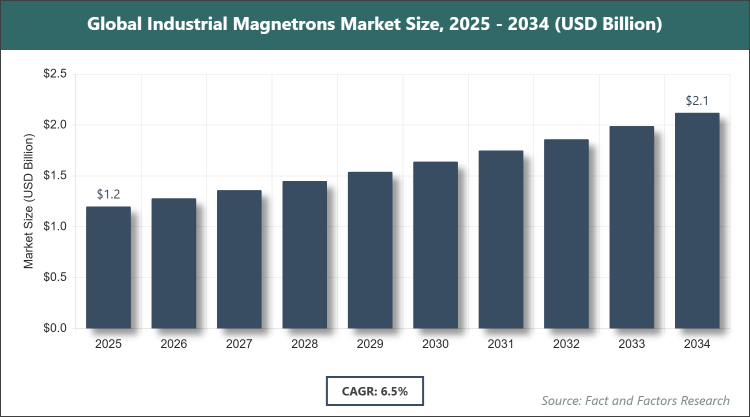
[245+ Pages Report] According to Facts & Factors, the global industrial magnetrons market size was estimated at USD 1.2 billion in 2025 and is expected to reach USD 2.1 billion by the end of 2034. The industrial magnetrons industry is anticipated to grow by a CAGR of 6.5% between 2026 and 2034. The industrial magnetrons Market is driven by increasing demand in microwave heating and radar applications.
 Market Overview
Industrial magnetrons are high-power vacuum tubes that generate microwave energy for various applications, functioning as oscillators in radar systems, heating equipment, and medical devices. These components convert electrical energy into electromagnetic waves through electron interaction in a magnetic field, providing efficient power amplification without external input signals. The market encompasses the production, distribution, and utilization of these devices across industries requiring precise microwave generation for heating, drying, or detection purposes.
Key Insights
- As per the analysis shared by our research analyst, the global industrial magnetrons market is estimated to grow annually at a CAGR of around 6.5% over the forecast period (2026-2034).
- In terms of revenue, the global industrial magnetrons market size was valued at around USD 1.2 billion in 2025 and is projected to reach USD 2.1 billion, by 2034.
- The market is driven by expanding applications in food processing and defense sectors.
- Based on the type, the continuous wave segment dominated the market with 60% share due to its stable output suitable for industrial heating applications.
- Based on the application, the industrial heating segment dominated the market with 45% share owing to rising demand in food and chemical processing for efficient energy use.
- Based on the end-user, the manufacturing segment dominated the market with 50% share because of widespread use in material processing and drying operations.
- North America dominated the global market with 35% share due to advanced defense technologies and strong food processing industry.
Growth Drivers
- Expansion in Food Processing Industry
The food industry's increasing adoption of microwave technology for drying, cooking, and sterilization has boosted demand for industrial magnetrons. These devices offer efficient, uniform heating that preserves product quality while reducing energy consumption, aligning with industry goals for sustainability and cost-effectiveness.
This trend is supported by rising global food production needs and innovations in microwave systems for large-scale operations. As consumer preferences shift toward processed foods, manufacturers invest in advanced magnetron technologies to enhance production capabilities and meet regulatory standards for food safety.
Restraints
- High Initial Investment Costs
The substantial capital required for magnetron-based systems, including equipment and integration, poses a barrier for small and medium enterprises. This high entry cost limits market penetration in developing regions where budget constraints are significant.
Additionally, the need for specialized maintenance and replacement parts increases operational expenses, deterring potential adopters. Economic uncertainties can further delay investments, slowing overall market growth despite long-term efficiency benefits.
Opportunities
- Advancements in Defense and Radar Technologies
Ongoing developments in radar systems for military and aviation applications present opportunities for high-power magnetrons. Enhanced designs offering better frequency stability and power output can capture market share in defense contracts.
Collaborations with government agencies and R&D investments in next-generation magnetrons could open new revenue streams. As geopolitical tensions rise, increased defense spending worldwide is expected to drive demand for reliable microwave components.
Challenges
- Stringent Environmental Regulations
Regulations on electromagnetic emissions and energy efficiency require continuous product modifications, increasing R&D costs for manufacturers. Compliance with standards like FCC and EU directives can delay product launches.
Balancing performance with regulatory requirements remains a key challenge. Failure to comply can result in market restrictions, affecting global competitiveness and necessitating ongoing adaptations to evolving environmental policies.
Report Scope
Report Attribute |
Details |
Market Size 2025 |
USD 1.2 Billion |
Projected Market Size in 2034 |
USD 2.1 Billion |
CAGR Growth Rate |
6.5% CAGR |
Base Year |
2025 |
Forecast Years |
2026-2034 |
Key Market Players |
L3Harris Technologies, Toshiba Electron Tubes & Devices Co., Richardson Electronics, Hitachi Power Solutions, Panasonic Corporation, NJR New Japan Radio, Teledyne e2v, CPI International, MUEGGE GmbH, Samsung, and Others. |
Key Segment |
By Type, By Application, By End-User, and By Region |
Major Regions Covered |
North America, Europe, Asia Pacific, Latin America, and the Middle East & Africa |
Purchase Options |
Request customized purchase options to meet your research needs. Explore purchase options |
Market Segmentation
The industrial magnetrons market is segmented by type, application, end-user, and region.
Based on Type Segment, the industrial magnetrons market is divided into continuous wave, pulsed, and others. The most dominant segment is continuous wave, holding a significant share due to its reliable and stable output for prolonged operations in heating applications, driving market growth by enabling efficient industrial processes. The second most dominant is pulsed, favored for its high peak power in radar systems, contributing to expansion through defense and telecommunications advancements.
Based on Application Segment, the industrial magnetrons market is divided into industrial heating, radar systems, medical, and others. The most dominant segment is industrial heating, accounting for the largest portion as it supports energy-efficient processing in food and chemicals, propelling market development. The second most dominant is radar systems, driven by military and aviation needs for precise detection, boosting overall industry progress.
Based on End-User Segment, the industrial magnetrons market is divided into manufacturing, defense, healthcare, and others. The manufacturing segment dominates, utilizing magnetrons for material processing and drying, fueling market growth through industrial efficiency gains. The defense segment is second, leveraging high-power capabilities for radar, contributing to expansion via security investments.
Recent Developments
- In 2023, L3Harris Technologies launched a new line of high-power continuous wave magnetrons for industrial heating applications, offering improved efficiency and longer operational life.
- In 2024, Toshiba Electron Tubes & Devices Co. introduced advanced pulsed magnetrons for radar systems, featuring enhanced frequency stability and reduced size for aerospace integration.
- Richardson Electronics announced a partnership with a leading magnetron manufacturer in 2025 to expand distribution of industrial-grade components in Europe and Asia.
Regional Analysis
- North America to dominate the global market
North America leads the industrial magnetrons market, primarily due to its advanced defense and food processing industries. The United States dominates with significant investments in radar technologies and microwave heating systems for military and commercial applications. The region's strong R&D infrastructure fosters innovation, while stringent safety standards drive adoption of efficient magnetrons. This position is reinforced by collaborations between government agencies and private firms, ensuring continuous technological advancements.
Europe maintains a strong presence in the industrial magnetrons market, supported by robust manufacturing and aerospace sectors. Germany emerges as the dominating country, leveraging its engineering expertise in precision equipment for industrial and medical uses. The region's focus on energy efficiency aligns with EU regulations, promoting magnetron applications in sustainable processing. Collaborative research initiatives across countries enhance product development, contributing to steady market growth.
Asia Pacific is experiencing rapid expansion in the industrial magnetrons market, fueled by industrialization and growing food processing needs. China stands out as the dominating country, with massive production capacities and increasing defense investments driving demand. The region's cost-effective manufacturing and rising exports of processed goods support market penetration, positioning it for future leadership.
Latin America shows emerging potential in the industrial magnetrons market, driven by food industry growth. Brazil dominates with its large agricultural sector requiring efficient drying and heating solutions. Investments in infrastructure improve adoption rates, though economic volatility poses challenges to consistent expansion.
The Middle East & Africa region is gradually developing in the industrial magnetrons market, led by oil and gas applications. South Africa emerges as a key player with growing manufacturing capabilities. Regional focus on diversification from oil dependency supports adoption in new sectors, contributing to slow but steady growth.
Competitive Analysis
The global industrial magnetrons market is dominated by players:
- L3Harris Technologies
- Toshiba Electron Tubes & Devices Co.
- Richardson Electronics
- Hitachi Power Solutions
- Panasonic Corporation
- NJR New Japan Radio
- Teledyne e2v
- CPI International
- MUEGGE GmbH
- Samsung
The global industrial magnetrons market is segmented as follows:
By Type
- Continuous Wave
- Pulsed
- Others
By Application
- Industrial Heating
- Radar Systems
- Medical
- Others
By End-User
- Manufacturing
- Defense
- Healthcare
- Others
By Region
- North America
- The U.S.
- Canada
- Mexico
- Europe
- France
- The UK
- Spain
- Germany
- Italy
- Rest of Europe
- Asia Pacific
- China
- Japan
- India
- Australia
- Southeast Asia
- Rest of Asia Pacific
- The Middle East & Africa
- Saudi Arabia
- UAE
- Egypt
- Kuwait
- South Africa
- Rest of the Middle East & Africa
- Latin America
- Brazil
- Argentina
- Rest of Latin America
Industry Major Market Players
The global industrial magnetrons market is dominated by players:
- L3Harris Technologies
- Toshiba Electron Tubes & Devices Co.
- Richardson Electronics
- Hitachi Power Solutions
- Panasonic Corporation
- NJR New Japan Radio
- Teledyne e2v
- CPI International
- MUEGGE GmbH
- Samsung
Frequently Asked Questions



Copyright © 2025 - 2026, All Rights Reserved, Facts and Factors