
Search Market Research Report
Expandable Microspheres Market Size, Share Global Analysis Report, 2026-2034

Expandable Microspheres Market Size, Share, Growth Analysis Report By Type (Dry and Wet), By Application (Lightweight Fillers, Blowing Agents, and Others), By End-User (Automotive, Construction, Consumer Goods, Sports & Leisure, and Others), and By Region - Global Industry Insights, Overview, Comprehensive Analysis, Trends, Statistical Research, Market Intelligence, Historical Data and Forecast 2026-2034
Industry Insights
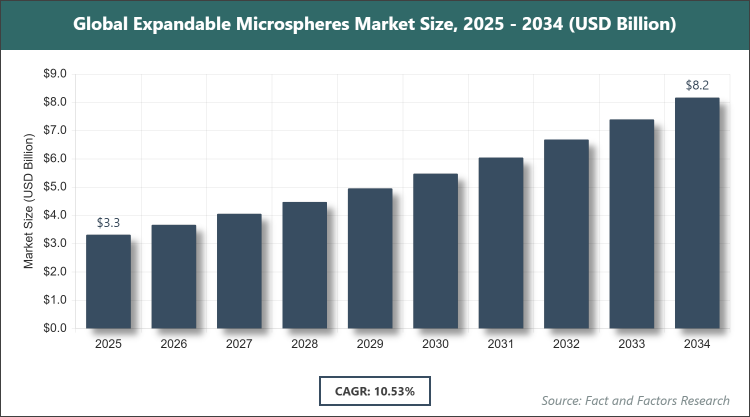
[222+ Pages Report] According to Facts & Factors, the global expandable microspheres market size was estimated at USD 3.32 billion in 2025 and is expected to reach USD 8.2 billion by the end of 2034. The expandable microspheres industry is anticipated to grow by a CAGR of 10.53% between 2026 and 2034. The expandable microspheres Market is driven by rising demand for lightweight and energy-efficient materials.
 Market Overview
Expandable microspheres are small, spherical particles consisting of a thermoplastic polymer shell encapsulating a low-boiling-point hydrocarbon gas. When heated, the gas expands, causing the shell to soften and increase in volume significantly, resulting in lightweight, hollow structures. These materials are widely utilized as fillers or blowing agents to reduce density, improve insulation, and enhance product performance without compromising structural integrity. They find applications across diverse industries where weight reduction and thermal properties are critical, offering versatile solutions for modern manufacturing needs.
Key Insights
- As per the analysis shared by our research analyst, the expandable microspheres market is estimated to grow annually at a CAGR of around 10.53% over the forecast period (2026-2034).
- In terms of revenue, the expandable microspheres market size was valued at around USD 3.32 Billion in 2025 and is projected to reach USD 8.2 Billion by 2034.
- The expandable microspheres Market is driven by increasing adoption in automotive and construction for lightweighting applications.
- Based on the type, the dry segment dominated the market in 2025 with a market share of 70.4% due to its ease of handling, longer shelf life, and superior compatibility with dry processing methods in industries like paints and coatings.
- Based on the application, the lightweight fillers segment dominated the market in 2025 with a market share of 55% owing to its ability to reduce material weight while maintaining strength, which is essential for fuel efficiency in transportation and cost savings in packaging.
- Based on the end-user, the automotive segment dominated the market in 2025 with a market share of 35% because of the growing emphasis on vehicle lightweighting to meet stringent emission regulations and improve fuel economy.
- Based on the region, North America dominated the market in 2025 with a market share of 40.4% attributed to advanced manufacturing infrastructure, high R&D investments, and strong demand from aerospace and automotive sectors.
Growth Drivers
- Rising Demand for Lightweight Materials in Automotive Industry
The automotive sector's push for fuel efficiency and reduced emissions has significantly boosted the adoption of expandable microspheres. These materials enable manufacturers to create lighter components without sacrificing durability, leading to improved vehicle performance and compliance with environmental standards. Innovations in electric vehicles further amplify this trend, as weight reduction directly enhances battery range and overall efficiency.
This driver is supported by global regulatory pressures and consumer preferences for sustainable transportation. As automakers invest in advanced composites, expandable microspheres play a pivotal role in achieving these goals, fostering long-term market expansion through technological integration and supply chain optimizations.
Restraints
- High Production Costs and Raw Material Volatility
The manufacturing of expandable microspheres involves specialized processes and raw materials like polymers and hydrocarbons, which are subject to price fluctuations due to geopolitical factors and supply chain disruptions. This increases overall production costs, potentially limiting accessibility for smaller manufacturers and hindering market penetration in price-sensitive regions.
Additionally, the need for precise control in production to ensure consistent quality adds to operational expenses. These challenges can slow adoption in emerging markets where cost competitiveness is crucial, requiring industry players to focus on efficiency improvements and alternative sourcing strategies to mitigate impacts.
Opportunities
- Expansion in Emerging Applications like 3D Printing and Insulation
Advancements in additive manufacturing and building insulation present new avenues for expandable microspheres, where their expansion properties can enhance material versatility and thermal performance. The rise of sustainable construction practices and innovative printing technologies opens doors for customized solutions, driving demand in untapped sectors.
This opportunity aligns with global trends toward energy-efficient buildings and rapid prototyping. By leveraging R&D, companies can develop tailored products, capturing market share in high-growth areas and fostering collaborations with tech firms to accelerate innovation and application diversity.
Challenges
- Environmental Concerns and Regulatory Compliance
Increasing scrutiny on plastic-based materials poses challenges, as expandable microspheres often rely on non-biodegradable polymers. Stricter environmental regulations demand eco-friendly alternatives, potentially raising compliance costs and necessitating reformulations that could affect product performance.
Balancing sustainability with functionality remains a key hurdle. Industry stakeholders must invest in bio-based innovations and recycling initiatives to address these issues, ensuring long-term viability while navigating evolving standards and consumer expectations for greener products.
Report Scope
Report Attribute |
Details |
Market Size 2025 |
USD 3.32 Billion |
Projected Market Size in 2034 |
USD 8.2 Billion |
CAGR Growth Rate |
10.53% CAGR |
Base Year |
2025 |
Forecast Years |
2026-2034 |
Key Market Players |
Nouryon, Matsumoto Yushi-Seiyaku Co. Ltd., Kureha Corporation, Chase Corporation, The Kish Company, Sekisui Chemical Co. Ltd., Trelleborg AB, Akzo Nobel N.V. (Expancel), SINOSTEEL MAANSHAN NEW MATERIAL TECHNOLOGY CO. LTD, Luminex Corporation, Thermo Fisher Scientific, Momentive Performance Materials Inc., Potters Industries LLC, and Others. |
Key Segment |
By Type, By Application, By End-User, and By Region |
Major Regions Covered |
North America, Europe, Asia Pacific, Latin America, and the Middle East & Africa |
Purchase Options |
Request customized purchase options to meet your research needs. Explore purchase options |
Market Segmentation
The expandable microspheres market is segmented by type, application, end-user, and region.
Based on Type Segment, the expandable microspheres market is divided into dry, and wet. The dry segment stands out as the most dominant, capturing a significant market share due to its advantages in storage stability and ease of incorporation into various formulations. The wet segment follows as the second most dominant, valued for its immediate usability in liquid-based applications and enhanced dispersion properties. The dominance of the dry type drives the market by enabling efficient large-scale production and reducing transportation costs, while the wet type contributes by supporting specialized wet processing techniques that improve product uniformity and application flexibility in industries like coatings and adhesives.
Based on Application Segment, the expandable microspheres market is divided into lightweight fillers, blowing agents, and others. Lightweight fillers emerge as the most dominant subsegment, benefiting from their role in weight reduction across multiple products, which enhances efficiency and cost-effectiveness. Blowing agents rank as the second most dominant, prized for their controlled expansion in foaming processes. The lightweight fillers' dominance propels market growth by addressing demands for sustainable and high-performance materials in transportation, whereas blowing agents aid in creating porous structures that improve insulation and cushioning, collectively driving innovation and broader adoption.
Based on End-User Segment, the expandable microspheres market is divided into automotive, construction, consumer goods, sports & leisure, and others. The automotive subsegment dominates, driven by the need for lightweight components that boost fuel efficiency and vehicle dynamics. Construction follows as the second most dominant, utilizing these materials for improved insulation and reduced structural weight. Automotive dominance accelerates market expansion through regulatory-driven innovations, while construction contributes by enabling energy-efficient buildings, together fostering advancements in material science and sustainable practices.
Recent Developments
- In April 2025, Nouryon unveiled Expancel WB microspheres at the Chinaplas exhibition in Shanghai, introducing an innovation for white shoe soles in the apparel industry, enhancing performance and comfort to meet growing consumer demands.
- In April 2025, Terumo Europe N.V. launched BioPearlTM microspheres, the first resorbable drug-eluting microspheres, expanding therapeutic options in minimally invasive treatments by combining drug-eluting technology with resorbable benefits.
- In December 2024, Nouryon introduced Expancel BIO microspheres, a partially bio-based lightweight filler and blowing agent targeted at sustainable applications in construction and automotive sectors.
- In 2025, Nouryon launched Expancel XS200 microspheres, an advanced product for interior decorative paints that reduces paint weight significantly while maintaining performance properties.
Regional Analysis
- North America to dominate the global market
North America leads the expandable microspheres market, primarily due to its robust industrial base and innovation-driven economy. The United States stands out as the dominating country, with advanced R&D facilities and a strong presence of key manufacturers fostering technological advancements. The region's emphasis on lightweight materials in aerospace and automotive sectors, coupled with stringent environmental regulations, drives sustained growth and adoption.
Europe follows closely, characterized by a focus on sustainability and high-quality manufacturing. Germany dominates within the region, leveraging its engineering expertise and automotive industry to integrate expandable microspheres into efficient production processes. The area's commitment to green technologies and circular economy principles supports market expansion through innovative applications in construction and consumer goods.
Asia Pacific exhibits rapid growth, fueled by industrialization and expanding end-use sectors. China emerges as the dominating country, benefiting from large-scale manufacturing capabilities and increasing investments in infrastructure. The region's rising demand for lightweight solutions in transportation and packaging, along with cost-effective production, positions it for significant market contributions.
Latin America shows emerging potential, with growth tied to infrastructure development and automotive expansion. Brazil dominates the region, utilizing its growing industrial sector to adopt expandable microspheres for weight reduction and insulation. Challenges like economic volatility are offset by opportunities in sustainable building practices and foreign investments.
The Middle East & Africa region is developing, driven by construction booms and oil-related applications. South Africa leads as the dominating country, supported by its mining and manufacturing industries incorporating these materials for enhanced performance. The area's focus on diversification and energy efficiency presents avenues for future market penetration.
Competitive Analysis
The global expandable microspheres market is dominated by players:
- Nouryon
- Matsumoto Yushi-Seiyaku Co. Ltd.
- Kureha Corporation
- Chase Corporation
- The Kish Company
- Sekisui Chemical Co. Ltd.
- Trelleborg AB
- Akzo Nobel N.V. (Expancel)
- SINOSTEEL MAANSHAN NEW MATERIAL TECHNOLOGY CO. LTD
- Luminex Corporation
- Thermo Fisher Scientific
- Momentive Performance Materials Inc.
- Potters Industries LLC
The global expandable microspheres market is segmented as follows:
By Type
- Dry
- Wet
By Application
- Lightweight Fillers
- Blowing Agents
- Others
By End-User
- Automotive
- Construction
- Consumer Goods
- Sports & Leisure
- Others
By Region
- North America
- The U.S.
- Canada
- Mexico
- Europe
- France
- The UK
- Spain
- Germany
- Italy
- Rest of Europe
- Asia Pacific
- China
- Japan
- India
- Australia
- Southeast Asia
- Rest of Asia Pacific
- The Middle East & Africa
- Saudi Arabia
- UAE
- Egypt
- Kuwait
- South Africa
- Rest of the Middle East & Africa
- Latin America
- Brazil
- Argentina
- Rest of Latin America
Industry Major Market Players
The global expandable microspheres market is dominated by players:
- Nouryon
- Matsumoto Yushi-Seiyaku Co. Ltd.
- Kureha Corporation
- Chase Corporation
- The Kish Company
- Sekisui Chemical Co. Ltd.
- Trelleborg AB
- Akzo Nobel N.V. (Expancel)
- SINOSTEEL MAANSHAN NEW MATERIAL TECHNOLOGY CO. LTD
- Luminex Corporation
- Thermo Fisher Scientific
- Momentive Performance Materials Inc.
- Potters Industries LLC
Frequently Asked Questions



Copyright © 2025 - 2026, All Rights Reserved, Facts and Factors