
Search Market Research Report
Centrifugal Fans Market Size, Share Global Analysis Report, 2026-2034

Centrifugal Fans Market Size, Share, Growth Analysis Report By Type (Forward Curved, Backward Curved, Radial, and Others), By Application (Ventilation, Cooling, Drying, Material Handling, and Others), By End-Use (Residential, Commercial, Industrial), and By Region - Global Industry Insights, Overview, Comprehensive Analysis, Trends, Statistical Research, Market Intelligence, Historical Data and Forecast 2026-2034
Industry Insights
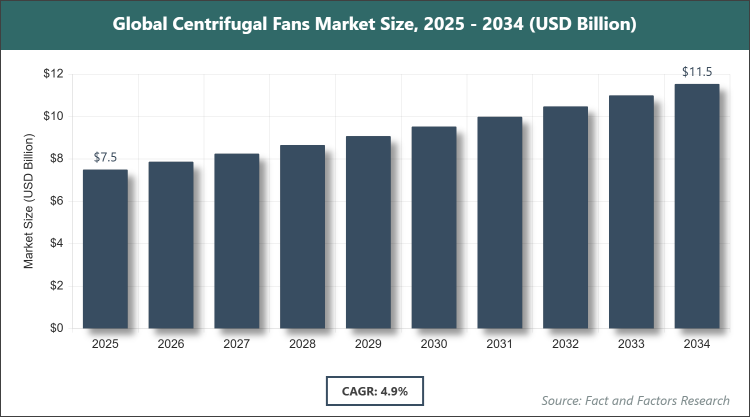
[215+ Pages Report] According to Facts & Factors, the global centrifugal fans market size was estimated at USD 7.5 billion in 2025 and is expected to reach USD 11.5 billion by the end of 2034. The centrifugal fans industry is anticipated to grow by a CAGR of 4.9% between 2026 and 2034. The centrifugal fans Market is driven by rising demand for energy-efficient ventilation systems across industrial applications.
 Market Overview
Centrifugal fans, also known as radial fans or blowers, are mechanical devices designed to move air or gases in a radial direction perpendicular to the axis of rotation, utilizing centrifugal force generated by a rotating impeller to increase air pressure and velocity for various airflow applications. These fans consist of key components including an impeller with blades, a housing or casing that directs airflow, and a drive mechanism, making them essential for creating directed air streams in systems requiring higher pressure than axial fans can provide.
Key Insights
- As per the analysis shared by our research analyst, the global centrifugal fans market is expected to grow annually at a CAGR of around 4.9% during the forecast period (2026-2034).
- In terms of revenue, the global centrifugal fans market size was valued at around USD 7.5 billion in 2025 and is projected to reach USD 11.5 billion by 2034.
- The centrifugal fans market is driven by increasing industrialization and demand for efficient air handling systems.
- Based on the type, the backward curved segment dominated with around 45% share due to its high energy efficiency and ability to handle high-pressure applications effectively.
- Based on the application, the ventilation segment dominated with approximately 40% share owing to stringent regulations on air quality and workplace safety driving adoption in industrial and commercial settings.
- Based on the end-use, the industrial segment dominated with over 60% share because of extensive use in manufacturing, chemical processing, and power generation for reliable airflow management.
- Based on region, Asia Pacific dominated with 40% share attributed to rapid urbanization, industrial expansion, and infrastructure development in emerging economies.
Growth Drivers
- Rising Industrialization and Infrastructure Development
The global push towards industrialization, particularly in emerging economies, has significantly boosted the demand for centrifugal fans as essential components in ventilation, cooling, and material handling systems across manufacturing facilities, power plants, and chemical processing units. This trend is further amplified by massive infrastructure projects including new commercial buildings, data centers, and transportation hubs that require robust air movement solutions to maintain optimal environmental conditions and ensure operational efficiency.
Additionally, government initiatives promoting sustainable industrial practices and energy-efficient equipment have encouraged the adoption of advanced centrifugal fans with improved aerodynamics and variable speed controls, leading to reduced energy consumption and lower operational costs for end-users while complying with evolving environmental standards.
- Increasing Focus on Energy Efficiency and Sustainability
Stringent environmental regulations worldwide are compelling industries to adopt energy-efficient centrifugal fans that minimize power consumption while maximizing airflow performance, driving innovation in fan design with features like backward-curved impellers and EC motors. This shift not only helps companies reduce their carbon footprint but also aligns with corporate sustainability goals, creating a competitive advantage in markets where green certifications are increasingly valued.
Moreover, the integration of smart technologies such as IoT-enabled monitoring systems in centrifugal fans allows for real-time performance optimization and predictive maintenance, further enhancing energy savings and extending equipment lifespan in demanding industrial environments.
Restraints
- High Initial Installation and Maintenance Costs
The substantial upfront costs associated with high-quality centrifugal fans, including specialized materials for corrosion resistance and advanced control systems, pose a significant barrier for small and medium enterprises in adopting these solutions, potentially slowing market penetration in price-sensitive regions. Additionally, the need for professional installation and periodic maintenance to ensure optimal performance adds to the total ownership costs, deterring budget-constrained users from upgrading from basic fan systems.
Furthermore, in volatile economic conditions, industries may delay capital investments in new equipment, opting instead for repairs on existing systems, which limits the growth potential for new centrifugal fan sales despite their long-term efficiency benefits.
- Intense Market Competition and Price Pressures
The presence of numerous local and international manufacturers in the centrifugal fans market has led to intense competition, resulting in price wars that squeeze profit margins for established players while making it challenging to maintain quality standards. This competitive landscape also encourages the entry of low-cost alternatives from unorganized sectors, which may not meet performance or safety requirements but appeal to cost-conscious buyers in developing markets.
Moreover, rapid technological advancements require continuous R&D investments from companies to stay competitive, placing additional financial strain on smaller manufacturers who may struggle to keep pace with innovation demands.
Opportunities
- Technological Advancements in Smart Fan Systems
The emergence of Industry 4.0 has opened avenues for developing smart centrifugal fans integrated with sensors, AI algorithms, and cloud connectivity for automated airflow control and energy management in smart factories and buildings. These advanced systems offer opportunities for manufacturers to differentiate their products through value-added features like remote monitoring and fault prediction, appealing to tech-savvy industries seeking to optimize operations.
In addition, partnerships between fan manufacturers and software companies can lead to innovative solutions that combine hardware excellence with digital intelligence, expanding market reach into new sectors like data centers and renewable energy facilities.
- Expansion in Emerging Markets and Green Building Initiatives
Rapid urbanization in Asia Pacific and Latin America presents untapped opportunities for centrifugal fan suppliers to penetrate growing construction and industrial sectors with tailored solutions for local climate and regulatory needs. The global emphasis on green building certifications like LEED is driving demand for eco-friendly fans that contribute to energy-efficient designs in new constructions and retrofits.
Furthermore, government incentives for sustainable infrastructure projects create favorable conditions for market expansion, allowing companies to establish strong footholds through localized production and distribution networks.
Challenges
- Stringent Regulatory Compliance and Standards
Evolving international standards on noise levels, vibration, and emissions require centrifugal fan manufacturers to continuously update designs and materials, increasing development costs and time-to-market for new products. Compliance with diverse regional regulations can complicate global supply chains and export strategies for companies operating internationally.
Additionally, failure to meet these standards can result in product recalls or market restrictions, damaging brand reputation and requiring significant resources to rectify.
- Supply Chain Disruptions and Raw Material Volatility
Global supply chain vulnerabilities, exacerbated by geopolitical tensions and pandemics, can lead to delays in procuring key components like motors and impellers, affecting production schedules for centrifugal fans. Fluctuations in raw material prices, particularly for steel and aluminum, directly impact manufacturing costs and profit margins.
Moreover, reliance on specific suppliers for specialized parts increases risk exposure, prompting the need for diversified sourcing strategies that may involve higher logistics expenses.
Report Scope
Report Attribute |
Details |
Market Size 2025 |
USD 7.5 Billion |
Projected Market Size in 2034 |
USD 11.5 Billion |
CAGR Growth Rate |
4.9% CAGR |
Base Year |
2025 |
Forecast Years |
2026-2034 |
Key Market Players |
Ebm-Papst, Greenheck Fan, Systemair, Twin City Fan, FläktGroup, Johnson Controls, Loren Cook, Acme Fans, New York Blower, Zhejiang Shangfeng, Nortek Air Solutions, Mitsui Miike Machinery, Ventmeca, Yilida, Cincinnati Fan, Soler & Palau, Nanfang Ventilator, Howden, and Others. |
Key Segment |
By Type, By Application, By End-Use, and By Region |
Major Regions Covered |
North America, Europe, Asia Pacific, Latin America, and the Middle East & Africa |
Purchase Options |
Request customized purchase options to meet your research needs. Explore purchase options |
Market Segmentation
The centrifugal fans market is segmented by type, application, end-user, and region.
Based on Type Segment, the centrifugal fans market is divided into forward curved, backward curved, radial, and others. The backward curved segment emerges as the most dominant, commanding around 45% market share, primarily due to its superior energy efficiency, ability to handle high-pressure applications with minimal power consumption, and reduced noise levels compared to other types, making it ideal for industrial ventilation and HVAC systems where operational cost savings and performance reliability are paramount.
This dominance drives overall market growth by encouraging adoption in energy-conscious sectors, as these fans optimize airflow while minimizing electricity usage, thus supporting sustainability goals and reducing long-term operating expenses for end-users. The forward curved segment ranks as the second most dominant, with approximately 30% share, owing to its compact design, high airflow at low pressures, and cost-effectiveness for applications like commercial air conditioning and residential ventilation, where space constraints and budget considerations play crucial roles; it contributes to market expansion by enabling accessible entry points for smaller-scale projects and broadening the technology's reach across diverse building types.
Based on Application Segment, the centrifugal fans market is divided into ventilation, cooling, drying, material handling, and others. The ventilation segment stands out as the most dominant, holding about 40% market share, driven by stringent air quality regulations and the need for effective airflow management in confined industrial and commercial spaces, where these fans excel in removing contaminants and maintaining healthy environments; this leadership propels market growth by addressing critical safety and compliance needs across manufacturing and building sectors.
The cooling segment follows as the second most dominant, with roughly 25% share, attributed to rising demand for efficient heat dissipation in data centers, power plants, and processing industries, where centrifugal fans provide reliable high-velocity airflow to prevent equipment overheating; it fuels market advancement by supporting the expansion of temperature-sensitive technologies and infrastructure.
Based on End-Use Segment, the centrifugal fans market is divided into residential, commercial, industrial. The industrial segment is the most dominant, capturing over 60% market share, due to its essential role in heavy-duty applications like chemical processing, power generation, and manufacturing, where robust, high-pressure airflow is required for process efficiency and worker safety; this supremacy drives market growth by aligning with global industrial expansion and the need for durable ventilation solutions in harsh environments.
The commercial segment is the second most dominant, with around 25% share, fueled by increasing construction of offices, malls, and hospitals demanding reliable HVAC systems for comfort and air circulation; it contributes to market progress by capitalizing on urbanization trends and energy-efficient building designs.
Recent Developments
- In September 2023, ebm-papst Group launched the second generation of its RadiCal centrifugal fan series, featuring improved aerodynamics for higher efficiency and reduced noise, targeting HVAC and industrial ventilation applications to meet growing demands for energy-saving solutions.
- In February 2025, Chart Industries and Flowserve announced a merger to create a combined entity focused on process technologies, including enhanced centrifugal fan offerings for industrial air handling, aiming to leverage synergies in service and aftermarket support for global customers.
- In 2023, Ingersoll Rand completed multiple acquisitions, including Roots, strengthening its portfolio in low-pressure centrifugal blowers and fans for municipal and industrial applications, expanding cross-selling opportunities in wastewater treatment and pneumatic conveying sectors.
Regional Analysis
- Asia Pacific to dominate the global market
Asia Pacific dominates the global centrifugal fans market, driven by rapid industrialization, massive infrastructure investments, and booming manufacturing sectors in countries like China and India, where demand for efficient ventilation and cooling systems surges in factories, power plants, and urban developments. China stands out as the leading country, with its extensive chemical, steel, and electronics industries requiring high-performance fans for air quality control and process optimization amidst strict environmental policies.
North America holds a significant position in the centrifugal fans market, supported by advanced industrial modernization, stringent energy-efficiency regulations, and widespread adoption of smart HVAC systems in manufacturing, data centers, and commercial buildings. The United States leads the region, bolstered by its robust automotive, aerospace, and pharmaceutical sectors that rely on reliable centrifugal fans for precise airflow management and compliance with occupational safety standards.
Europe maintains a strong presence in the centrifugal fans market, fueled by a focus on sustainable technologies, green building initiatives, and upgrades in industrial ventilation to meet EU emission directives. Germany emerges as the dominant country, with its engineering prowess and emphasis on high-tech manufacturing, chemical processing, and renewable energy projects demanding innovative, low-noise centrifugal fans for enhanced operational efficiency.
Latin America is experiencing steady growth in the centrifugal fans market, propelled by expanding mining, oil & gas, and food processing industries that require durable fans for harsh environmental conditions and material handling. Brazil leads the region, driven by its large-scale agricultural and industrial operations, where centrifugal fans play a crucial role in drying processes and ventilation for worker safety.
The Middle East & Africa region is witnessing emerging opportunities in the centrifugal fans market, supported by oil & gas exploration, construction booms, and water treatment projects amid arid climates. Saudi Arabia dominates, with its petrochemical complexes and infrastructure developments necessitating high-pressure centrifugal fans for cooling and exhaust systems in extreme temperatures.
Competitive Analysis
The global centrifugal fans market is dominated by players:
- Ebm-Papst
- Greenheck Fan
- Systemair
- Twin City Fan
- FläktGroup
- Johnson Controls
- Loren Cook
- Acme Fans
- New York Blower
- Zhejiang Shangfeng
- Nortek Air Solutions
- Mitsui Miike Machinery
- Ventmeca
- Yilida
- Cincinnati Fan
- Soler & Palau
- Nanfang Ventilator
- Howden
- And Others.
The global centrifugal fans market is segmented as follows:
By Type
- Forward Curved
- Backward Curved
- Radial
- Others
By Application
- Ventilation
- Cooling
- Drying
- Material Handling
- Others
By End-Use
- Residential
- Commercial
- Industrial
By Region
- North America
- The U.S.
- Canada
- Mexico
- Europe
- France
- The UK
- Spain
- Germany
- Italy
- Rest of Europe
- Asia Pacific
- China
- Japan
- India
- Australia
- Southeast Asia
- Rest of Asia Pacific
- The Middle East & Africa
- Saudi Arabia
- UAE
- Egypt
- Kuwait
- South Africa
- Rest of the Middle East & Africa
- Latin America
- Brazil
- Argentina
- Rest of Latin America
Industry Major Market Players
The global centrifugal fans market is dominated by players:
- Ebm-Papst
- Greenheck Fan
- Systemair
- Twin City Fan
- FläktGroup
- Johnson Controls
- Loren Cook
- Acme Fans
- New York Blower
- Zhejiang Shangfeng
- Nortek Air Solutions
- Mitsui Miike Machinery
- Ventmeca
- Yilida
- Cincinnati Fan
- Soler & Palau
- Nanfang Ventilator
- Howden
- And Others.
Frequently Asked Questions



Copyright © 2025 - 2026, All Rights Reserved, Facts and Factors