
Search Market Research Report
USBL Market Size, Share Global Analysis Report, 2026-2034

USBL Market Size, Share, Growth Analysis Report By Component (Transceivers, Transponders/Responders, Beacons, Software, and Others), By Application (Navigation, Positioning, Tracking, Offshore Construction, and Others), By End-User (Oil & Gas, Defense & Security, Renewable Energy, Marine Research, and Others), and By Region - Global Industry Insights, Overview, Comprehensive Analysis, Trends, Statistical Research, Market Intelligence, Historical Data and Forecast 2026-2034
Industry Insights
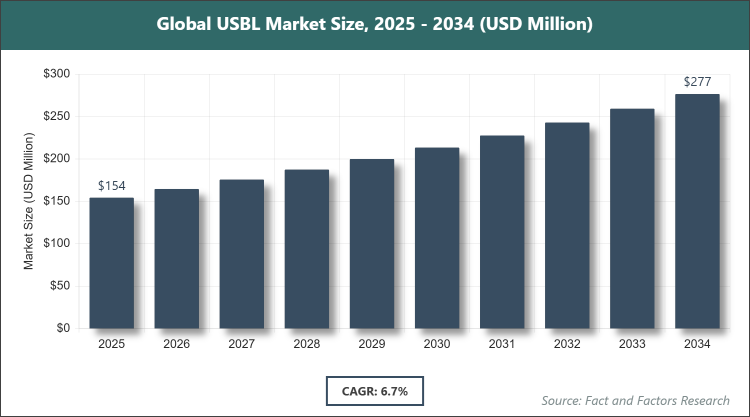
[228+ Pages Report] According to Facts & Factors, the global USBL market size was estimated at USD 154.3 million in 2025 and is expected to reach USD 280 million by the end of 2034. The USBL industry is anticipated to grow by a CAGR of 6.7% between 2026 and 2034. The USBL Market is driven by rising offshore exploration and advancements in underwater positioning technologies.
 Market Overview
The USBL market, referring to Ultra-Short Baseline positioning systems, encompasses acoustic underwater tracking technologies that utilize a compact array of transducers to determine the position of subsea assets with high precision, serving critical roles in navigation, surveying, and asset management for marine operations without incorporating quantitative metrics in this foundational explanation.
Key Insights
- As per the analysis shared by our research analyst, the global USBL market is estimated to grow annually at a CAGR of around 6.7% over the forecast period (2026-2034).
- In terms of revenue, the global USBL market size was valued at around USD 154.3 million in 2025 and is projected to reach USD 280 million by 2034.
- The market is driven by expanding offshore oil & gas activities and increasing demand for precise subsea positioning.
- Based on the Component, the Transceivers segment dominated the market in 2025 with a share of over 35%, due to its essential role in signal transmission and reception for accurate positioning in marine environments.
- Based on the Application, the Positioning segment dominated the market in 2025 with a share of over 40%, attributed to its critical use in real-time tracking of underwater vehicles and equipment.
- Based on the End-User, the Oil & Gas segment dominated the market in 2025 with a share of over 45%, owing to extensive offshore exploration and production requiring reliable subsea navigation.
- Based on the region, North America dominated the market in 2025 with a share of around 35%, driven by advanced marine research initiatives and the strong presence of key industry players in the United States.
Growth Drivers
- Rising Offshore Exploration Activities
The expansion of offshore oil and gas exploration, particularly in deep-water regions, is a primary driver for USBL systems, as they provide essential, precise positioning for remotely operated vehicles (ROVs) and autonomous underwater vehicles (AUVs) during drilling and surveying operations. This demand is amplified by the need for enhanced safety and efficiency in challenging underwater environments, leading to increased adoption of advanced acoustic technologies.
Technological integrations such as improved signal processing and hybrid systems combining USBL with inertial navigation further accelerate growth, enabling better accuracy in dynamic conditions and supporting the industry's shift towards automated subsea operations.
Restraints
- High Initial Investment Costs
The substantial capital required for deploying USBL systems, including sophisticated transceivers and software, poses a barrier for small-scale operators in marine industries, limiting market penetration in cost-sensitive regions. This financial constraint often results in delayed upgrades or reliance on outdated technologies, affecting overall adoption rates.
Environmental factors like water salinity and temperature variations can degrade signal accuracy, necessitating additional calibration and maintenance expenses that further strain budgets for end-users.
Opportunities
- Advancements in Renewable Energy Projects
The growth of offshore wind farms and marine renewable energy installations creates avenues for USBL applications in site surveying and construction, where precise positioning ensures efficient turbine placement and cable laying. Innovations in portable and cost-effective systems open doors for smaller renewable projects to utilize high-accuracy tracking.
Collaborations between technology providers and energy firms foster customized solutions, potentially unlocking new revenue streams through integrated platforms that combine USBL with AI for predictive maintenance in renewable setups.
Challenges
- Regulatory and Environmental Compliance
Stringent maritime regulations on acoustic emissions to protect marine life challenge USBL deployments, requiring modifications to reduce noise pollution while maintaining performance. This compliance adds complexity to system design and increases development timelines.
Geopolitical tensions in key offshore regions disrupt supply chains for critical components, potentially leading to shortages and elevated prices that hinder market stability.
Report Scope
Report Attribute |
Details |
Market Size 2025 |
USD 154.3 Million |
Projected Market Size in 2034 |
USD 280 Million |
CAGR Growth Rate |
6.7% CAGR |
Base Year |
2025 |
Forecast Years |
2026-2034 |
Key Market Players |
Kongsberg Maritime, Sonardyne International Ltd., Teledyne Marine, iXblue (Exail), EdgeTech, EvoLogics GmbH, LinkQuest, Applied Acoustics, Seatronics, Blueprint Design Engineering Ltd., and Others. |
Key Segment |
By Component, By Application, By End-User, and By Region |
Major Regions Covered |
North America, Europe, Asia Pacific, Latin America, and the Middle East & Africa |
Purchase Options |
Request customized purchase options to meet your research needs. Explore purchase options |
Market Segmentation
The USBL market is segmented by component, application, end-user, and region.
Based on Component Segment, the USBL market is divided into Transceivers, Transponders/Responders, Beacons, Software, and Others. The most dominant segment is Transceivers, holding over 35% share, due to their core function in enabling bidirectional communication for precise distance measurements, driving the market by supporting high-accuracy operations in defense and oil exploration; the second most dominant is Software, essential for data processing and integration, contributing to growth through advanced algorithms that enhance system reliability and user interface in complex underwater scenarios.
Based on Application Segment, the USBL market is divided into Navigation, Positioning, Tracking, Offshore Construction, and Others. The most dominant segment is Positioning, with over 40% share, as it provides real-time coordinates for subsea assets, propelling the market by facilitating efficient ROV deployments in marine surveys; the second most dominant is Tracking, crucial for monitoring dynamic objects, aiding expansion through applications in underwater vehicle control and asset recovery.
Based on End-User Segment, the USBL market is divided into Oil & Gas, Defense & Security, Renewable Energy, Marine Research, and Others. The most dominant segment is Oil & Gas, capturing over 45% share, owing to its reliance on accurate subsea positioning for exploration, fueling market progress by enabling deep-water operations and reducing risks; the second most dominant is Defense & Security, where USBL supports naval missions, advancing the market through integrations with autonomous systems for strategic surveillance.
Recent Developments
- In February 2026, an INS + USBL System was introduced to cut mobilization time and enhance safety for SEP Hydrographic operations.
- In December 2025, an offshore support vessel upgraded with a high-precision USBL positioning system for improved subsea tasks.
- In May 2025, Teledyne Marine participated in SeaSEC Challenge, showcasing integrated USBL for maritime security.
- In March 2025, Imenco announced a partnership with Teledyne Marine to develop USBL-enabled sensor modules for AUVs.
Regional Analysis
- North America to dominate the global market
North America excels in the USBL domain with its advanced technological infrastructure and significant investments in marine defense and energy sectors that demand high-precision underwater solutions. The United States dominates as the key country, propelled by leading manufacturers like Teledyne Marine and government-funded R&D in naval technologies. The region's focus on offshore wind and oil exploration integrates USBL for efficient operations, supported by robust regulatory frameworks that encourage innovation while ensuring environmental compliance.
Asia Pacific demonstrates rapid advancement through expanding maritime activities and industrialization, with China as the dominating country leveraging state-backed initiatives for subsea exploration and renewable projects. This area capitalizes on cost-effective manufacturing to supply global markets, fostering growth in tracking applications amid rising demand for underwater resources.
Europe upholds a prominent role with its emphasis on sustainable marine technologies and collaborative research, positioning the United Kingdom as the dominating country through expertise in acoustic systems from firms like Sonardyne. The continent prioritizes integrations with autonomous vehicles for environmental monitoring, enhancing market resilience.
Latin America is emerging via resource-rich offshore sectors, led by Brazil as the dominating country utilizing USBL in deep-water oil fields. This region benefits from international partnerships to advance local capabilities in positioning for energy security.
The Middle East & Africa progresses through strategic oil and gas developments, with the United Arab Emirates as the dominating country investing in advanced subsea tech for diversification. This area focuses on robust systems for harsh environments, supporting regional infrastructure.
Competitive Analysis
The global USBL market is dominated by players:
- Kongsberg Maritime
- Sonardyne International Ltd.
- Teledyne Marine
- iXblue (Exail)
- EdgeTech
- EvoLogics GmbH
- LinkQuest
- Applied Acoustics
- Seatronics
- Blueprint Design Engineering Ltd.
The global USBL market is segmented as follows:
By Component
- Transceivers
- Transponders/Responders
- Beacons
- Software
- Others
By Application
- Navigation
- Positioning
- Tracking
- Offshore Construction
- Others
By End-User
- Oil & Gas
- Defense & Security
- Renewable Energy
- Marine Research
- Others
By Region
-
North America
- The U.S.
- Canada
- Mexico
- Europe
- France
- The UK
- Spain
- Germany
- Italy
- Rest of Europe
- Asia Pacific
- China
- Japan
- India
- Australia
- Southeast Asia
- Rest of Asia Pacific
- The Middle East & Africa
- Saudi Arabia
- UAE
- Egypt
- Kuwait
- South Africa
- Rest of the Middle East & Africa
- Latin America
- Brazil
- Argentina
- Rest of Latin America
Industry Major Market Players
- Kongsberg Maritime
- Sonardyne International Ltd.
- Teledyne Marine
- iXblue (Exail)
- EdgeTech
- EvoLogics GmbH
- LinkQuest
- Applied Acoustics
- Seatronics
- Blueprint Design Engineering Ltd.
Frequently Asked Questions



Copyright © 2025 - 2026, All Rights Reserved, Facts and Factors