
Search Market Research Report
Unmanned Aerial Vehicle (UAV) Market Size, Share Global Analysis Report, 2026-2034

Unmanned Aerial Vehicle (UAV) Market Size, Share, Growth Analysis Report By Type (Fixed Wing, Rotary Wing, Hybrid, and Others), By Application (Military & Defense, Commercial, Consumer, and Others), By End-User (Agriculture, Construction, Logistics, Media & Entertainment, Public Safety, and Others), and By Region - Global Industry Insights, Overview, Comprehensive Analysis, Trends, Statistical Research, Market Intelligence, Historical Data and Forecast 2026-2034
Industry Insights
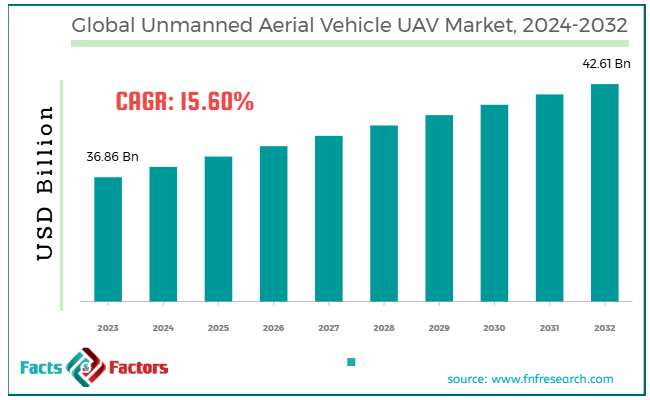
[240+ Pages Report] According to Facts & Factors, the global Unmanned Aerial Vehicle (UAV) market size was estimated at USD 41.27 billion in 2025 and is expected to reach USD 160.44 billion by the end of 2034. The Unmanned Aerial Vehicle (UAV) industry is anticipated to grow by a CAGR of 16.4% between 2026 and 2034. The Unmanned Aerial Vehicle (UAV) Market is driven by technological advancements and expanding applications in defense and commercial sectors.
 Market Overview
The unmanned aerial vehicle (UAV) market involves the development, production, and deployment of remotely piloted or autonomous aircraft designed for various tasks, including surveillance, reconnaissance, delivery, and data collection, offering advantages in cost-efficiency, safety, and versatility across military, commercial, and consumer applications without relying on onboard human operators.
Key Insights
- As per the analysis shared by our research analyst, the global Unmanned Aerial Vehicle (UAV) market is estimated to grow annually at a CAGR of around 16.4% over the forecast period (2026-2034).
- In terms of revenue, the global Unmanned Aerial Vehicle (UAV) market size was valued at around USD 41.27 billion in 2025 and is projected to reach USD 160.44 billion by 2034.
- The market is driven by increasing adoption in defense surveillance and commercial logistics.
- Based on the Type, the Rotary Wing segment dominated the market in 2025 with a share of over 61%, due to its versatility in hovering and maneuverability for urban and close-range operations.
- Based on the Application, the Military & Defense segment dominated the market in 2025 with a share of over 60%, attributed to high demand for reconnaissance and tactical missions in global conflicts.
- Based on the End-User, the Defense segment dominated the market in 2025 with a share of over 68%, owing to substantial government investments in advanced UAV technologies for security.
- Based on the region, North America dominated the market in 2025 with a share of around 34%, driven by leading manufacturers and high defense spending in the United States.
Growth Drivers
- Advancements in AI and Autonomous Technologies
Integration of artificial intelligence enables enhanced autonomy, allowing UAVs to perform complex tasks like real-time data analysis and obstacle avoidance without constant human intervention. This capability expands applications in precision agriculture, disaster response, and border surveillance, driving market adoption by improving efficiency and reducing operational costs.
Ongoing R&D in battery life and sensor fusion further supports longer flight times and better performance, attracting investments from both defense and commercial sectors to leverage these innovations for competitive advantages.
Restraints
- Regulatory Hurdles and Airspace Restrictions
Strict regulations on drone operations, including beyond visual line of sight (BVLOS) limitations, hinder widespread deployment, particularly in urban areas where airspace congestion poses safety risks. Compliance with varying international standards increases development timelines and costs for manufacturers.
Privacy concerns and potential misuse lead to additional scrutiny, potentially delaying approvals and limiting market entry for new players in sensitive applications like public safety.
Opportunities
- Expansion in Commercial Delivery and Logistics
The rise of e-commerce fuels demand for UAV-based last-mile delivery, offering faster and cost-effective solutions in remote or congested areas. Partnerships with logistics giants like Amazon accelerate infrastructure development for drone hubs and automated systems.
Emerging markets in developing regions present untapped potential, where UAVs can address challenges in healthcare supply chains and agricultural monitoring, supported by favorable government policies.
Challenges
- Cybersecurity Vulnerabilities
Increasing reliance on connected systems exposes UAVs to hacking risks, potentially compromising missions or data integrity in critical defense operations. Developing robust encryption and secure communication protocols requires significant investment.
Battery limitations in endurance constrain long-range applications, necessitating advancements in energy density while balancing weight and cost factors.
Report Scope
Report Attribute |
Details |
Market Size 2025 |
USD 41.27 Billion |
Projected Market Size in 2034 |
USD 160.44 Billion |
CAGR Growth Rate |
16.4% CAGR |
Base Year |
2025 |
Forecast Years |
2026-2034 |
Key Market Players |
DJI, Northrop Grumman Corporation, General Atomics Aeronautical Systems, Lockheed Martin Corporation, Boeing Company, Parrot SA, AeroVironment, Inc., Teledyne FLIR LLC, BAE Systems PLC, Yuneec International Co. Ltd., and Others. |
Key Segment |
By Type, By Application, By End-User, and By Region |
Major Regions Covered |
North America, Europe, Asia Pacific, Latin America, and the Middle East & Africa |
Purchase Options |
Request customized purchase options to meet your research needs. Explore purchase options |
Market Segmentation
The Unmanned Aerial Vehicle (UAV) market is segmented by type, application, end-user, and region.
Based on Type Segment, the Unmanned Aerial Vehicle (UAV) market is divided into Fixed Wing, Rotary Wing, Hybrid, and Others. The most dominant segment is Rotary Wing, holding over 61% share, due to its superior hover capabilities and ease of use in diverse environments like urban surveillance, driving the market by enabling agile operations in commercial inspections and military reconnaissance; the second most dominant is Fixed Wing, valued for long-range endurance, contributing to growth through applications in large-area mapping and persistent monitoring.
Based on Application Segment, the Unmanned Aerial Vehicle (UAV) market is divided into Military & Defense, Commercial, Consumer, and Others. The most dominant segment is Military & Defense, with over 60% share, as it provides essential tools for intelligence gathering and targeted strikes, propelling the market by meeting global security demands with advanced tactical systems; the second most dominant is Commercial, driven by expanding uses in delivery and agriculture, aiding expansion through cost-effective data collection and logistics solutions.
Based on End-User Segment, the Unmanned Aerial Vehicle (UAV) market is divided into Agriculture, Construction, Logistics, Media & Entertainment, Public Safety, and Others. The most dominant segment is Defense, capturing over 68% share, owing to heavy investments in unmanned systems for strategic operations, fueling market progress by enhancing military capabilities with autonomous features; the second most dominant is Agriculture, where UAVs optimize crop management, advancing the market through precision farming technologies.
Recent Developments
- In February 2025, AeroVironment launched the JUMP 20-X, a new Group-3 UAS Drone with advanced AI-powered autonomy for maritime and defense missions.
- In June 2025, Aykar and Leonardo established a joint venture focusing on unmanned technologies.
- In July 2025, DJI unveiled three new agricultural drones, Agras T100, T70P, and T25P, to enhance large-scale precision farming.
- In November 2025, Unmanned Systems Group launched the Supercam S180 unmanned aerial vehicle as part of a joint exhibition.
Regional Analysis
- North America to dominate the global market
North America asserts dominance in the UAV sector through its cutting-edge technological ecosystem and substantial defense expenditures that prioritize unmanned systems for enhanced security. The United States leads as the dominating country, with major firms like Northrop Grumman driving innovations in autonomous flight and AI integration for military applications. The region's robust regulatory framework supports commercial expansions in delivery and agriculture, fostering a competitive landscape for startups and established players alike.
Asia Pacific emerges as a high-growth area fueled by rapid industrialization and government initiatives promoting drone adoption in diverse sectors like agriculture and surveillance. China stands out as the dominating country, leveraging massive manufacturing capabilities and state-backed R&D to produce cost-effective UAVs for global export. The continent's focus on smart cities integrates drones for urban management, amplifying market potential amid population density challenges.
Europe maintains a strong position with its emphasis on regulatory harmonization and sustainable technologies, positioning Germany as the dominating country through engineering prowess in precision systems. The area prioritizes collaborative projects under EU frameworks, advancing UAVs for environmental monitoring and border security while addressing privacy concerns effectively.
Latin America shows promising development supported by resource extraction and agricultural needs, with Brazil as the dominating country utilizing drones for vast terrain mapping. This region capitalizes on foreign investments to build local capabilities, enhancing efficiency in mining and farming operations.
The Middle East & Africa progresses via strategic defense enhancements, led by the United Arab Emirates as the dominating country through ambitious programs in unmanned warfare. This area focuses on arid-adapted technologies for surveillance, supporting regional stability efforts.
Competitive Analysis
The global Unmanned Aerial Vehicle (UAV) market is dominated by players:
- DJI
- Northrop Grumman Corporation
- General Atomics Aeronautical Systems
- Lockheed Martin Corporation
- Boeing Company
- Parrot SA
- AeroVironment, Inc.
- Teledyne FLIR LLC
- BAE Systems PLC
- Yuneec International Co. Ltd.
The global Unmanned Aerial Vehicle (UAV) market is segmented as follows:
By Type
- Fixed Wing
- Rotary Wing
- Hybrid
- Others
By Application
- Military & Defense
- Commercial
- Consumer
- Others
By End-User
- Agriculture
- Construction
- Logistics
- Media & Entertainment
- Public Safety
- Others
By Region
- North America
- The U.S.
- Canada
- Mexico
- Europe
- France
- The UK
- Spain
- Germany
- Italy
- Rest of Europe
- Asia Pacific
- China
- Japan
- India
- Australia
- Southeast Asia
- Rest of Asia Pacific
- The Middle East & Africa
- Saudi Arabia
- UAE
- Egypt
- Kuwait
- South Africa
- Rest of the Middle East & Africa
- Latin America
- Brazil
- Argentina
- Rest of Latin America
Industry Major Market Players
- DJI
- Northrop Grumman Corporation
- General Atomics Aeronautical Systems
- Lockheed Martin Corporation
- Boeing Company
- Parrot SA
- AeroVironment, Inc.
- Teledyne FLIR LLC
- BAE Systems PLC
- Yuneec International Co. Ltd.
Frequently Asked Questions
What are the various stages in the value chain of the global Unmanned Aerial Vehicle (UAV) industry?



Copyright © 2025 - 2026, All Rights Reserved, Facts and Factors