
Search Market Research Report
Performance Fabrics Market Size, Share Global Analysis Report, 2026-2034

Performance Fabrics Market Size, Share, Growth Analysis Report By Type (Polyester, Nylon, Aramid, and Others), By Application (Sportswear, Protective Clothing, Automotive Textiles, Medical Textiles, and Others), By End-User (Apparel, Industrial, Defense & Public Safety, and Others), and By Region - Global Industry Insights, Overview, Comprehensive Analysis, Trends, Statistical Research, Market Intelligence, Historical Data and Forecast 2026-2034
Industry Insights
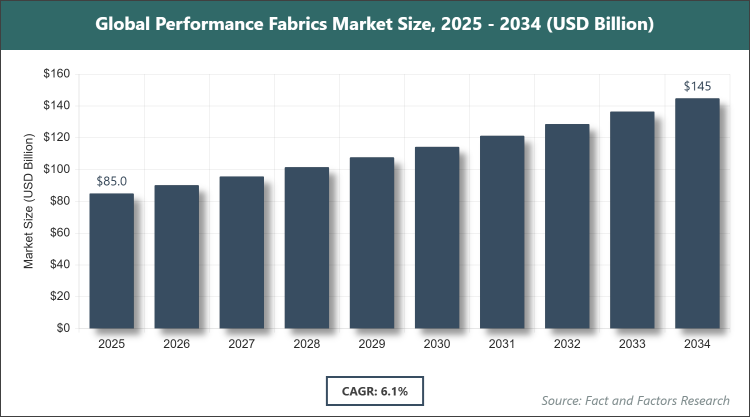
[239 + Pages Report] According to Facts & Factors, the global Performance Fabrics market size was estimated at USD 85 billion in 2025 and is expected to reach USD 145 billion by the end of 2034. The Performance Fabrics industry is anticipated to grow by a CAGR of 6.1% between 2026 and 2034. The Performance Fabrics Market is driven by rising demand for functional, durable, and high-performance textiles across sportswear, protective gear, automotive, and industrial applications.
 Market Overview
The Performance Fabrics market encompasses advanced textile materials engineered with specialized functional properties such as moisture management, breathability, flame resistance, UV protection, abrasion resistance, and antimicrobial capabilities that far exceed those of conventional fabrics. These fabrics are produced through advanced weaving, knitting, coating, lamination, and membrane technologies using synthetic fibers like polyester, nylon, and aramid, often combined with functional finishes or membranes to deliver targeted performance characteristics. They find critical use in demanding environments where standard textiles would fail, serving industries that require lightweight strength, weather resistance, thermal regulation, or chemical protection while maintaining comfort, flexibility, and durability for end users ranging from athletes and first responders to industrial workers and medical professionals.
Key Insights
- As per the analysis shared by our research analyst, the Performance Fabrics market is estimated to grow annually at a CAGR of around 6.1% over the forecast period (2026-2034).
- In terms of revenue, the Performance Fabrics market size was valued at around USD 85 billion in 2025 and is projected to reach USD 145 billion by 2034.
- The Performance Fabrics Market is driven by increasing demand for functional textiles in sports, protective, and industrial sectors.
- Based on the Type, the Polyester segment dominated the market in 2025 with a share of 48% due to its excellent durability, cost-effectiveness, moisture-wicking properties, and versatility across multiple applications.
- Based on the Application, the Sportswear segment dominated the market in 2025 with a share of 39% owing to the global boom in fitness, athleisure fashion, and outdoor activities requiring breathable, stretchable, and quick-dry fabrics.
- Based on the End-User, the Apparel segment dominated the market in 2025 with a share of 55% because of massive consumption in sportswear, outdoor clothing, and everyday functional garments driven by consumer lifestyle shifts.
- Asia Pacific dominated the global Performance Fabrics market in 2025 with a share of 47% attributed to large-scale manufacturing capacity, raw material availability, growing sportswear exports, and rising domestic demand from apparel and industrial sectors.
Growth Drivers
- Rising Health and Fitness Consciousness
The global surge in participation in sports, outdoor activities, and fitness routines has dramatically increased demand for high-performance sportswear that offers moisture management, compression, and UV protection, directly boosting consumption of specialized performance fabrics.
Stringent workplace safety regulations and growing awareness of personal protective equipment have expanded the use of flame-retardant, cut-resistant, and chemical-resistant fabrics in industrial and defense applications, creating steady high-volume demand.
Restraints
- High Production Costs and Technical Complexity
Advanced performance fabrics require specialized raw materials, multi-step processing, and rigorous testing, resulting in higher manufacturing costs that limit adoption among price-sensitive end users and smaller manufacturers.
Environmental concerns regarding the use of synthetic fibers and chemical finishes create regulatory and consumer resistance, pushing manufacturers to invest in sustainable alternatives that are still in early commercialization stages.
Opportunities
- Integration of Smart and Sustainable Technologies
Incorporation of sensors, phase-change materials, and conductive yarns into performance fabrics is opening premium segments in wearable technology, medical monitoring, and military applications with higher margins.
Shift toward bio-based fibers, recycled polyester, and low-impact manufacturing processes is enabling brands to meet sustainability targets while tapping into the growing eco-conscious consumer base across apparel and industrial markets.
Challenges
- Raw Material Price Volatility and Supply Chain Issues
Fluctuations in petrochemical prices and disruptions in specialty fiber supply directly impact production costs and lead times, affecting profitability and consistent product availability across global markets.
Intense competition from low-cost conventional textiles in developing regions and the need for continuous R&D to meet evolving performance standards create pressure on smaller players and require significant capital investment.
Report Scope
Report Attribute |
Details |
Market Size 2025 |
USD 85 Billion |
Projected Market Size in 2034 |
USD 145 Billion |
CAGR Growth Rate |
6.1% CAGR |
Base Year |
2025 |
Forecast Years |
2026-2034 |
Key Market Players |
DuPont de Nemours, Inc., Toray Industries, Inc., Teijin Limited, Invista, Milliken & Company, Gore, 3M Company, and Others. |
Key Segment |
By Type, By Application, By End-User, and By Region |
Major Regions Covered |
North America, Europe, Asia Pacific, Latin America, and the Middle East & Africa |
Purchase Options |
Request customized purchase options to meet your research needs. Explore purchase options |
Market Segmentation
The Performance Fabrics market is segmented by type, application, end-user, and region.
Based on Type Segment, the Performance Fabrics market is divided into polyester, nylon, aramid, and others. The most dominant segment is Polyester, followed by Nylon. Polyester dominates because of its optimal balance of strength, elasticity, moisture-wicking ability, quick-drying characteristics, and competitive pricing, which make it the preferred choice for sportswear and industrial applications while driving volume growth and enabling manufacturers to offer customized functional finishes that further accelerate market expansion and innovation across end-use industries.
Based on Application Segment, the Performance Fabrics market is divided into sportswear, protective clothing, automotive textiles, medical textiles, and others. The most dominant segment is Sportswear, followed by Protective Clothing. Sportswear leads the segment due to the explosive growth in global fitness trends, athleisure fashion, and outdoor recreational activities that demand lightweight, breathable, stretchable, and durable fabrics, generating the largest consumption volumes and stimulating continuous product development in moisture management and compression technologies that propel overall market revenue growth.
Based on End-User Segment, the Performance Fabrics market is divided into apparel, industrial, defense & public safety, and others. The most dominant segment is Apparel, followed by Industrial. Apparel dominates because everyday and performance clothing for sports, outdoor, and casual wear accounts for the highest volume usage, supported by rising consumer spending on functional garments and brand-driven demand for innovative textiles that enhance comfort and performance, thereby creating sustained market momentum through large-scale apparel manufacturing and retail channels worldwide.
Recent Developments
- In January 2025, Toray Industries introduced a new recycled polyester performance fabric with enhanced breathability and stretch for premium sportswear brands in Europe and North America.
- In April 2025, DuPont launched an advanced Kevlar-based protective fabric line with improved cut and flame resistance for industrial and military applications.
- In July 2025, Teijin Limited expanded its Twaron aramid production capacity in Asia to meet growing demand from automotive and protective clothing sectors.
- In October 2025, Gore announced the commercial availability of a new GORE-TEX membrane with superior waterproof-breathable performance for outdoor apparel manufacturers.
- In December 2025, Milliken & Company introduced a sustainable antimicrobial performance fabric collection using recycled content for healthcare and hospitality end uses.
Regional Analysis
- Asia Pacific to dominate the global market
Asia Pacific leads the Performance Fabrics market through its massive textile manufacturing infrastructure, abundant availability of raw materials, and position as the global hub for sportswear and apparel production. The region benefits from rapid urbanization, rising disposable incomes, and strong government support for technical textile industries in key economies. Export-oriented manufacturing combined with robust domestic consumption in sportswear and industrial applications further strengthens its dominance. China dominates within Asia Pacific with its unparalleled production scale, advanced weaving and coating technologies, vertically integrated supply chains, and leadership in supplying performance fabrics to global brands while also serving its huge internal market for protective and automotive textiles.
North America maintains significant growth in the Performance Fabrics market, supported by technological innovation, high consumer spending on premium sportswear, and stringent safety standards across industrial and defense sectors. The region excels in R&D for smart fabrics and sustainable materials while benefiting from the strong brand presence of major sportswear and protective equipment companies. The United States dominates within North America through its advanced material science ecosystem, presence of leading specialty chemical and textile companies, and high adoption rates of high-performance fabrics in military, automotive, and athletic applications.
Europe exhibits steady and innovation-led expansion in the Performance Fabrics market, driven by strict environmental regulations, strong emphasis on worker safety, and leadership in sustainable and circular textile solutions. The region supports premium pricing for high-quality functional fabrics in the outdoor, medical, and automotive sectors. Germany dominates within Europe with its world-class engineering capabilities, advanced chemical and textile machinery industries, and central role in developing next-generation performance fabrics for automotive, protective clothing, and technical applications across the continent.
Latin America is witnessing accelerating development in the Performance Fabrics market, fueled by growing sportswear consumption, industrialization, and increasing safety awareness inthe mining and oil & gas sectors. Rising foreign investments in local manufacturing and expanding retail presence of international sportswear brands are boosting demand. Brazil dominates the region with its large population, vibrant apparel industry, and expanding industrial base that increasingly incorporates performance fabrics for protective and functional applications.
The Middle East & Africa region shows promising growth in the Performance Fabrics market, supported by infrastructure development, rising safety standards in oil & gas and construction, and growing interest in sportswear among younger populations. Strategic investments in textile parks and imports of advanced materials are enhancing local capabilities. The United Arab Emirates leads within the region through its modern manufacturing initiatives, focus on diversification, and role as a re-export hub for high-performance textiles serving construction, hospitality, and sports sectors across the Middle East.
Competitive Analysis
The global Performance Fabrics market is dominated by players:
- DuPont de Nemours, Inc.
- Toray Industries, Inc.
- Teijin Limited
- Invista (Koch Industries)
- Milliken & Company
- Gore (W. L. Gore & Associates)
- 3M Company
- Royal Ten Cate (TenCate)
- Hexcel Corporation
- Owens Corning
The global Performance Fabrics market is segmented as follows:
By Type
- Polyester
- Nylon
- Aramid
- Others
By Application
- Sportswear
- Protective Clothing
- Automotive Textiles
- Medical Textiles
- Others
By End-User
- Apparel
- Industrial
- Defense & Public Safety
- Others
By Region
- North America
- The U.S.
- Canada
- Mexico
- Europe
- France
- The UK
- Spain
- Germany
- Italy
- Rest of Europe
- Asia Pacific
- China
- Japan
- India
- Australia
- Southeast Asia
- Rest of Asia Pacific
- The Middle East & Africa
- Saudi Arabia
- UAE
- Egypt
- Kuwait
- South Africa
- Rest of the Middle East & Africa
- Latin America
- Brazil
- Argentina
- Rest of Latin America
Industry Major Market Players
- DuPont de Nemours, Inc.
- Toray Industries, Inc.
- Teijin Limited
- Invista (Koch Industries)
- Milliken & Company
- Gore (W. L. Gore & Associates)
- 3M Company
- Royal Ten Cate (TenCate)
- Hexcel Corporation
- Owens Corning
Frequently Asked Questions



Copyright © 2025 - 2026, All Rights Reserved, Facts and Factors