
Search Market Research Report
U.S. School Furniture Market Size, Share Global Analysis Report, 2026-2034

U.S. School Furniture Market Size, Share, Growth Analysis Report By Product Type (Seating Furniture, Storage Units, Lab Equipment, and Others), By Application (Classroom, Library & Labs, and Others), By End-User (Primary Schools, Secondary Schools, and Others), and By Region - Global Industry Insights, Overview, Comprehensive Analysis, Trends, Statistical Research, Market Intelligence, Historical Data and Forecast 2026-2034
Industry Insights
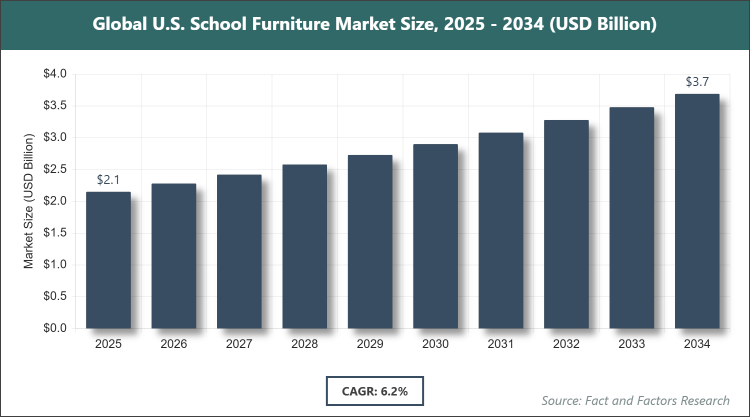
[215+ Pages Report] According to Facts & Factors, the U.S. School Furniture market size was estimated at USD 2.15 billion in 2025 and is expected to reach USD 3.70 billion by the end of 2034. The U.S. School Furniture industry is anticipated to grow by a CAGR of 6.2% between 2026 and 2034. The U.S. School Furniture Market is driven by increasing investments in educational infrastructure and ergonomic designs.
 Market Overview
The U.S. school furniture market encompasses the design, manufacturing, and distribution of furnishings tailored for educational environments, including desks, chairs, storage units, and lab equipment, aimed at promoting student comfort, collaboration, and learning efficiency while adhering to safety and durability standards across K-12 institutions.
Key Insights
- As per the analysis shared by our research analyst, the U.S. School Furniture market is estimated to grow annually at a CAGR of around 6.2% over the forecast period (2026-2034).
- In terms of revenue, the U.S. School Furniture market size was valued at around USD 2.15 billion in 2025 and is projected to reach USD 3.70 billion by 2034.
- The market is driven by a rising focus on flexible learning spaces and student health in schools.
- Based on the Product Type, the Seating Furniture segment dominated the market in 2025 with a share of over 55%, due to its emphasis on ergonomics and adaptability for prolonged student use in classrooms.
- Based on the Application, the Classroom segment dominated the market in 2025 with a share of over 77%, attributed to the need for modular setups supporting collaborative and tech-integrated education.
- Based on the End-User, the Primary Schools segment dominated the market in 2025 with a share of over 50%, owing to higher enrollment and focus on safe, durable furniture for young learners.
- Based on the region, South dominated the market in 2025 with a share of around 35%, driven by large student populations and significant state investments in school infrastructure upgrades.
Growth Drivers
- Increasing Investments in Educational Infrastructure
Government funding and private initiatives for school modernization are fueling demand for updated furniture, as states allocate budgets for renovations that incorporate ergonomic and flexible designs to enhance learning outcomes. This support is particularly evident in programs aimed at integrating technology, requiring furniture with built-in features for devices.
Advancements in materials like sustainable woods and plastics improve durability and appeal, encouraging schools to replace outdated items with eco-friendly options that align with green building standards and long-term cost savings.
Restraints
- Budget Constraints in Public Schools
Limited funding in many districts restricts large-scale purchases, leading to delayed upgrades and reliance on low-cost alternatives that may compromise quality and longevity. This issue is exacerbated by economic fluctuations affecting state education budgets.
Supply chain disruptions for raw materials increase costs, making it challenging for manufacturers to maintain affordable pricing while meeting demand for customized solutions.
Opportunities
- Rise of Hybrid and Flexible Learning Models
The shift towards blended education creates needs for adaptable furniture that supports both in-person and remote setups, opening markets for modular pieces that can be reconfigured easily. This trend attracts innovations in smart furniture with integrated tech.
Sustainability certifications and eco-materials offer premium positioning, appealing to environmentally conscious districts and enabling partnerships with green suppliers for differentiated products.
Challenges
- Regulatory Compliance and Safety Standards
Stringent requirements for fire-retardant and non-toxic materials raise production costs, requiring ongoing R&D to meet evolving guidelines across states. Non-compliance risks can lead to product recalls and loss of trust.
Competition from imported low-cost furniture pressures domestic manufacturers to innovate while managing margins, amid concerns over quality and durability in budget-driven purchases.
Report Scope
Report Attribute |
Details |
Market Size 2025 |
USD 2.15 Billion |
Projected Market Size in 2034 |
USD 3.70 Billion |
CAGR Growth Rate |
6.2% CAGR |
Base Year |
2025 |
Forecast Years |
2026-2034 |
Key Market Players |
Steelcase Inc., MillerKnoll, Inc., Virco Manufacturing Corporation, The HON Company, Knoll, Inc., Haworth, Inc., Smith System, KI (Krueger International), VS America, Inc., Paragon Furniture, Inc., and Others. |
Key Segment |
By Product Type, By Application, By End-User, and By Region |
Major Regions Covered |
North America, Europe, Asia Pacific, Latin America, and the Middle East & Africa |
Purchase Options |
Request customized purchase options to meet your research needs. Explore purchase options |
Market Segmentation
The U.S. School Furniture market is segmented by product type, application, end-user, and region.
Based on Product Type Segment, the U.S. School Furniture market is divided into Seating Furniture, Storage Units, Lab Equipment, and Others. The most dominant segment is Seating Furniture, holding over 55% share, due to its critical role in student comfort and posture support during long hours, driving the market by enabling ergonomic environments that boost focus and reduce health issues; the second most dominant is Storage Units, essential for organization in modern classrooms, contributing to growth through flexible designs that accommodate tech and supplies efficiently.
Based on Application Segment, the U.S. School Furniture market is divided into Classroom, Library & Labs, and Others. The most dominant segment is Classroom, with over 77% share, as it forms the core of daily education activities requiring versatile setups, propelling the market by facilitating collaborative learning and tech integration; the second most dominant is Library & Labs, driven by specialized needs for hands-on experiments and research, aiding expansion through durable, adaptable solutions for STEM-focused curricula.
Based on End-User Segment, the U.S. School Furniture market is divided into Primary Schools, Secondary Schools, and Others. The most dominant segment is Primary Schools, capturing over 50% share, owing to high enrollment and emphasis on safe, engaging spaces for young children, fueling market progress by prioritizing developmental furniture that supports early education; the second most dominant is Secondary Schools, where advanced designs meet teen needs, advancing the market through innovations in modular and tech-ready pieces.
Recent Developments
- In March 2024, Smith System partnered with Landscape Forms to introduce 'OpenSpaces', a line of durable outdoor school furniture enhancing learning experiences.
- In February 2023, Smith System, under Steelcase, appointed six new Premier Dealer Partners to expand the distribution of innovative classroom solutions.
- In January 2024, Classroom Furniture launched 'GreenClassroom', an eco-friendly product line in partnership with EcoMate for sustainable materials.
- In April 2025, the U.S. Department of Education announced a USD 1 billion initiative for school infrastructure upgrades, including modern furniture procurement.
Regional Analysis
- South to dominate the market
The South region stands as a powerhouse in the U.S. school furniture landscape, characterized by expansive educational systems and substantial investments in student facilities that prioritize durability and flexibility. Texas emerges as the dominating state, leveraging its large student population and state-funded programs to drive demand for ergonomic and tech-integrated furniture. The area's warm climate influences preferences for robust materials, fostering innovations that enhance collaborative learning while addressing diverse demographic needs.
The West region exhibits dynamic growth through its focus on innovative and sustainable designs, with California leading as the dominating state via progressive education policies and tech-savvy environments. This area emphasizes modular setups that support hybrid models, attracting manufacturers to develop eco-friendly solutions amid urban expansion.
The Midwest maintains steady progress with its emphasis on practical and cost-effective furniture, positioning Illinois as the dominating state through industrial hubs and renovation initiatives. The region balances tradition with modernity, promoting durable pieces for rural and urban schools alike.
The Northeast showcases maturity in quality-driven markets, with New York as the dominating state utilizing dense populations and high budgets for premium ergonomic options. This area integrates advanced features to meet rigorous standards, enhancing student engagement in historic yet updated institutions.
Competitive Analysis
The U.S. School Furniture market is dominated by players:
- Steelcase Inc.
- MillerKnoll, Inc.
- Virco Manufacturing Corporation
- The HON Company
- Knoll, Inc.
- Haworth, Inc.
- Smith System
- KI (Krueger International)
- VS America, Inc.
- Paragon Furniture, Inc.
The U.S. School Furniture market is segmented as follows:
By Product Type
- Seating Furniture
- Storage Units
- Lab Equipment
- Others
By Application
- Classroom
- Library & Labs
- Others
By End-User
- Primary Schools
- Secondary Schools
- Others
By Region
- Northeast
- Midwest
- South
- West
Industry Major Market Players
- Steelcase Inc.
- MillerKnoll, Inc.
- Virco Manufacturing Corporation
- The HON Company
- Knoll, Inc.
- Haworth, Inc.
- Smith System
- KI (Krueger International)
- VS America, Inc.
- Paragon Furniture, Inc.
Frequently Asked Questions



Copyright © 2025 - 2026, All Rights Reserved, Facts and Factors