
Search Market Research Report
Trencher Market Size, Share Global Analysis Report, 2026-2034

Trencher Market Size, Share, Growth Analysis Report By Type (Wheel Trencher, Chain Trencher, Micro Trencher, Rock Trencher, and Others), By Application (Agricultural Trenching, Oil and Gas Pipeline Installation, Energy Cables and Fiber Optic Laying, Telecommunication Networks Construction, Sewers and Water Pipelines Installation, and Others), By End-User (Construction, Agriculture, Telecommunications, Oil & Gas, Utilities, Mining, and Others), and By Region - Global Industry Insights, Overview, Comprehensive Analysis, Trends, Statistical Research, Market Intelligence, Historical Data and Forecast 2026-2034
Industry Insights
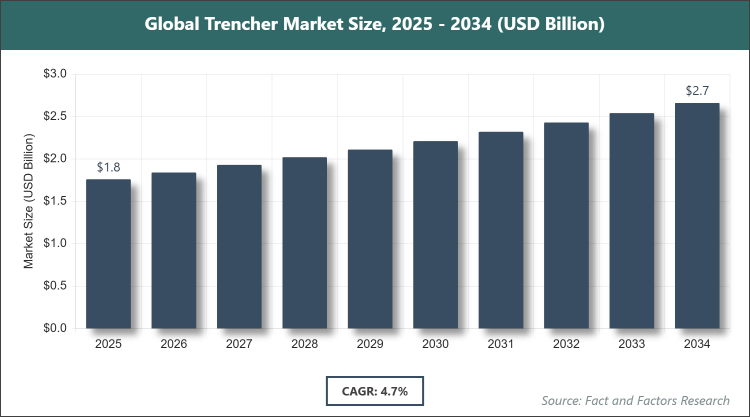
[225+ Pages Report] According to Facts & Factors, the global trencher market size was estimated at USD 1.76 billion in 2025 and is expected to reach USD 2.67 billion by the end of 2034. The trencher industry is anticipated to grow by a CAGR of 4.7% between 2026 and 2034. The trencher Market is driven by increasing infrastructure development worldwide.
 Market Overview
The trencher market encompasses equipment designed for digging narrow ditches or trenches in the ground, primarily used for installing underground utilities such as pipes, cables, and drainage systems. Trenchers are essential in construction, agriculture, and utility sectors, offering efficient excavation compared to manual methods. These machines vary in size and type, from compact models for small-scale projects to heavy-duty versions for large infrastructure works, enabling precise and rapid trenching while minimizing surface disruption.
Key Insights
- As per the analysis shared by our research analyst, the trencher market is estimated to grow annually at a CAGR of around 4.7% over the forecast period (2026-2034).
- In terms of revenue, the trencher market size was valued at around USD 1.76 billion in 2025, and is expected to reach USD 2.67 billion by 2034.
- The trencher market is driven by increasing infrastructural development across the globe.
- Based on the type, the wheel trencher segment accounted for the largest market share of 43% in 2025, because of its precision in hard surfaces and suitability for infrastructure projects.
- Based on the application, the agricultural trenching segment accounted for the largest market share of 30% in 2025, due to rising demand for efficient irrigation and drainage systems in farming.
- Based on the end-user, the construction segment accounted for the largest market share of 35% in 2025, owing to extensive use in road, highway, and urban development projects.
- The North America region is expected to dominate the global market with a share of 35%.
Growth Drivers
- Infrastructure Development
The global push for infrastructure modernization, including roads, highways, railways, and urban expansion, significantly boosts the trencher market. Governments worldwide are investing heavily in these projects to support economic growth and urbanization, creating a steady demand for efficient trenching equipment. Trenchers enable quick and precise excavation for underground utilities, reducing project timelines and labor costs, which is crucial in large-scale developments.
This driver is further amplified by initiatives like smart city projects and renewable energy installations, where trenchers are vital for laying cables and pipelines. As populations grow and cities expand, the need for reliable utility networks intensifies, positioning trenchers as indispensable tools in achieving sustainable infrastructure goals.
- Utility Installation Expansion
The rising deployment of fiber optic networks, 5G infrastructure, and utility lines for water, gas, and electricity drives trencher adoption. With increasing digital connectivity demands, telecom companies require minimal-disruption trenching solutions, making micro and chain trenchers popular. This factor enhances market growth by addressing the need for high-speed internet and energy distribution in both urban and rural areas.
Additionally, environmental regulations favoring underground installations over overhead lines contribute to this driver, as trenchers help comply with safety and aesthetic standards. The integration of advanced technologies like GPS for accurate trenching further supports efficient utility projects, fostering long-term market expansion.
- Technological Advancements
Innovations in trencher design, such as automation, telematics, and electric-powered models, improve efficiency and reduce operational costs. These advancements allow for precise control, remote monitoring, and lower emissions, appealing to environmentally conscious sectors. As manufacturers focus on user-friendly features, adoption rates increase among contractors seeking productivity gains.
This driver also includes the shift toward semi-autonomous and AI-integrated trenchers, which address labor shortages by minimizing manual intervention. Such technologies not only enhance safety but also enable operations in challenging terrains, driving overall market innovation and competitiveness.
Restraints
- High Initial Costs
The substantial upfront investment required for purchasing advanced trenchers limits market penetration, especially for small contractors and developing regions. High costs encompass not just the equipment but also training and accessories, creating barriers to entry.
This restraint impacts market growth by slowing adoption in budget-constrained projects, where alternatives like manual digging or renting may be preferred. Economic fluctuations can exacerbate this issue, delaying purchases and affecting manufacturer revenues.
- Skilled Labor Shortage
A lack of trained operators hinders efficient trencher utilization, as complex machines require specialized skills for safe and effective operation. This shortage leads to increased downtime and higher training expenses for companies.
In regions with aging workforces, this restraint poses long-term challenges, potentially stalling project timelines and reducing overall market demand. Efforts to mitigate through training programs are ongoing but insufficient to fully address the gap.
Opportunities
- Rental and Leasing Services
The growing trend of equipment rental provides access to trenchers without heavy capital outlay, benefiting small businesses and short-term projects. This model expands market reach by offering flexible options and maintenance support.
Opportunities arise from partnerships between manufacturers and rental firms, enabling wider distribution and testing of new models. As construction cycles vary, rentals ensure steady utilization, driving revenue growth in volatile markets.
- Emerging Markets in Asia Pacific
Rapid urbanization and infrastructure investments in countries like China and India create untapped potential for trencher sales. Government initiatives for smart cities and rural development fuel demand for efficient excavation tools.
This opportunity is enhanced by increasing foreign investments and technology transfers, allowing local players to adopt advanced trenchers. As these regions prioritize sustainable development, eco-friendly models can capture significant market share.
Challenges
- Maintenance and Operational Costs
Ongoing expenses for repairs, parts, and fuel pose challenges, particularly in harsh environments where wear and tear is accelerated. High maintenance can deter long-term ownership and affect profitability.
This challenge is compounded by supply chain disruptions for spare parts, leading to extended downtimes. Manufacturers must innovate durable designs to alleviate these issues and sustain market trust.
- Regulatory Compliance
Stringent environmental and safety regulations require trenchers to meet emission standards and noise limits, increasing development costs. Non-compliance risks fines and project delays.
Adapting to varying regional regulations adds complexity for global players, potentially slowing market entry. Continuous updates to equipment designs are necessary to navigate this evolving landscape.
Report Scope
Report Attribute |
Details |
Market Size 2025 |
USD 1.76 Billion |
Projected Market Size in 2034 |
USD 2.67 Billion |
CAGR Growth Rate |
4.7% CAGR |
Base Year |
2025 |
Forecast Years |
2026-2034 |
Key Market Players |
Vermeer Corporation, The Charles Machine Works, Inc. (Ditch Witch), Tesmec S.p.A., Toro Company, Mastenbroek Limited, Wolfe Heavy Equipment, Barreto Manufacturing, Bobcat Company, Cleveland Trencher Company, Inc., Inter-Drain, and Others. |
Key Segment |
By Type, By Application, By End-User, and By Region |
Major Regions Covered |
North America, Europe, Asia Pacific, Latin America, and the Middle East & Africa |
Purchase Options |
Request customized purchase options to meet your research needs. Explore purchase options |
Market Segmentation
The trencher market is segmented by type, application, end-user, and region.
Based on Type Segment, the trencher market is divided into wheel trencher, chain trencher, micro trencher, rock trencher, and others. The most dominant wheel trencher segment leads due to its superior precision on hard surfaces like asphalt and concrete, making it ideal for urban infrastructure and road projects, while the second dominant chain trencher excels in versatile soil conditions for utility and pipeline installations; wheel trenchers drive the market by enabling efficient, minimal-disruption excavation in high-demand construction sectors, reducing labor needs and project times, whereas chain trenchers contribute through their robustness in agricultural and energy applications, supporting broader industry growth amid rising global infrastructure investments.
Based on Application Segment, the trencher market is divided into agricultural trenching, oil and gas pipeline installation, energy cables and fiber optic laying, telecommunication networks construction, sewers and water pipelines installation, and others. The most dominant agricultural trenching segment thrives from the need for precise irrigation and drainage systems in modern farming, enhancing crop yields and sustainability, while the second dominant telecommunication networks construction benefits from rapid 5G and fiber optic expansions; agricultural applications drive market growth by promoting mechanized farming in developing regions, cutting manual labor and boosting efficiency, whereas telecom segments accelerate adoption through urban digitalization demands, fostering innovations in micro-trenching techniques for minimal environmental impact.
Based on End-User Segment, the trencher market is divided into construction, agriculture, telecommunications, oil & gas, utilities, mining, and others. The most dominant construction end-user leads owing to extensive use in building roads, highways, and urban developments requiring reliable underground installations, while the second dominant utilities segment focuses on water, gas, and electricity networks; construction drives the market by aligning with global infrastructure booms, improving project speeds and safety, whereas utilities contribute through essential maintenance and expansion of essential services, supporting energy transitions and smart grid implementations.
Recent Developments
- In September 2025, Ditch Witch introduced Crab Steering Mode and Coordinated Steering on its RT70 and RT125 trenchers, enhancing maneuverability in tight spaces and improving operator control for urban utility projects, which boosts productivity and safety in confined job sites.
- In April 2025, Ditch Witch partnered with Mastenbroek to market the Bulldog trencher in the U.S., targeting wildfire-prone areas with advanced rock-cutting capabilities, enabling faster installation of firebreaks and underground lines to mitigate natural disaster risks.
- In February 2025, Barreto unveiled the 30RTK Track Trencher equipped with a 31hp engine and 48-inch digging depth, designed for heavy-duty landscaping and construction, offering enhanced stability and power for challenging terrains.
- In April 2021, Jan de Nul Group and Osbit developed the Swordfish underwater trenching vehicle with mechanical chain cutter and jetting systems, powered by hydraulic and electric units, advancing offshore cable and pipeline burial efficiency.
- In June 2022, Asso Group integrated Sonardyne's underwater navigation technology into its trenching equipment for offshore wind installations, incorporating Lodestar sensors for precise attitude and heading, improving accuracy in subsea operations.
Regional Analysis
- North America to dominate the global market
North America leads the trencher market due to its robust infrastructure sector, with the United States as the dominating country, driven by extensive highway expansions, urban renewal projects, and a strong emphasis on utility modernization including fiber optic and 5G networks. The region's advanced construction industry benefits from technological integrations like GPS and automation, supported by government funding such as the INFRA program, fostering innovation and efficiency in excavation practices. Additionally, the presence of key manufacturers enhances supply chain reliability, while a skilled workforce ensures optimal equipment utilization across diverse terrains from urban centers to rural areas.
Europe exhibits strong growth in the trencher market, with Germany as the dominating country, propelled by precision engineering traditions and sustainability-focused initiatives like renewable energy installations and smart city developments. The region's stringent environmental regulations encourage adoption of low-emission electric trenchers, aiding in underground utility projects for water and telecom networks. Collaborative efforts among EU nations promote cross-border infrastructure, such as high-speed rail and pipeline systems, where trenchers play a pivotal role in minimizing surface disruption and ensuring long-term durability.
Asia Pacific is rapidly expanding in the trencher market, with China as the dominating country, fueled by massive urbanization and government-led projects under initiatives like the Belt and Road, emphasizing road, rail, and utility constructions. The region's burgeoning population drives demand for agricultural trenching to enhance food security through efficient irrigation, while emerging economies like India invest in telecom and energy infrastructure. Technological adoption, including affordable ride-on models, supports cost-effective operations in varied landscapes from mountainous areas to coastal zones.
Latin America shows promising potential in the trencher market, with Brazil as the dominating country, supported by mining and agricultural sectors requiring durable equipment for pipeline and drainage installations. Infrastructure investments in transportation and utilities address urban growth challenges, where trenchers aid in sustainable development amid diverse geographies like rainforests and highlands. Regional partnerships with international firms introduce advanced technologies, improving efficiency and reducing environmental impacts in resource-rich areas.
The Middle East & Africa region is growing steadily in the trencher market, with Saudi Arabia as the dominating country, driven by Vision 2030's focus on diversified economy through oil & gas pipelines, desalination projects, and urban expansions. Trenchers are crucial for arid terrain excavations in utility and construction works, supported by foreign investments in renewable energy like solar cable laying. Challenges like harsh climates are met with rugged machine designs, promoting resilience in infrastructure builds across deserts and coastal regions.
Competitive Analysis
The global trencher market is dominated by players:
- Vermeer Corporation
- The Charles Machine Works, Inc. (Ditch Witch)
- Tesmec S.p.A.
- Toro Company
- Mastenbroek Limited
- Wolfe Heavy Equipment
- Barreto Manufacturing
- Bobcat Company
- Cleveland Trencher Company, Inc.
- Inter-Drain
- Gravis Robotics
- Simex S.r.l.
- Takeuchi Manufacturing
- Trencor (Astec Industries)
- EZ Trench
- UNAC SAS
- Guntert & Zimmerman
The global trencher market is segmented as follows:
By Type
- Wheel Trencher
- Chain Trencher
- Micro Trencher
- Rock Trencher
- Others
By Application
- Agricultural Trenching
- Oil and Gas Pipeline Installation
- Energy Cables and Fiber Optic Laying
- Telecommunication Networks Construction
- Sewers and Water Pipelines Installation
- Others
By End-User
- Construction
- Agriculture
- Telecommunications
- Oil & Gas
- Utilities
- Mining
- Others
By Region
- North America
- The U.S.
- Canada
- Mexico
- Europe
- France
- The UK
- Spain
- Germany
- Italy
- Rest of Europe
- Asia Pacific
- China
- Japan
- India
- Australia
- Southeast Asia
- Rest of Asia Pacific
- The Middle East & Africa
- Saudi Arabia
- UAE
- Egypt
- Kuwait
- South Africa
- Rest of the Middle East & Africa
- Latin America
- Brazil
- Argentina
- Rest of Latin America
Industry Major Market Players
The global trencher market is dominated by players:
- Vermeer Corporation
- The Charles Machine Works, Inc. (Ditch Witch)
- Tesmec S.p.A.
- Toro Company
- Mastenbroek Limited
- Wolfe Heavy Equipment
- Barreto Manufacturing
- Bobcat Company
- Cleveland Trencher Company, Inc.
- Inter-Drain
- Gravis Robotics
- Simex S.r.l.
- Takeuchi Manufacturing
- Trencor (Astec Industries)
- EZ Trench
- UNAC SAS
- Guntert & Zimmerman
Frequently Asked Questions



Copyright © 2025 - 2026, All Rights Reserved, Facts and Factors