
Search Market Research Report
Vermicompost Market Size, Share Global Analysis Report, 2025-2034

Vermicompost Market Size, Share, Growth Analysis Report By Form (Solid, Liquid), By Source (Cattle Manure, Horse Manure, Poultry Manure, Food Waste), By Application (Agriculture, Horticulture, Waste Management, Soil Remediation, Others), and By Region - Global Industry Insights, Overview, Comprehensive Analysis, Trends, Statistical Research, Market Intelligence, Historical Data and Forecast 2025-2034
Industry Insights
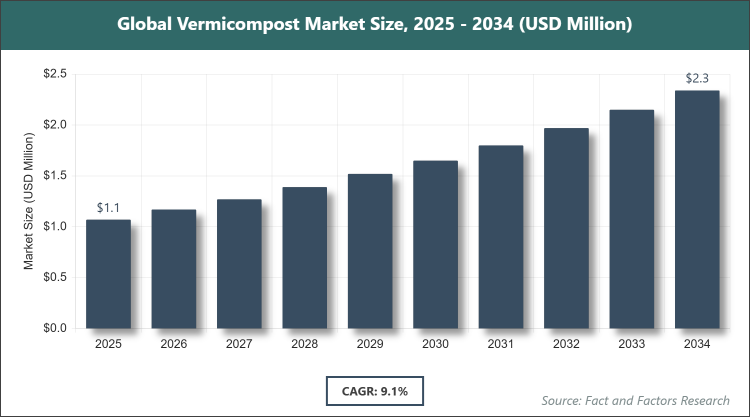
[220+ Pages Report] According to Facts & Factors, the global Vermicompost market size was estimated at USD 1.07 billion in 2025 and is expected to reach USD 2.35 billion by the end of 2034. The Vermicompost industry is anticipated to grow by a CAGR of 9.1% between 2025 and 2034. The Vermicompost Market is driven by increasing demand for organic farming practices.
 Market Overview
Vermicompost is an organic fertilizer produced through the decomposition of organic waste by earthworms, resulting in a nutrient-rich soil amendment that enhances soil fertility, structure, and microbial activity. It is a sustainable alternative to chemical fertilizers, promoting eco-friendly agriculture by recycling waste materials into valuable resources for plant growth.
Key Insights
- As per the analysis shared by our research analyst, the global Vermicompost market is estimated to grow annually at a CAGR of around 9.1% over the forecast period (2025-2034).
- In terms of revenue, the global Vermicompost market size was valued at around USD 1.07 billion in 2025 and is projected to reach USD 2.35 billion by 2034.
- The market is driven by increasing demand for organic farming practices.
- Based on the Form, the Solid segment dominated the market with a share of 78.2%, as it offers ease of storage, transport, and application compared to liquid forms.
- Based on the Source, the Cattle Manure segment dominated the market with a share of 42.1%, owing to its abundance and nutrient-rich profile that enhances compost quality.
- Based on the Application, the Agriculture segment dominated the market with a share of 56.8%, driven by widespread adoption in organic farming to improve soil health and crop yields.
- Asia-Pacific dominated the global market with a share of 43.9%, due to large-scale adoption of organic farming and availability of raw materials for composting.
Growth Drivers
- Rising Global Demand for Organic Farming Practices
The shift towards sustainable agriculture has propelled the demand for vermicompost as farmers increasingly opt for natural soil enhancers over synthetic fertilizers. This trend is fueled by consumer preferences for organic produce, which encourages the use of eco-friendly inputs to maintain soil health and reduce environmental impact.
Government initiatives and subsidies further support this transition, providing incentives for organic farming methods that incorporate vermicompost to improve crop productivity while minimizing chemical residues in food chains.
Restraints
- Limited Awareness Among Farmers
Many farmers, particularly in rural and developing areas, lack knowledge about vermicompost's benefits, leading to continued reliance on readily available chemical fertilizers that offer quicker visible results. This awareness gap hinders market penetration and slows adoption rates.
Insufficient extension services and demonstration projects exacerbate the issue, as without proper education and training, farmers hesitate to invest in vermicompost production or usage despite its long-term advantages for soil sustainability.
Opportunities
- Expanding Waste Management Initiatives
Growing investments in converting organic waste into valuable compost present significant opportunities, supported by funding for advanced waste processing technologies. This not only addresses environmental concerns but also creates new revenue streams for vermicompost producers.
Innovations in AI-powered waste management and disaster cleanup projects further enhance efficiency, enabling scalable production of high-quality vermicompost from diverse waste sources to meet rising market demands.
Challenges
- Insufficient Awareness and Training for Farmers
The lack of comprehensive training programs on vermicompost application and production poses a major challenge, limiting its widespread use. Farmers often face difficulties in understanding optimal usage techniques, which affects efficacy and market growth.
Without targeted educational efforts and support from agricultural institutions, overcoming skepticism and building confidence in vermicompost's benefits remains difficult, impacting overall industry expansion.
Report Scope
Report Attribute |
Details |
Market Size 2025 |
USD 1.07 Million |
Projected Market Size in 2034 |
USD 2.35 Million |
CAGR Growth Rate |
9.1% CAGR |
Base Year |
2025 |
Forecast Years |
2025-2034 |
Key Market Players |
Wiggly Wigglers, TNAU (Tamil Nadu Agricultural University), Worm Power, Uncle Jim’s Worm Farm, Midwest BioSystems, Sun Valley Worm Farm, Red Worm Composting, Texas Worm Ranch, Nature’s Little Recyclers, and Others. |
Key Segment |
By Form, By Source, By Application, and By Region |
Major Regions Covered |
North America, Europe, Asia Pacific, Latin America, and the Middle East & Africa |
Purchase Options |
Request customized purchase options to meet your research needs. Explore purchase options |
Market Segmentation
The Vermicompost market is segmented by Form, Source, Application, and region.
Based on Form Segment, the Vermicompost market is divided into Solid, Liquid, and others. The most dominant segment is Solid, accounting for the largest share due to its practicality in handling and application across various farming scales. The second most dominant is Liquid, which offers advantages in quick absorption and foliar applications. Solid's dominance stems from its stability, longer shelf life, and cost-effectiveness in transportation, driving market growth by catering to large agricultural operations. Liquid supports the market by enabling precise nutrient delivery in horticulture and hydroponics, enhancing overall adoption.
Based on Source Segment, the Vermicompost market is divided into Cattle Manure, Horse Manure, Poultry Manure, Food Waste, and others. The most dominant segment is Cattle Manure, holding the leading position because of its high nutrient content and widespread availability from livestock farming. The second most dominant is Food Waste, valued for its role in urban waste recycling. Cattle Manure drives the market by providing a balanced mix of essential nutrients that improve soil fertility, making it ideal for organic agriculture. Food Waste contributes by promoting sustainable waste management, reducing landfill burdens while producing vermicompost rich in organic matter to support market expansion.
Based on Application Segment, the Vermicompost market is divided into Agriculture, Horticulture, Waste Management, Soil Remediation, Others, and others. The most dominant segment is Agriculture, capturing the biggest share owing to its extensive use in crop production for enhanced yields. The second most dominant is Horticulture, applied in gardens and nurseries for plant health. Agriculture dominates and drives the market through large-scale integration in organic farming, boosting soil structure and reducing chemical dependency. Horticulture aids growth by supporting ornamental and vegetable cultivation, where vermicompost's nutrient profile ensures vibrant growth and sustainability.
Recent Developments
- January 2025: Worm Power secured a $900,000 USDA grant under the Fertilizer Production Expansion Program to expand its vermicomposting facility in Avon, New York.
- 2025: TNAU researchers published a study on enriching goat dung vermicompost with Azolla pinnata, showing higher nitrogen, carbon, and potassium levels.
Regional Analysis
- Asia-Pacific to dominate the global market
Asia-Pacific holds the largest share in the global vermicompost market, driven by extensive agricultural activities and government policies promoting organic farming. The region's vast arable land and increasing awareness of sustainable practices contribute to high demand. India emerges as the dominating country, with its large farming community adopting vermicompost to enhance soil quality in diverse climates. Rapid urbanization also boosts waste-to-compost initiatives, further strengthening market position.
North America exhibits strong growth due to supportive grants and a focus on reducing chemical fertilizers. The United States leads as the dominating country, with advanced vermicomposting facilities and research in sustainable agriculture. Consumer demand for organic products drives adoption across farms and urban gardens, fostering innovation in production techniques.
Europe's market is expanding with strict regulations on chemical inputs and a rising preference for organic food. Germany stands out as the dominating country, emphasizing eco-friendly farming and investing in vermicompost for soil health. Collaborative efforts among EU nations enhance distribution and awareness, supporting steady regional growth.
Latin America shows promising potential with its agricultural heritage and shift towards sustainable soil management. Brazil is the dominating country, leveraging vast farmlands to integrate vermicompost in crop cycles. Initiatives for waste recycling and export-oriented organic produce further propel market development in the region.
The Middle East & Africa are gradually adopting vermicompost, particularly in arid areas for soil enrichment. South Africa dominates, with programs addressing water scarcity through improved soil retention using vermicompost. Growing interest in organic exports and local farming sustainability drives emerging market opportunities.
Competitive Analysis
The global Vermicompost market is dominated by players:
- Wiggly Wigglers
- TNAU (Tamil Nadu Agricultural University)
- Worm Power
- Uncle Jim’s Worm Farm
- Midwest BioSystems
- Sun Valley Worm Farm
- Red Worm Composting
- Texas Worm Ranch
- Nature’s Little Recyclers
The global Vermicompost market is segmented as follows:
By Form
- Solid
- Liquid
By Source
- Cattle Manure
- Horse Manure
- Poultry Manure
- Food Waste
By Application
- Agriculture
- Horticulture
- Waste Management
- Soil Remediation
- Others
By Region
- North America
- The U.S.
- Canada
- Mexico
- Europe
- France
- The UK
- Spain
- Germany
- Italy
- Rest of Europe
- Asia Pacific
- China
- Japan
- India
- Australia
- Southeast Asia
- Rest of Asia Pacific
- The Middle East & Africa
- Saudi Arabia
- UAE
- Egypt
- Kuwait
- South Africa
- Rest of the Middle East & Africa
- Latin America
- Brazil
- Argentina
- Rest of Latin America
Table of Content
Industry Major Market Players
The global Vermicompost market is dominated by players:
- Wiggly Wigglers
- TNAU (Tamil Nadu Agricultural University)
- Worm Power
- Uncle Jim’s Worm Farm
- Midwest BioSystems
- Sun Valley Worm Farm
- Red Worm Composting
- Texas Worm Ranch
- Nature’s Little Recyclers



Copyright © 2025 - 2026, All Rights Reserved, Facts and Factors