
Search Market Research Report
Spray Dryer Market Size, Share Global Analysis Report, 2026-2034

Spray Dryer Market Size, Share, Growth Analysis Report By Type (Rotary Atomizer, Nozzle Atomizer, Fluidized, Closed Loop, Centrifugal, and Others), By Drying Stage (Single Stage, Two Stage, Multi Stage, and Others), By Application (Food & Dairy, Pharmaceutical, Chemical, and Others), and By Region - Global Industry Insights, Overview, Comprehensive Analysis, Trends, Statistical Research, Market Intelligence, Historical Data and Forecast 2026-2034
Industry Insights
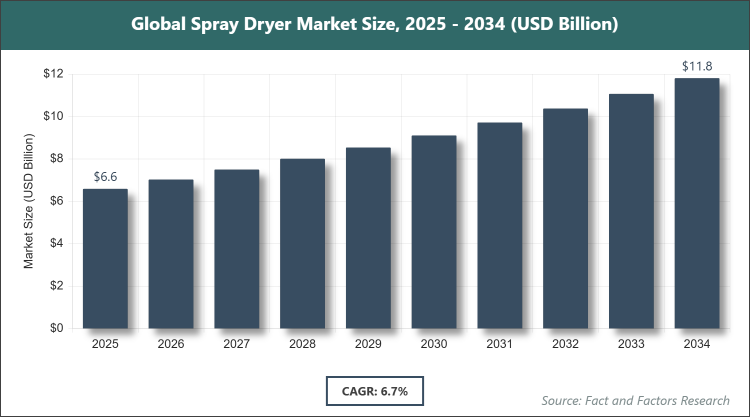
[224+ Pages Report] According to Facts & Factors, the global spray dryer market size was estimated at USD 6.59 billion in 2025 and is expected to reach USD 11.75 billion by the end of 2034. The spray dryer industry is anticipated to grow by a CAGR of 6.7% between 2026 and 2034. The spray dryer Market is driven by increasing demand for processed foods and pharmaceuticals.
 Market Overview
A spray dryer is a device used to transform liquid or slurry materials into dry powder form through the process of atomization and rapid evaporation in a hot gas stream. This technology is essential in industries where moisture removal is critical to enhance product stability, shelf life, and ease of handling, without relying on specific quantitative data.
Key Insights
- As per the analysis shared by our research analyst, the global spray dryer market is anticipated to grow by a CAGR of 6.7% between 2026 and 2034.
- In terms of revenue, the global spray dryer market size was estimated at USD 6.59 billion in 2025 and is expected to reach USD 11.75 billion by the end of 2034.
- The spray dryer market is driven by increasing demand for processed foods and advancements in pharmaceutical formulations.
- Based on the type, the nozzle atomizer segment dominated with a share of over 30% due to its versatility in handling various feed materials and producing uniform particle sizes, which enhances product quality and efficiency in large-scale operations.
- Based on the drying stage, the single stage segment dominated with a share of over 40% as it offers simplicity, lower operational costs, and suitability for heat-sensitive materials, making it ideal for food and pharmaceutical applications.
- Based on the application, the food & dairy segment dominated with a share of over 35% owing to the need for extended shelf life and convenient powdered products like milk and infant formulas.
- North America dominated with a share of over 34% due to its advanced manufacturing infrastructure, high adoption in pharmaceuticals, and strong demand from the food processing sector.
Growth Drivers
- Rising Demand for Processed and Instant Foods
The increasing consumer preference for convenient, ready-to-eat foods has boosted the adoption of spray drying technology, which enables the production of stable, powdered ingredients with extended shelf life. This method preserves nutritional value and flavor while reducing transportation costs, making it indispensable in the food industry.
The global expansion of food processing facilities, particularly in emerging economies, further amplifies this demand, as manufacturers seek efficient drying solutions to meet rising production volumes and quality standards.
Restraints
- High Installation and Operational Costs
The substantial upfront investment required for spray dryer equipment, including specialized components and energy-intensive operations, poses a barrier for small and medium-sized enterprises. Maintenance and energy consumption add to the ongoing expenses, limiting widespread adoption in cost-sensitive markets.
Fluctuations in energy prices can exacerbate these costs, impacting profitability and slowing market penetration in regions with unstable economic conditions or limited access to affordable power sources.
Opportunities
- Technological Advancements in Energy-Efficient Systems
Innovations such as automated controls and heat recovery systems present opportunities to reduce energy usage and operational costs, attracting environmentally conscious industries. These advancements also enable precise particle size control, expanding applications in high-value sectors like biopharmaceuticals.
The integration of AI and IoT for real-time monitoring opens new avenues for customization, allowing manufacturers to optimize processes and meet specific regulatory requirements in pharmaceuticals and chemicals.
Challenges
- Stringent Environmental Regulations
Compliance with emission standards for volatile organic compounds and particulate matter requires additional investments in filtration and exhaust systems, increasing complexity and costs. This can delay project timelines and affect market growth in regulated regions.
The need for sustainable practices, such as reducing carbon footprints, challenges traditional spray drying methods, pushing the industry toward greener alternatives amid global environmental pressures.
Report Scope
Report Attribute |
Details |
Market Size 2025 |
USD 6.59 Billion |
Projected Market Size in 2034 |
USD 11.75 Billion |
CAGR Growth Rate |
6.7% CAGR |
Base Year |
2025 |
Forecast Years |
2026-2034 |
Key Market Players |
GEA Group Aktiengesellschaft, SPX FLOW, Buchi Labortechnik AG, Dedert Corporation, European SprayDry Technologies, Carrier Vibrating Equipment, Inc., Freund-Vector Corporation, Larsson Starch Technology AB, Tetra Pak Group, Yamato Scientific Co., Ltd., and Others. |
Key Segment |
By Type, By Drying Stage, By Application, and By Region |
Major Regions Covered |
North America, Europe, Asia Pacific, Latin America, and the Middle East & Africa |
Purchase Options |
Request customized purchase options to meet your research needs. Explore purchase options |
Market Segmentation
The spray dryer market is segmented by type, drying stage, application, end-user, and region.
Based on Type Segment, the spray dryer market is divided into rotary atomizer, nozzle atomizer, fluidized, closed loop, centrifugal, and others. The nozzle atomizer segment is the most dominant, holding a significant market share due to its ability to produce fine, uniform particles essential for high-quality outputs in food and pharmaceuticals. This dominance drives the market by enabling efficient processing of viscous feeds and improving product solubility. The rotary atomizer is the second most dominant, valued for its high throughput in large-scale operations, contributing to market growth through cost-effective drying of bulk materials.
Based on Drying Stage Segment, the spray dryer market is divided into single-stage, two-stage, multi-stage, and others. The single-stage segment is the most dominant, capturing a large share as it simplifies operations and reduces energy consumption for straightforward drying needs in dairy and chemicals. This helps drive the market by offering quick, economical solutions for heat-sensitive products. The two-stage segment is the second most dominant, preferred for applications requiring finer control over moisture content, enhancing market expansion through improved product stability in pharmaceuticals.
Based on Application Segment, the spray dryer market is divided into food & dairy, pharmaceutical, chemical, and others. The food & dairy segment is the most dominant, with a substantial share driven by the need for powdered milk, flavors, and ingredients that ensure longer shelf life and ease of transport. This dominance propels the market by addressing global food security and convenience demands. The pharmaceutical segment is the second most dominant, growing due to its role in creating bioavailable drug formulations, fueling market growth through innovation in drug delivery systems.
Recent Developments
- In May 2024, GEA unveiled a new pharmaceutical spray dryer at ACHEMA, featuring enhanced energy efficiency and real-time monitoring capabilities to optimize production in biopharma applications.
- In January 2025, Dedert Corporation commissioned a new spray drying plant for plant-based proteins, integrating advanced automation to improve yield and reduce environmental impact.
- In June 2022, SPX FLOW collaborated with Flottweg to develop end-to-end solutions for nutrition and beverage industries, enhancing spray drying processes for better scalability.
Regional Analysis
- North America to dominate the global market
North America leads the spray dryer market due to its robust pharmaceutical and food processing sectors, supported by advanced R&D infrastructure and high adoption of innovative drying technologies. The region's focus on quality standards and efficient manufacturing drives demand, with the U.S. as the dominating country, benefiting from major players and extensive industrial applications.
Asia Pacific is experiencing rapid growth in the spray dryer market, fueled by expanding food and chemical industries amid urbanization and rising consumer demand. China dominates this region with its massive production capabilities and investments in modernizing facilities to meet global export standards.
Europe maintains a strong position in the spray dryer market through stringent regulations and emphasis on sustainable practices in pharmaceuticals and dairy. Germany stands out as the dominating country, leveraging its engineering expertise and focus on energy-efficient solutions to advance market developments.
Latin America shows promising growth in the spray dryer market, driven by agricultural exports and increasing food processing needs. Brazil dominates, capitalizing on its vast dairy and chemical sectors to enhance product preservation and international trade competitiveness.
The Middle East & Africa region is emerging in the spray dryer market, supported by investments in food security and chemical industries. South Africa leads as the dominating country, utilizing spray drying for nutritional products and resource-efficient manufacturing in arid environments.
Competitive Analysis
The global spray dryer market is dominated by players:
- GEA Group Aktiengesellschaft
- SPX FLOW
- Buchi Labortechnik AG
- Dedert Corporation
- European SprayDry Technologies
- Carrier Vibrating Equipment Inc.
- Freund-Vector Corporation
- Larsson Starch Technology AB
- Tetra Pak Group
- Yamato Scientific Co., Ltd.
The global spray dryer market is segmented as follows:
By Type
- Rotary Atomizer
- Nozzle Atomizer
- Fluidized
- Closed Loop
- Centrifugal
- Others
By Drying Stage
- Single Stage
- Two Stage
- Multi Stage
- Others
By Application
- Food & Dairy
- Pharmaceutical
- Chemical
- Others
By Region
- North America
- The U.S.
- Canada
- Mexico
- Europe
- France
- The UK
- Spain
- Germany
- Italy
- Rest of Europe
- Asia Pacific
- China
- Japan
- India
- Australia
- Southeast Asia
- Rest of Asia Pacific
- The Middle East & Africa
- Saudi Arabia
- UAE
- Egypt
- Kuwait
- South Africa
- Rest of the Middle East & Africa
- Latin America
- Brazil
- Argentina
- Rest of Latin America
Table of Content
Industry Major Market Players
The global spray dryer market is dominated by players:
- GEA Group Aktiengesellschaft
- SPX FLOW
- Buchi Labortechnik AG
- Dedert Corporation
- European SprayDry Technologies
- Carrier Vibrating Equipment, Inc.
- Freund-Vector Corporation
- Larsson Starch Technology AB
- Tetra Pak Group
- Yamato Scientific Co., Ltd.



Copyright © 2025 - 2026, All Rights Reserved, Facts and Factors