
Search Market Research Report
Serial Device Server Market Size, Share Global Analysis Report, 2025 - 2034

Serial Device Server Market Size, Share, Growth Analysis Report By Type (Wired and Wireless), By Product (Less than 2-Port, 2-Port, 4-Port, 8-Port, 16-Port and More than 16-Port), Application (Traffic Signal Communication, Access Control System, Product Line Data Collection and Attendance System), By End-User (IT & Logistics, Healthcare, Energy & Utility, BFSI, Government and Retail), And By Region - Global Industry Insights, Overview, Comprehensive Analysis, Trends, Statistical Research, Market Intelligence, Historical Data and Forecast 2025 - 2034
Industry Insights
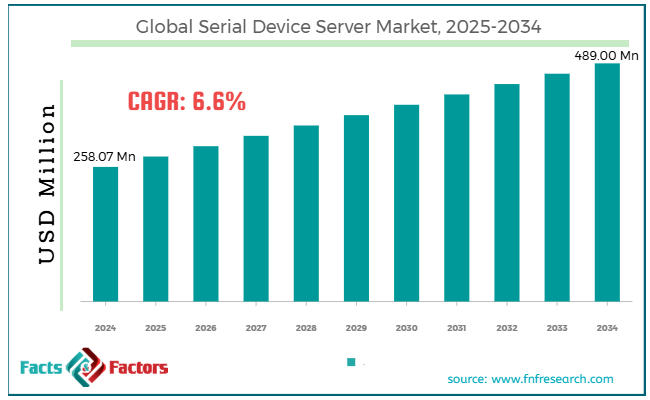
[223+ Pages Report] According to Facts & Factors, the global serial device server market size was worth around USD 258.07 million in 2024 and is predicted to grow to around USD 489.00 million by 2034 with a compound annual growth rate (CAGR) of roughly 6.6% between 2025 and 2034.
 Market Overview
A computer that facilitates serial device communication via an IP-based network is called a serial device server. It converts serial signals into Ethernet-compatible signals so that devices and applications connected to networks can use them remotely. By offering cabled network access, the serial server serves as a middleman for a peripheral device that is linked locally. This enables businesses to utilize outdated hardware that lacks networking capabilities out of the box. There are numerous designs and configurations of serial device servers that are suitable for various use cases.
A basic serial server can be used to enable printer sharing among employees in the same physical workspace; it is not necessary to provide security or authorization features. When further control over the connected equipment is needed, far more advanced serial to Ethernet device servers are employed. Ethernet serial device servers are utilized in industrial applications and automated assembly lines where security is a top priority. They offer full encryption and authentication.
Key Insights
- As per the analysis shared by our research analyst, the global serial device server market is estimated to grow annually at a CAGR of around 6.6% over the forecast period (2025-2034).
- In terms of revenue, the global serial device server market size was valued at around USD 258.07 million in 2024 and is projected to reach USD 489.00 million, by 2034.
- The rising product launch is expected to drive market growth over the forecast period.
- Based on the type, the wired segment is expected to dominate the market over the forecast period.
- Based on the application, the access control system is expected to hold a prominent market share during the forecast period.
- Based on region, North America is expected to dominate the market during the forecast period.
Growth Drivers
- Increasing trends of automation among industries drive market growth
Automation within an industry refers to the use of technology for process control and monitoring, such as artificial intelligence, robotics, machine learning, and the Internet of Things. A serial device server is becoming more and more necessary for the deployment of automation due to the growing trend of automation in industries. These servers are used by industries for a variety of purposes, including interoperability and standardization, legacy system connectivity, and centralized monitoring and control. Industrial equipment can be monitored and controlled centrally thanks in large part to these servers. The equipment data is captured for monitoring and analysis with the use of serial devices.
For instance, in March 2024, EPEVER introduced EPEVER TCP 306, a server that enables remote real-time controller and inverter monitoring. Because of its ability to carry data quickly and efficiently over long distances while using less power, the server has played a significant role in the market's growth. The market demand for serial device servers is therefore being driven by the increasing trend of automation in enterprises.
Restraints
- Increasing inclination towards alternative technology hinders market growth
Serial device servers are seeing less market expansion as a result of the increasing industry adoption of wireless communication technologies like Wi-Fi and cellular networks. Wireless connectivity allows objects and networks to communicate directly with one other, doing away with the necessity for physical cable.
Furthermore, these servers create one more area where network security is vulnerable. When the devices are not properly secured, they serve as a point of entry for hackers. Thus, the aforementioned statements hamper the market growth.
Opportunities
- Increasing adoption of advanced technology provides a lucrative opportunity for market growth
It is anticipated that the increasing use of big data, cloud computing, and other cutting-edge technologies in the healthcare industry for monitoring and diagnostics would open up new avenues for market expansion. Modern technologies have made it easier to monitor patients remotely, which has increased demand for serial device servers that can send data in real time across cloud-based platforms.
As a result, cutting-edge servers, such as those built on USB and Wi-Fi, help link and share devices to enable remote patient monitoring. As a result, they are one of the numerous serial device server market opportunities that propel market development.
Challenges
- Risk related to security poses a major challenge to market expansion
Serial Device Servers can create new security risks if they are not set up or maintained correctly, even while they include security capabilities to safeguard communication between serial devices and networked computers. Unauthorized network access to serial devices may result in data breaches or interruptions to operations. Thus, security risk poses a major challenge to the market expansion.
Report Scope
Report Attribute |
Details |
Market Size in 2024 |
USD 258.07 Million |
Projected Market Size in 2034 |
USD 489.00 Million |
CAGR Growth Rate |
6.6% CAGR |
Base Year |
2024 |
Forecast Years |
2025-2034 |
Key Market Players |
Comtrol Corporation, Moxa, 3onedata, Advantech, Siemens Industrial Communication, Digi International, OMEGA, Kyland, Atop Technologies Inc., EtherWAN Systems, Korenix Technology, Perle, Westermo, Sealevel Systems, Chiyu Technology, ORing Industrial Networking Corp., Sena Technologies, Silex Technology America Inc., Tibbo Technology Inc., UTEK, and others. |
Key Segment |
By Type, By Product, By Application, By End-User, and Region |
Major Regions Covered |
North America, Europe, Asia Pacific, Latin America, and the Middle East &, Africa |
Purchase Options |
Request customized purchase options to meet your research needs. Explore purchase options |
Segmentation Analysis
The global serial device server industry is segmented based on type, product, application, end-user and region.
Based on the type, the global serial device server market is bifurcated into wired and wireless. The wired segment is expected to dominate the market over the forecast period due to the growing use of servers in automated production systems, power environment and security systems, and access & control systems.
Furthermore, by enabling improved signal processing, wired device servers guarantee the reliability and stability of programmable logic devices. The growing use of wired serial servers in various applications for better data transfer over long distances is a major factor propelling the market growth.
Based on the product, the global serial device server industry is bifurcated into less than 2-port, 2-port, 4-port, 8-port, 16-port and more than 16-port.
Based on the application, the global serial device server market is bifurcated into traffic signal communication, access control systems, product line data collection and attendance systems. The access control system is expected to hold a prominent market share during the forecast period. Device servers facilitate information transfer in both directions between network interfaces and serial ports.
Additionally, the effectiveness of the access control system's operation is improved by the use of premium device servers. In a nutshell, the primary factor propelling the market expansion is these servers' capacity to support bi-directional information transfer, which enhances the effectiveness of access control systems.
Based on the end-user, the global serial device server industry is bifurcated into IT & logistics, healthcare, energy & utility, BFSI, government and retail.
Regional Analysis
- North America is expected to dominate the market during the forecast period
North America is expected to capture the largest revenue share of the market during the forecast period. The growth in the market for advanced serial device servers is a result of the data centers and the IT industry's expansion, which raises demand for these servers. The business is expanding even faster because of developments in software that allows data centers to be remotely monitored utilizing a serial port for reliable long-distance communication. The analysis of trends in the serial device server market indicates that the main factor driving the market's growth in the area is data centers' growing need for servers to facilitate the effective movement of data.
For instance, in August 2022, the largest data center market that requires advanced servers to connect the devices is the Northern Virginia region, according to Cushman & Wakefield. The North American market is growing at a significant rate due in significant part to the increase of data centers.
Competitive Analysis
The global serial device server market is dominated by players:
- Comtrol Corporation
- Moxa
- 3onedata
- Advantech
- Siemens Industrial Communication
- Digi International
- OMEGA
- Kyland
- Atop Technologies Inc.
- EtherWAN Systems
- Korenix Technology
- Perle
- Westermo
- Sealevel Systems
- Chiyu Technology
- ORing Industrial Networking Corp.
- Sena Technologies
- Silex Technology America Inc.
- Tibbo Technology Inc.
- UTEK
The global serial device server market is segmented as follows:
By Type
- Wired
- Wireless
By Product
- Less than 2-Port
- 2-Port
- 4-Port
- 8-Port
- 16-Port
- More than 16-Port
By Application
- Traffic Signal Communication
- Access Control System
- Product Line Data Collection
- Attendance System
By End-User
- IT & Logistics
- Healthcare
- Energy & Utility
- BFSI
- Government
- Retail
By Regional Segment Analysis
- North America
- The U.S.
- Canada
- Mexico
- Europe
- France
- The UK
- Spain
- Germany
- Italy
- Rest of Europe
- Asia Pacific
- China
- Japan
- India
- Australia
- Southeast Asia
- Rest of Asia Pacific
- The Middle East & Africa
- Saudi Arabia
- UAE
- Egypt
- Kuwait
- South Africa
- Rest of the Middle East & Africa
- Latin America
- Brazil
- Argentina
- Rest of Latin America
Table of Content
Industry Major Market Players
- Comtrol Corporation
- Moxa
- 3onedata
- Advantech
- Siemens Industrial Communication
- Digi International
- OMEGA
- Kyland
- Atop Technologies Inc.
- EtherWAN Systems
- Korenix Technology
- Perle
- Westermo
- Sealevel Systems
- Chiyu Technology
- ORing Industrial Networking Corp.
- Sena Technologies
- Silex Technology America Inc.
- Tibbo Technology Inc.
- UTEK



Copyright © 2025 - 2026, All Rights Reserved, Facts and Factors