
Search Market Research Report
Road Sweeper Market Size, Share Global Analysis Report, 2026-2034

Road Sweeper Market Size, Share, Growth Analysis Report By Type (Mechanical Broom Sweeper, Regenerative-Air Sweeper, Vacuum Sweeper, and Others), By Application (Urban Road, Highway, Airport, Industrial, and Others), By End-User (Municipal Corporation, Industrial, Contractors, and Others), and By Region - Global Industry Insights, Overview, Comprehensive Analysis, Trends, Statistical Research, Market Intelligence, Historical Data and Forecast 2026-2034
Industry Insights
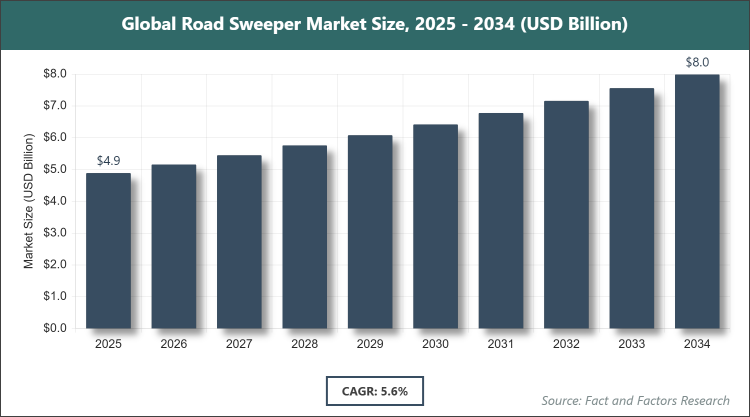
[228 Pages Report] According to Facts & Factors, the global road sweeper market size was estimated at USD 4.89 billion in 2025 and is expected to reach USD 8.31 billion by the end of 2034. The Road Sweeper industry is anticipated to grow by a CAGR of 5.6% between 2026 and 2034. The Road Sweeper Market is driven by increasing urbanization and government initiatives for clean and sustainable cities.
 Market Overview
The road sweeper market involves the design, manufacturing, and distribution of specialized vehicles equipped with brushing, vacuuming, or air-blowing mechanisms to remove debris, dust, litter, and pollutants from roads, highways, airports, and industrial surfaces. These machines, available in compact, truck-mounted, or autonomous variants, are powered by diesel, electric, or hybrid systems and incorporate water suppression for dust control, ensuring efficient cleaning while complying with environmental standards. The market serves municipal, commercial, and industrial sectors focused on maintaining hygiene, reducing air pollution, and enhancing infrastructure longevity through regular surface maintenance without relying on manual labor.
Key Insights
- As per the analysis shared by our research analyst, the Road Sweeper market is estimated to grow annually at a CAGR of around 5.6% over the forecast period (2026-2034).
- In terms of revenue, the Road Sweeper market size was valued at around USD 4.89 billion in 2025 and is projected to reach USD 8.31 billion by 2034.
- The market is driven by increasing urbanization and government initiatives for clean and sustainable cities.
- Based on the type, the mechanical broom sweeper segment dominated the market in 2025 with a market share of 50% due to its cost-effectiveness, robustness, and effectiveness in removing heavy debris from urban and highway surfaces.
- Based on the application, the urban road segment dominated the market in 2025 with a market share of 40% due to rising city expansions and the need for frequent cleaning to maintain public health and aesthetics.
- Based on the end-user, the municipal corporation segment dominated the market in 2025 with a market share of 53% due to government mandates for sanitation and allocation of budgets for urban maintenance equipment.
- Asia Pacific dominated the global market in 2025 with a market share of 35% due to rapid urbanization, infrastructure development, and smart city projects in countries like China and India.
Growth Drivers
- Rapid Urbanization and Infrastructure Expansion
The accelerating pace of urban development in emerging economies is driving the need for efficient road cleaning solutions to manage increased traffic, waste, and pollution, with road sweepers playing a crucial role in maintaining clean streets and preventing drainage blockages. Government investments in smart cities and sustainable infrastructure further propel adoption, as these machines integrate advanced features like GPS for optimized routes and low-emission engines to meet green standards. This demand is particularly strong in densely populated areas where manual cleaning is inefficient.
Innovations in electric and autonomous sweepers are enhancing operational efficiency, reducing labor costs, and minimizing environmental impact, attracting municipal bodies and contractors. Collaborations between manufacturers and local authorities for pilot programs in high-growth regions are fostering market penetration, ensuring long-term expansion through tailored solutions for diverse terrains and climates.
Restraints
- High Initial Costs and Maintenance Requirements
The substantial capital investment required for advanced road sweepers, including electric models with sophisticated batteries and sensors, limits adoption among small municipalities and developing regions with constrained budgets. Maintenance challenges, such as frequent part replacements for brushes and filters, add to operational expenses, deterring potential buyers in cost-sensitive markets.
This restraint may slow market growth in areas lacking skilled technicians or spare parts availability, leading to reliance on outdated manual methods. Manufacturers are addressing this through financing options and modular designs, but economic fluctuations can still impact procurement decisions.
Opportunities
- Shift Towards Electric and Autonomous Technologies
Stringent emission regulations and sustainability goals are opening doors for electric road sweepers, which offer zero-emission operations and lower noise levels ideal for urban nighttime cleaning. Autonomous features, enabled by AI and sensors, promise reduced human intervention and improved precision, appealing to smart city initiatives worldwide.
Emerging markets with government subsidies for green vehicles present expansion potential, with partnerships for technology transfer accelerating adoption. This opportunity diversifies product offerings, targeting eco-conscious sectors like airports and industrial parks for specialized solutions.
Challenges
- Regulatory Variations and Supply Chain Disruptions
Differing environmental and safety standards across regions complicate product standardization, requiring costly adaptations for manufacturers entering new markets. Supply chain issues, including shortages of electronic components for advanced models, can delay deliveries and increase prices amid global uncertainties.
Overcoming this involves robust supplier networks and compliance expertise, but smaller players may face barriers, leading to market consolidation. Educating stakeholders on benefits is key to navigating these hurdles effectively.
Report Scope
Report Attribute |
Details |
Market Size 2025 |
USD 4.89 Billion |
Projected Market Size in 2034 |
USD 8.31 Billion |
CAGR Growth Rate |
5.6% CAGR |
Base Year |
2025 |
Forecast Years |
2026-2034 |
Key Market Players |
Johnston Sweepers Limited, Dulevo International S.p.A., Hako GmbH, Nilfisk Group, Bucher Industries AG, Elgin Sweeper Company, Boschung Group, Dulevo India Pvt. Ltd., Tennant Company, Madvac Exprolink, Global Environmental Products, Aebi Schmidt Holding AG, SANY Group, TYMCO Inc., ZOOMLION, and Others. |
Key Segment |
By Type, By Application, By End-User, and By Region |
Major Regions Covered |
North America, Europe, Asia Pacific, Latin America, and the Middle East & Africa |
Purchase Options |
Request customized purchase options to meet your research needs. Explore purchase options |
Market Segmentation
The Road Sweeper market is segmented by type, application, end-user, and region.
Based on Type Segment, the Road Sweeper market is divided into mechanical broom sweeper, regenerative-air sweeper, vacuum sweeper, and others. The most dominant is the mechanical broom sweeper, and the second most dominant is the regenerative-air sweeper. The mechanical broom sweeper leads due to its proven reliability in handling coarse debris and cost-effective operation for large-scale cleaning, driving the market by enabling efficient maintenance in high-traffic urban areas and supporting infrastructure projects; this dominance enhances growth through widespread municipal adoption and adaptability to various surfaces. The regenerative-air sweeper ranks second, favored for its dust suppression capabilities without water usage, contributing to market demand by aligning with environmental regulations and water conservation efforts in arid regions.
Based on Application Segment, the Road Sweeper market is divided into urban road, highway, airport, industrial, and others. The most dominant is the urban road, and the second most dominant is the highway. Urban road dominates owing to the constant need for cleanliness in cities amid population growth, propelled by smart city funding; this propels market growth by addressing pollution and health concerns through regular sweeping. Highway is second, utilizing high-capacity sweepers for safety and debris removal, driving the market via infrastructure investments and traffic management requirements.
Based on End-User Segment, the Road Sweeper market is divided into municipal corporations, industrial, contractors, and others. The most dominant is the municipal corporation, and the second most dominant isthe industrial. The municipal corporation segment prevails due to regulatory obligations for public sanitation and budget allocations for equipment, fueled by urbanization; this fuels market growth through large fleet deployments and policy-driven purchases. Industrial ranks second, leveraging sweepers for site maintenance and compliance, contributing to growth amid manufacturing expansions.
Recent Developments
- In September 2023, the Municipal Corporation of Delhi, India, announced it would appoint a consultant for INR 62 crore for the mechanical cleaning of arterial roads.
- In September 2022, Ideanomics announced that its subsidiary US Hybrid will supply proprietary hybrid and electric propulsion kits to Global Environmental Products for 62 zero-emission street sweepers, to be provided to US cities such as California, New York City, Montana, the City of Helena, and Washington D.C.
- In October 2020, Trombia Technologies launched the world’s first autonomous, high-power electric street sweeper with a capacity to cut 3 million metric tons of CO2 annually.
- In June 2023, Modine announced that Elgin Sweeper Company will use the Modine EVantage™ L-CON Battery Thermal Management System for producing the hybrid variant of the Pelican® three-wheeled mechanical sweeper.
- In February 2021, 6 European countries, including London, invested USD 302.8 million through their Sharing Cities program into smart technologies.
Regional Analysis
- Asia Pacific to dominate the global market
Asia Pacific leads the road sweeper market, with China as the dominating country, driven by massive smart city projects and pollution control measures requiring advanced cleaning equipment for vast urban expansions. India's sanitation campaigns like Swachh Bharat boost municipal adoption, while Japan's technological integrations enhance efficiency in dense cities. The region's manufacturing hubs ensure affordable production, attracting investments and sustaining dominance through export growth and policy support for sustainable development.
North America shows strong advancement in the road sweeper market, led by the United States, with strict environmental regulations promoting electric models for urban and highway maintenance. Canada's focus on winter debris clearing and Mexico's industrial growth drive demand, emphasizing innovation in autonomous tech. Overall, emphasis on public health and infrastructure resilience positions the region for consistent progress.
Europe exhibits maturity in the road sweeper market, dominated by Germany's engineering leadership in producing efficient, low-emission sweepers for municipal use. The United Kingdom's clean air zones and France's eco-initiatives foster hybrid adoption, enhancing sustainability. EU policies on the circular economy encourage upgrades, bolstering market stability through collaborative advancements.
Latin America emerges with potential in the road sweeper market, with Brazil leading through urbanization and tourism needs for clean streets in major cities. Mexico's manufacturing sectors and Argentina's infrastructure projects increase industrial usage, supported by regional agreements. Focusing on environmental remediation addresses pollution, driving gradual expansion via localized solutions.
The Middle East & Africa region gains momentum in the road sweeper market, spearheaded by Saudi Arabia's Vision 2030, investing in mega-cities requiring advanced cleaning for deserts and urban areas. South Africa's mining operations and the UAE's smart Dubai initiative promote adoption, while oil economies diversify. Partnerships enhance technology access, fostering growth amid resource management.
Competitive Analysis
The global Road Sweeper market is dominated by players:
- Johnston Sweepers Limited
- Dulevo International S.p.A.
- Hako GmbH
- Nilfisk Group
- Bucher Industries AG
- Elgin Sweeper Company
- Boschung Group
- Dulevo India Pvt. Ltd.
- Tennant Company
- Madvac Exprolink
- Global Environmental Products
- Aebi Schmidt Holding AG
- SANY Group
- TYMCO Inc.
- ZOOMLION
The global Road Sweeper market is segmented as follows:
By Type
- Mechanical Broom Sweeper
- Regenerative-Air Sweeper
- Vacuum Sweeper
- Others
By Application
- Urban Road
- Highway
- Airport
- Industrial
- Others
By End-User
- Municipal Corporation
- Industrial
- Contractors
- Others
By Region
- North America
- The U.S.
- Canada
- Mexico
- Europe
- France
- The UK
- Spain
- Germany
- Italy
- Rest of Europe
- Asia Pacific
- China
- Japan
- India
- Australia
- Southeast Asia
- Rest of Asia Pacific
- The Middle East & Africa
- Saudi Arabia
- UAE
- Egypt
- Kuwait
- South Africa
- Rest of the Middle East & Africa
- Latin America
- Brazil
- Argentina
- Rest of Latin America
Table of Content
Industry Major Market Players



Copyright © 2025 - 2026, All Rights Reserved, Facts and Factors