
Search Market Research Report
Overprint Varnish Market Size, Share Global Analysis Report, 2026-2034

Overprint Varnish Market Size, Share, Growth Analysis Report By Type (Water-Based Overprint Varnish, Solvent-Based Overprint Varnish, UV-Curable Overprint Varnish, and Others), By Application (Packaging, Labels, Commercial Printing, Publications, and Others), By End-User (Food & Beverage, Pharmaceuticals, Cosmetics & Personal Care, and Others), and By Region - Global Industry Insights, Overview, Comprehensive Analysis, Trends, Statistical Research, Market Intelligence, Historical Data and Forecast 2026-2034
Industry Insights
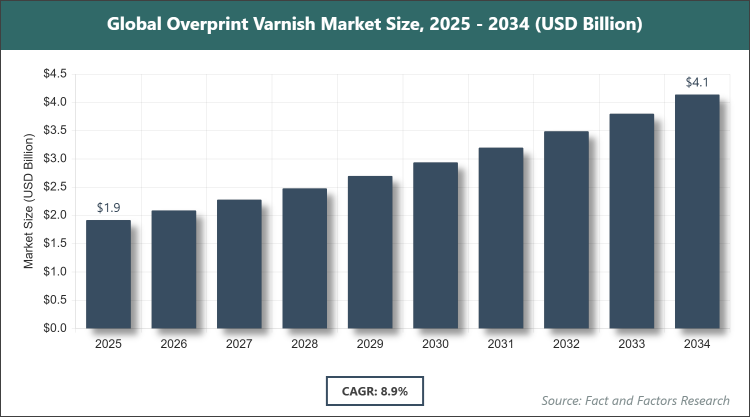
[237 + Pages Report] According to Facts & Factors, the global Overprint Varnish market size was estimated at USD 1.92 billion in 2025 and is expected to reach USD 4.12 billion by the end of 2034. The Overprint Varnish industry is anticipated to grow by a CAGR of 8.9% between 2026 and 2034. The Overprint Varnish Market is driven by rising demand for premium protective and aesthetic coatings in flexible and rigid packaging, combined with the global shift toward sustainable, low-VOC formulations.
 Market Overview
The Overprint Varnish market covers the production, formulation, and application of specialized transparent coatings applied over printed surfaces to deliver enhanced protection, gloss or matte finish, abrasion resistance, and chemical durability while improving visual appeal and extending product shelf life. These varnishes are formulated using water-based, solvent-based, or UV-curable technologies and are widely used across packaging, labels, commercial prints, and publications to safeguard inks from smudging, fading, or scratching during handling, transportation, and consumer use. The market includes high-performance formulations that comply with food-contact regulations, offer recyclability, and support high-speed printing lines, serving as a critical value-adding step in the printing and converting process for brand owners seeking premium shelf presence and functional performance.
Key Insights
- As per the analysis shared by our research analyst, the Overprint Varnish market is estimated to grow annually at a CAGR of around 8.9% over the forecast period (2026-2034).
- In terms of revenue, the Overprint Varnish market size was valued at around USD 1.92 billion in 2025 and is projected to reach USD 4.12 billion by 2034.
- The Overprint Varnish Market is driven by ethe xpanding global packaging industry and demand for sustainable low-VOC coatings.
- Based on the Type, the UV-Curable Overprint Varnish segment dominated the market in 2025 with a share of 46% due to instant curing, zero VOC emissions, high gloss levels, and compatibility with high-speed printing presses.
- Based on the Application, the Packaging segment dominated the market in 2025 with a share of 59%, owing to massive volume requirements in food, beverage, and consumer goods packaging for scuff resistance and brand protection.
- Based on the End-User, the Food & Beverage segment dominated the market in 2025 with a share of 51% because of stringent regulatory requirements for food-contact safety and the need for durable, glossy finishes on primary and secondary packaging.
- Asia Pacific dominated the global Overprint Varnish market in 2025 with a share of 44%, attributed to the rapid expansion of flexible packaging manufacturing, strong e-commerce growth, and the presence of large-scale converters in China and India.
Growth Drivers
- Boom in Flexible and Sustainable Packaging
Explosive growth in e-commerce, ready-to-eat foods, and personal care products has dramatically increased demand for high-quality printed flexible packaging that requires protective overprint varnishes to maintain print integrity and shelf appeal throughout the supply chain.
Regulatory pressure to reduce plastic usage and VOC emissions has accelerated adoption of water-based and UV-curable varnishes that enable recyclable mono-material structures while delivering superior performance, thereby driving innovation and volume growth across the value chain.
Restraints
- Raw Material Price Volatility and Regulatory Compliance Costs
Fluctuations in petrochemical-derived resins and photoinitiators directly impact production costs of solvent-based and UV systems, squeezing margins for manufacturers and converters in price-sensitive markets.
Stringent global food-contact and environmental regulations require continuous reformulation and extensive testing, increasing R&D expenditure and delaying new product commercialization, particularly for smaller players.
Opportunities
- Digital Printing and Functional Coatings Expansion
The shift toward short-run digital printing creates demand for fast-curing, low-odor UV and water-based varnishes optimized for inkjet and electrophotographic processes, opening new high-margin application areas.
Development of antimicrobial, anti-fingerprint, and soft-touch functional overprint varnishes offers premium differentiation for luxury cosmetics, pharmaceuticals, and electronics packaging, enabling higher pricing and stronger customer loyalty.
Challenges
- Competition from In-Line Coatings and Alternative Technologies
Growing integration of in-line aqueous or UV coatings directly on press reduces the need for separate off-line overprint varnish application, pressuring traditional converters and requiring varnish suppliers to develop hybrid solutions.
Technical difficulties in achieving consistent performance on recycled and lightweight substrates, combined with varying print processes across regions, complicate formulation standardization and global supply chain management.
Report Scope
Report Attribute |
Details |
Market Size 2025 |
USD 1.92 Billion |
Projected Market Size in 2034 |
USD 4.12 Billion |
CAGR Growth Rate |
8.9% CAGR |
Base Year |
2025 |
Forecast Years |
2026-2034 |
Key Market Players |
Siegwerk Druckfarben AG & Co. KGaA, Flint Group, Michelman, Inc., PPG Industries, Inc., Covestro AG, FUJIFILM Corporation, Evonik Industries AG, ALTANA AG, and Others. |
Key Segment |
By Type, By Application, By End-User, and By Region |
Major Regions Covered |
North America, Europe, Asia Pacific, Latin America, and the Middle East & Africa |
Purchase Options |
Request customized purchase options to meet your research needs. Explore purchase options |
Market Segmentation
The Overprint Varnish market is segmented by Type, Application, End-User, and region.
Based on Type Segment, the Overprint Varnish market is divided into water-based overprint varnish, solvent-based overprint varnish, uv-curable overprint varnish, and others. The most dominant segment is UV-Curable Overprint Varnish, followed by Water-Based Overprint Varnish. UV-Curable Overprint Varnish dominates because of its instant curing under UV light, virtually zero VOC content, exceptional gloss and abrasion resistance, and suitability for high-speed modern printing lines, which collectively reduce energy consumption, speed up production, and meet stringent sustainability targets, thereby accelerating market revenue growth and encouraging continuous technological upgrades across the industry.
Based on Application Segment, the Overprint Varnish market is divided into packaging, labels, commercial printing, publications, and others. The most dominant segment is Packaging, followed by Labels. Packaging leads the segment due to its enormous volume across flexible pouches, cartons, and corrugated boxes, where varnish provides essential scuff protection, moisture barrier, and premium visual finish that enhances brand visibility on retail shelves, directly driving higher consumption volumes and stimulating demand for specialized food-safe and recyclable formulations that support the overall expansion of the global packaging sector.
Based on End-User Segment, the Overprint Varnish market is divided into food & beverage, pharmaceuticals, cosmetics & personal care, and others. The most dominant segment is Food & Beverage, followed by Pharmaceuticals. Food & Beverage dominates because of the sheer scale of primary and secondary packaging requirements combined with rigorous food-contact safety standards that necessitate certified low-migration varnishes, creating steady high-volume demand while pushing manufacturers to develop cost-effective, high-performance solutions that simultaneously protect prints and comply with global regulations, thereby fueling sustained market growth and innovation.
Recent Developments
- In March 2025, Evonik launched TEGO® Foamex 8420, a new defoamer specifically engineered for waterborne overprint varnishes and inks, delivering superior foam control in high-speed coating applications.
- In September 2025, Siegwerk introduced a new range of overprint varnishes optimized for digitally printed labels at Labelexpo Europe, offering enhanced gloss, scuff resistance, and compatibility with UV-inkjet systems.
- In June 2025, AkzoNobel Packaging Coatings commercially launched Accelstyle™ 100 waterborne gloss and Accelstyle™ 200 matt overprint varnishes, providing low-migration and high-performance finishes for food and beverage packaging.
- In May 2024 (expanded in 2025), Michelman showcased its latest water-based primer and overprint varnish portfolio at drupa, highlighting recyclable and high-gloss solutions for paper and board applications.
- In April 2025, Flint Group expanded its Evolution series with a new low-odor UV overprint varnish designed for narrow-web label printing, achieving faster curing and improved adhesion on synthetic substrates.
Regional Analysis
- Asia Pacific to dominate the global market
Asia Pacific leads the Overprint Varnish market through its position as the global manufacturing hub for flexible packaging, labels, and consumer goods, supported by massive investments in modern printing and converting infrastructure across China, India, and Southeast Asia. Rapid urbanization, expanding middle-class consumption, and explosive e-commerce growth have created unprecedented demand for attractively finished packaging that requires high-performance varnishes for protection and brand differentiation. Local governments actively promote sustainable packaging through regulations favoring low-VOC and recyclable materials, accelerating the shift from solvent-based to water-based and UV-curable technologies.
North America holds a significant position in the Overprint Varnish market, driven by advanced printing technology adoption, stringent food-safety regulations, and a mature brand-conscious consumer base that demands premium packaging finishes. The region benefits from early integration of digital printing workflows and a strong focus on circular economy principles that favor water-based and UV systems. The United States dominates within North America through its leadership in innovative packaging design, presence of major brand owners, and robust R&D ecosystem that continuously develops next-generation functional varnishes for e-commerce and sustainable applications.
Europe exhibits steady and technology-driven growth in the Overprint Varnish market, supported by strict environmental regulations, high consumer preference for eco-labeled products, and a well-established network of specialty chemical and printing companies. The region leads in the development of low-migration and bio-based varnish formulations that comply with the latest EU packaging directives. Germany dominates within Europe owing to its world-class machinery manufacturers, advanced chemical industry, and central role in supplying high-quality varnishes to automotive, pharmaceutical, and luxury goods packaging converters across the continent.
Latin America is experiencing accelerating growth in the Overprint Varnish market, fueled by rising domestic consumption, modernization of packaging facilities, and increasing foreign direct investment in food and beverage processing. Growing retail modernization and export-oriented manufacturing have heightened the need for durable printed packaging finishes. Brazil dominates the region with its large population, expanding processed food sector, and improving printing infrastructure that increasingly incorporates water-based and UV technologies to meet both local and international quality standards.
The Middle East & Africa region shows promising development in the Overprint Varnish market, driven by diversification of economies, growth in consumer goods manufacturing, and rising demand for packaged food and personal care products. Investments in modern packaging plants and increasing awareness of brand protection have created new opportunities for quality varnish applications. The United Arab Emirates leads within the region through its strategic position as a re-export hub, modern printing and packaging facilities, and government initiatives promoting high-value manufacturing and sustainable materials that support the adoption of advanced overprint solutions.
Competitive Analysis
The global Overprint Varnish market is dominated by players:
- Siegwerk Druckfarben AG & Co. KGaA
- Flint Group
- Michelman, Inc.
- PPG Industries, Inc.
- Covestro AG
- FUJIFILM Corporation
- Evonik Industries AG
- ALTANA AG
- Toyo Ink SC Holdings Co., Ltd.
- Huber Group
The global Overprint Varnish market is segmented as follows:
By Type
- Water-Based Overprint Varnish
- Solvent-Based Overprint Varnish
- UV-Curable Overprint Varnish
- Others
By Application
- Packaging
- Labels
- Commercial Printing
- Publications
- Others
By End-User
- Food & Beverage
- Pharmaceuticals
- Cosmetics & Personal Care
- Others
By Region
- North America
- The U.S.
- Canada
- Mexico
- Europe
- France
- The UK
- Spain
- Germany
- Italy
- Rest of Europe
- Asia Pacific
- China
- Japan
- India
- Australia
- Southeast Asia
- Rest of Asia Pacific
- The Middle East & Africa
- Saudi Arabia
- UAE
- Egypt
- Kuwait
- South Africa
- Rest of the Middle East & Africa
- Latin America
- Brazil
- Argentina
- Rest of Latin America
Table of Content
Industry Major Market Players
- Siegwerk Druckfarben AG & Co. KGaA
- Flint Group
- Michelman, Inc.
- PPG Industries, Inc.
- Covestro AG
- FUJIFILM Corporation
- Evonik Industries AG
- ALTANA AG
- Toyo Ink SC Holdings Co., Ltd.
- Huber Group



Copyright © 2025 - 2026, All Rights Reserved, Facts and Factors