
Search Market Research Report
Nutraceutical Packaging Market Size, Share Global Analysis Report, 2026-2034

Nutraceutical Packaging Market Size, Share, Growth Analysis Report By Packaging Type (Blisters & Strips, Bottles, Cans and Jars, Bags and Pouches, Cartons, Stick Packs, and Others), By Product Type (Dietary Supplements, Functional Foods, Functional Beverages, and Others), By Material Type (Plastic, Glass, Metal, Paper and Paperboard, and Others), and By Region - Global Industry Insights, Overview, Comprehensive Analysis, Trends, Statistical Research, Market Intelligence, Historical Data and Forecast 2026-2034
Industry Insights
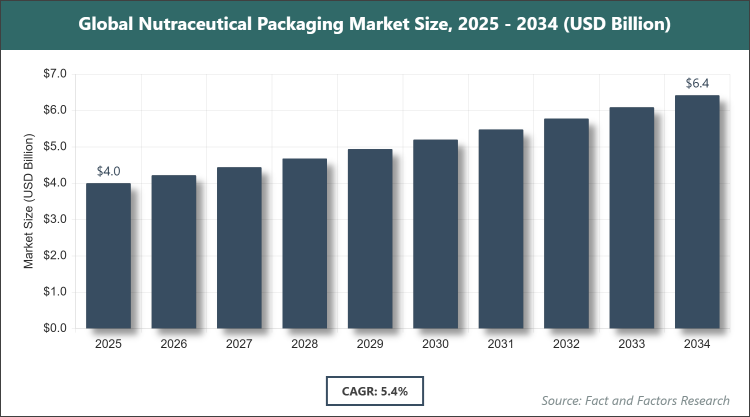
[220+ Pages Report] According to Facts & Factors, the global Nutraceutical Packaging market size was estimated at USD 4.0 billion in 2025 and is expected to reach USD 6.4 billion by the end of 2034. The Nutraceutical Packaging industry is anticipated to grow by a CAGR of 5.4% between 2026 and 2034. The Nutraceutical Packaging Market is driven by increasing consumer demand for health and wellness products coupled with advancements in sustainable packaging technologies.
 Market Overview
The nutraceutical packaging market encompasses the design, production, and distribution of packaging solutions specifically tailored for nutraceutical products, which include dietary supplements, functional foods, and beverages aimed at promoting health and wellness. This market focuses on ensuring product integrity, safety, and appeal through innovative materials and designs that protect against contamination, extend shelf life, and comply with regulatory standards.
Key Insights
- As per the analysis shared by our research analyst, the global Nutraceutical Packaging market is estimated to grow annually at a CAGR of around 5.4% over the forecast period (2026-2034).
- In terms of revenue, the global Nutraceutical Packaging market size was valued at around USD 4.0 billion in 2025 and is projected to reach USD 6.4 billion, by 2034.
- The market is driven by rising health awareness and increasing demand for functional foods and dietary supplements.
- Based on the Packaging Type, the Bottles segment dominated the market in 2025 with a share of 35% & why it is dominated due to their versatility, ease of use, and ability to provide secure protection for various product forms.
- Based on the Product Type, the Dietary Supplements segment dominated the market in 2025 with a share of 46% & why it is dominated owing to the high global consumption of supplements for preventive healthcare and nutritional support.
- Based on the Material Type, the Plastic segment dominated the market in 2025 with a share of 52% & why it is dominated because of its cost-effectiveness, lightweight nature, and flexibility in design.
- North America dominated the global market with 34% share & why it is dominated attributed to high consumer health consciousness, advanced manufacturing infrastructure, and stringent regulatory standards.
Growth Drivers
- Rising Consumer Health Awareness
The surge in consumer awareness regarding health and wellness has significantly propelled the nutraceutical packaging market. As individuals increasingly prioritize preventive healthcare, the demand for nutraceutical products like vitamins and functional foods has risen, necessitating specialized packaging to maintain efficacy and appeal. This trend is supported by global health campaigns and educational initiatives that emphasize the benefits of nutraceuticals, leading to expanded market opportunities for innovative packaging solutions.
Innovations in packaging technology, such as barrier films and active packaging, further enhance product shelf life and integrity, aligning with consumer preferences for safe and effective health products. This driver not only boosts market growth but also encourages investment in research and development to meet evolving consumer needs.
- Advancements in Sustainable Packaging
The shift towards eco-friendly materials has become a key growth driver, as environmental concerns prompt manufacturers to adopt biodegradable and recyclable packaging options. This transition reduces the ecological footprint and appeals to environmentally conscious consumers, driving demand for sustainable nutraceutical packaging.
Regulatory pressures and corporate sustainability goals further accelerate this trend, fostering innovation in materials like plant-based plastics and compostable films, which contribute to long-term market expansion.
Restraints
- High Production Costs
Elevated costs associated with advanced packaging materials and technologies pose a significant restraint, limiting accessibility for smaller manufacturers and potentially increasing product prices for consumers. This financial barrier can hinder market entry and slow adoption of innovative solutions.
Supply chain disruptions and fluctuations in raw material prices exacerbate this issue, impacting overall profitability and market growth in price-sensitive regions.
- Stringent Regulatory Compliance
Complex and varying regulations across regions require substantial compliance efforts, increasing operational complexities and costs for packaging manufacturers. Non-compliance risks can lead to product recalls and legal penalties, restraining market expansion.
The need for continuous adaptation to evolving standards further strains resources, particularly for global players navigating diverse regulatory landscapes.
Opportunities
- Expansion in Emerging Markets
Rapid urbanization and rising disposable incomes in emerging economies present opportunities for market penetration, as growing middle-class populations seek health-enhancing products. This creates demand for affordable and culturally adapted packaging solutions.
Strategic partnerships and local manufacturing can capitalize on these opportunities, fostering market growth through tailored offerings and enhanced distribution networks.
- Technological Innovations
Advancements in smart packaging, such as QR codes and sensors for freshness monitoring, offer opportunities to enhance consumer engagement and product differentiation. These technologies improve traceability and user experience, driving premium product segments.
Integration with digital platforms further expands opportunities, enabling personalized marketing and data-driven insights for manufacturers.
Challenges
- Supply Chain Vulnerabilities
Global supply chain disruptions, influenced by geopolitical tensions and pandemics, challenge consistent material availability and timely production, affecting market stability.
Dependency on imported raw materials heightens vulnerability, requiring diversified sourcing strategies to mitigate risks.
- Intense Market Competition
The presence of numerous players intensifies competition, pressuring margins and necessitating continuous innovation to maintain market share.
Differentiation through unique value propositions becomes essential, yet challenging, in a crowded marketplace.
Report Scope
Report Attribute |
Details |
Market Size 2025 |
USD 4.0 Billion |
Projected Market Size in 2034 |
USD 6.4 Billion |
CAGR Growth Rate |
5.4% CAGR |
Base Year |
2025 |
Forecast Years |
2026-2034 |
Key Market Players |
Amcor plc, Berry Global Inc., Gerresheimer AG, Schott AG, Mondi, WestRock Company, TricorBraun, CCL Industries, Sonoco Products Company, Constantia Flexibles, and Others. |
Key Segment |
By Packaging Type, By Product Type, By Material Type, and By Region |
Major Regions Covered |
North America, Europe, Asia Pacific, Latin America, and the Middle East & Africa |
Purchase Options |
Request customized purchase options to meet your research needs. Explore purchase options |
Market Segmentation
The Nutraceutical Packaging market is segmented by packaging type, product type, material type, and region.
Based on Packaging Type Segment, the Nutraceutical Packaging market is divided into Blisters & Strips, Bottles, Cans and Jars, Bags and Pouches, Cartons, Stick Packs, and others.
The most dominant segment is Bottles, followed by Blisters & Strips as the second most dominant. Bottles dominate due to their widespread use in storing liquids and solids, offering excellent protection against moisture and contamination, which is crucial for maintaining nutraceutical efficacy; this dominance drives the market by enabling efficient distribution and consumer convenience, while Blisters & Strips are second due to their popularity in unit-dose packaging for tablets and capsules, providing tamper-evidence and portability that enhance compliance and safety, thereby supporting market growth through improved user adherence and reduced waste.
Based on Product Type Segment, the Nutraceutical Packaging market is divided into Dietary Supplements, Functional Foods, Functional Beverages, and others.
The most dominant segment is Dietary Supplements, followed by Functional Foods as the second most dominant. Dietary Supplements dominate because of the surging global demand for vitamins, minerals, and herbal products for health maintenance, requiring specialized packaging to preserve potency and ensure dosage accuracy, which propels market expansion by catering to preventive health trends; Functional Foods are second dominant as they integrate health benefits into everyday consumables like fortified snacks, driving the need for attractive and functional packaging that highlights nutritional claims, thus contributing to market growth via increased consumer adoption of wellness-oriented diets.
Based on Material Type Segment, the Nutraceutical Packaging market is divided into Plastic, Glass, Metal, Paper and Paperboard, and others.
The most dominant segment is Plastic, followed by Paper and Paperboard as the second most dominant. Plastic dominates owing to its versatility, low cost, and ability to form various shapes while providing barrier properties against oxygen and light, essential for nutraceutical stability, which accelerates market growth by enabling mass production and affordability; Paper and Paperboard are second dominant due to their eco-friendly appeal and recyclability, appealing to sustainability-focused consumers and regulations, thereby driving the market through the adoption of green packaging alternatives that reduce environmental impact without compromising functionality.
Recent Developments
- In 2025, Amcor plc introduced a new line of recyclable plastic bottles for dietary supplements, emphasizing sustainability and reducing carbon footprint by 30%, which aligns with global eco-trends and enhances brand appeal.
- Berry Global Inc. acquired a specialized packaging firm in 2024 to expand its nutraceutical portfolio, focusing on innovative blister packs that improve child-resistant features and user convenience.
- In 2023, Gerresheimer AG launched glass jars with enhanced UV protection for functional foods, addressing degradation issues and extending shelf life, thereby supporting market demands for premium packaging.
Regional Analysis
- North America to dominate the global market
North America continues to lead the nutraceutical packaging market, driven by robust consumer demand for health products and advanced technological infrastructure. The region's emphasis on innovation in packaging solutions, such as smart labels and sustainable materials, supports market leadership. The United States stands out as the dominating country, with its large health-conscious population and established pharmaceutical and food industries fostering a dynamic environment for packaging advancements. This dominance is further bolstered by strong regulatory frameworks that ensure product safety and quality, encouraging investments in cutting-edge packaging technologies.
Europe exhibits strong growth in the nutraceutical packaging market, fueled by increasing awareness of wellness and stringent environmental regulations promoting eco-friendly solutions. Countries like Germany and the UK contribute significantly, with Germany dominating due to its engineering prowess and focus on high-quality, recyclable packaging. The region's diverse consumer base demands versatile packaging that caters to various product forms, from supplements to functional beverages. Collaborative efforts between manufacturers and regulators enhance innovation, ensuring compliance while addressing sustainability concerns.
Asia Pacific is emerging as a key player in the nutraceutical packaging market, propelled by rapid urbanization and rising disposable incomes that boost demand for health-enhancing products. China dominates the region, leveraging its massive population and expanding middle class to drive consumption of nutraceuticals, necessitating efficient and cost-effective packaging. The area's focus on affordable yet innovative solutions, such as flexible pouches, aligns with local preferences for convenience. Growing e-commerce platforms further amplify the need for durable packaging that withstands transportation challenges.
Latin America shows promising potential in the nutraceutical packaging market, supported by improving healthcare awareness and economic development. Brazil emerges as the dominating country, with its vibrant wellness culture and increasing adoption of dietary supplements spurring packaging innovations. The region's tropical climate influences packaging requirements for moisture resistance and stability. Local manufacturers are adapting to global trends by incorporating sustainable materials, enhancing market competitiveness.
The Middle East & Africa region is gradually advancing in the nutraceutical packaging market, driven by urbanization and a growing interest in health products. South Africa dominates, benefiting from its developed infrastructure and rising consumer focus on preventive health. The area's diverse climates necessitate robust packaging to maintain product integrity. Investments in local production capabilities are increasing, reducing reliance on imports and fostering regional growth.
Competitive Analysis
The global Nutraceutical Packaging market is dominated by players:
- Amcor plc
- Berry Global Inc.
- Gerresheimer AG
- Schott AG
- Mondi
- WestRock Company
- TricorBraun
- CCL Industries
- Sonoco Products Company
- Constantia Flexibles
- Graham Packaging Company
- Others
The global Nutraceutical Packaging market is segmented as follows:
By Packaging Type
- Blisters & Strips
- Bottles
- Cans and Jars
- Bags and Pouches
- Cartons
- Stick Packs
- Others
By Product Type
- Dietary Supplements
- Functional Foods
- Functional Beverages
- Others
By Material Type
- Plastic
- Glass
- Metal
- Paper and Paperboard
- Others
By Region
- North America
- The U.S.
- Canada
- Mexico
- Europe
- France
- The UK
- Spain
- Germany
- Italy
- Rest of Europe
- Asia Pacific
- China
- Japan
- India
- Australia
- Southeast Asia
- Rest of Asia Pacific
- The Middle East & Africa
- Saudi Arabia
- UAE
- Egypt
- Kuwait
- South Africa
- Rest of the Middle East & Africa
- Latin America
- Brazil
- Argentina
- Rest of Latin America
Table of Content
Industry Major Market Players
The global Nutraceutical Packaging market is dominated by players:
- Amcor plc
- Berry Global Inc.
- Gerresheimer AG
- Schott AG
- Mondi
- WestRock Company
- TricorBraun
- CCL Industries
- Sonoco Products Company
- Constantia Flexibles
- Graham Packaging Company
- Others



Copyright © 2025 - 2026, All Rights Reserved, Facts and Factors