
Search Market Research Report
Noise Vibration Harshness Testing Market Size, Share Global Analysis Report, 2026-2034

Noise Vibration Harshness Testing Market Size, Share, Growth Analysis Report By Component (Hardware, Software, Services), By Application (Buzz, Squeak and Rattle Noise Testing, Sound Intensity and Quality Analysis, Powertrain Performance Testing, Pass-by Noise Testing, and Others), By End-Use (Aerospace & Defense, Automotive, Consumer Electronics, Construction, Energy & Utility, and Others), and By Region - Global Industry Insights, Overview, Comprehensive Analysis, Trends, Statistical Research, Market Intelligence, Historical Data and Forecast 2026-2034
Industry Insights
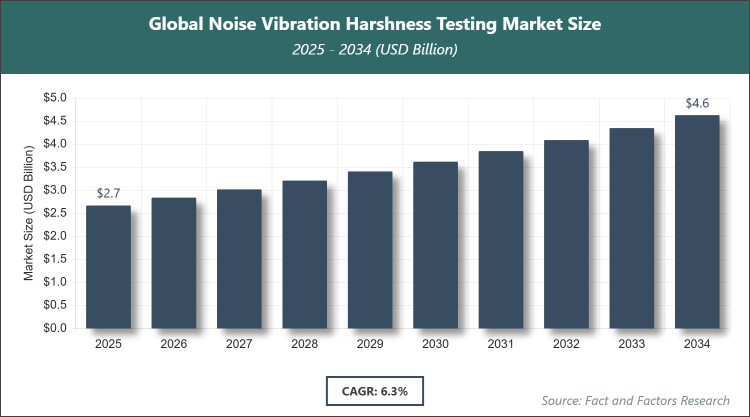
[235+ Pages Report] According to Facts & Factors, the global Noise Vibration Harshness Testing market size was estimated at USD 2.67 billion in 2025 and is expected to reach USD 4.62 billion by the end of 2034. The Noise Vibration Harshness Testing industry is anticipated to grow by a CAGR of 6.3% between 2026 and 2034. The Noise Vibration Harshness Testing Market is driven by increasing demand for quieter vehicles and stringent noise regulations.
 Market Overview
Noise Vibration Harshness (NVH) Testing refers to the process of measuring, analyzing, and controlling unwanted noise, vibrations, and harshness in products, particularly in vehicles and machinery, to enhance user comfort, safety, and performance. It involves using specialized equipment and software to identify sources of disturbances and mitigate them during design, manufacturing, and quality assurance stages.
Key Insights
- As per the analysis shared by our research analyst, the Noise Vibration Harshness Testing market is estimated to grow annually at a CAGR of around 6.3% over the forecast period (2026-2034).
- In terms of revenue, the Noise Vibration Harshness Testing market size was valued at around USD 2.67 billion in 2025 and is projected to reach USD 4.62 billion, by 2034.
- Due to increasing demand for comfortable and quiet vehicles, stringent regulations on noise emissions, and advancements in automotive technology.
- Based on the Component, the Hardware segment accounted for the largest market share of 60% due to its essential role in data collection through sensors and analyzers, which are critical for accurate NVH measurements.
- Based on the Application, the Sound Intensity and Quality Analysis segment accounted for the largest market share of 53% due to its widespread use in evaluating acoustic performance in vehicles and consumer products.
- Based on the End-Use, the Automotive segment accounted for the largest market share of 44% due to the high demand for NVH testing in vehicle development to meet consumer expectations for comfort.
- Based on the region, the “Asia Pacific” region was the leading revenue generator with a share of 38% due to rapid industrialization, expanding automotive manufacturing, and supportive government policies.
Growth Drivers
- Increasing Demand for Quieter and Comfortable Vehicles
The surge in consumer preferences for enhanced driving experiences has propelled the adoption of NVH testing solutions across the automotive sector. As urbanization grows, people are increasingly sensitive to noise and vibrations in daily commutes, pushing manufacturers to invest in advanced testing to ensure smoother and quieter rides. This trend is particularly evident in premium and electric vehicles where silence is a key selling point.
Technological integrations such as AI-driven analytics further amplify this driver by enabling precise identification and reduction of NVH issues early in the design phase, reducing recalls and improving brand reputation. Overall, this focus on user comfort is reshaping product development strategies in transportation and consumer goods industries.
- Shift Towards Electric and Hybrid Vehicles
The transition to electric mobility has introduced unique NVH challenges, such as high-frequency noises from electric motors and batteries, necessitating specialized testing equipment. Governments worldwide are promoting EV adoption through incentives and regulations, boosting the need for NVH solutions to address these new acoustic profiles. This shift not only expands the market but also fosters innovation in testing methodologies.
In addition, collaborations between automakers and testing firms are accelerating the development of tailored NVH tools, ensuring compliance with evolving standards and enhancing vehicle efficiency. This driver is set to sustain long-term growth as the global fleet electrifies.
- Stringent Regulatory Compliance for Noise Emissions
Global regulations mandating lower noise levels in vehicles and industrial equipment are compelling companies to integrate NVH testing into their operations. Bodies like the EPA and EU set strict limits on emissions, driving demand for reliable testing to avoid penalties and ensure market access. This regulatory push is especially strong in densely populated regions.
Furthermore, compliance enhances product quality, leading to competitive advantages and customer trust. As regulations tighten, the market for NVH testing services and software is expected to expand, supporting sustainable manufacturing practices.
Restraints
- High Initial Investment for Testing Facilities
The substantial costs associated with setting up NVH testing infrastructure, including specialized equipment and skilled personnel, pose a significant barrier for small and medium enterprises. This financial hurdle limits market entry and expansion, particularly in emerging economies where budgets are constrained.
Moreover, ongoing maintenance and calibration expenses add to the burden, potentially delaying adoption of advanced technologies. Despite these challenges, cost reductions through economies of scale and financing options could mitigate impacts over time.
Opportunities
- Rising Adoption of Electric Vehicles
The boom in EV production opens avenues for NVH testing tailored to battery and motor-specific vibrations, creating niche markets for innovative solutions. As EV penetration increases, testing firms can capitalize on the need for quiet operation to differentiate products.
This opportunity extends to aftermarket services and retrofitting, broadening revenue streams. Strategic partnerships with EV manufacturers will be key to harnessing this growth potential.
- Government Regulations Supporting Noise Reduction
Supportive policies aimed at curbing noise pollution are fostering investments in NVH technologies, particularly in urban planning and transportation. This creates demand for consulting and testing services to meet compliance.
Opportunities also arise in R&D for eco-friendly materials and designs, positioning companies as leaders in sustainable innovation.
Challenges
- Lack of Skilled Personnel
The complexity of NVH testing requires expertise in acoustics and engineering, but a shortage of trained professionals hampers efficient implementation. This skills gap can lead to inaccuracies and delays in product development.
Addressing this through training programs and academic collaborations is essential, though it demands time and resources from industry stakeholders.
- Technological Integration Complexities
Incorporating AI and advanced sensors into existing systems presents integration challenges, potentially increasing downtime and costs. Compatibility issues with legacy equipment further complicate adoption.
Overcoming these requires robust R&D efforts and standardized protocols to ensure seamless operations.
Report Scope
Report Attribute |
Details |
Market Size 2025 |
USD 2.67 Billion |
Projected Market Size in 2034 |
USD 4.62 Billion |
CAGR Growth Rate |
6.3% CAGR |
Base Year |
2025 |
Forecast Years |
2026-2034 |
Key Market Players |
Hottinger Brüel & Kjær (Spectris), HEAD Acoustics GmbH, Dewesoft d.o.o., Siemens, Data Physics Corporation, NATIONAL INSTRUMENTS CORP. (Emerson Electric Co.), Axiometrix Solutions, IMV Corporation, Prosig Ltd., Norsonic, Signal.X Technologies, LLC, Bertrandt, Schaeffler AG, and Others. |
Key Segment |
By Component, By Application, By End-Use, and By Region |
Major Regions Covered |
North America, Europe, Asia Pacific, Latin America, and the Middle East & Africa |
Purchase Options |
Request customized purchase options to meet your research needs. Explore purchase options |
Market Segmentation
The Noise Vibration Harshness Testing market is segmented by Component, Application, End-Use, and region.
Based on Component Segment, the Noise Vibration Harshness Testing market is divided into Hardware, Software, and Services. The most dominant segment is Hardware, which holds a significant share due to its foundational role in capturing real-time data through sensors, transducers, and analyzers, essential for precise NVH assessments; this dominance drives the market by enabling accurate diagnostics and compliance with quality standards, while the second most dominant is Software, which complements hardware by providing advanced data processing and simulation capabilities, helping to optimize designs and reduce development time through predictive analytics.
Based on Application Segment, the Noise Vibration Harshness Testing market is divided into Buzz, Squeak and Rattle Noise Testing, Sound Intensity and Quality Analysis, Powertrain Performance Testing, Pass-by Noise Testing, and Others. The most dominant segment is Sound Intensity and Quality Analysis, leading because it directly addresses consumer concerns about acoustic comfort in products like vehicles and electronics, driving market growth by facilitating improvements in sound design that enhance user satisfaction and brand loyalty; the second most dominant is Powertrain Performance Testing, which is crucial for evaluating engine and transmission vibrations, contributing to the market by ensuring efficiency and durability in automotive applications amid the rise of electrified powertrains.
Based on End-Use Segment, the Noise Vibration Harshness Testing market is divided into Aerospace & Defense, Automotive, Consumer Electronics, Construction, Energy & Utility, and Others. The most dominant segment is Automotive, dominating due to the sector's high volume production and stringent requirements for vehicle comfort and safety, propelling the market forward by integrating NVH testing in design phases to meet global standards and consumer demands; the second most dominant is Consumer Electronics, which grows rapidly as devices become more compact and silent, aiding market expansion through innovations in noise reduction for products like appliances and gadgets.
Recent Developments
- In September 2024, Advantech unveiled PCIE-1802 cards for vehicle noise, vibration, and harshness testing, featuring 24-bit analog input channels and synchronized sampling up to 216 kS/s for improved sound data accuracy, enhancing testing precision in automotive applications.
- In May 2022, imc Test and Measurement launched WAVE 2022 software for noise and vibration analysis, offering functions for sound pressure, sound power measurement, and vibration analysis, which streamlines data processing for engineers.
- In February 2025, Communication solutions like Cisco and Avaya integrated AI-powered noise-cancellation in contact centers using AI and NLP technologies, improving audio quality and operational efficiency.
- In October 2024, SimScale introduced features for computing and visualizing Engineered Reverberation Performance (ERP) in noise, vibration, and harshness simulation, including graph over frequency range and density field visualization, advancing simulation capabilities.
Regional Analysis
- Asia Pacific to dominate the global market
The Asia Pacific region dominates the Noise Vibration Harshness Testing market, driven by rapid industrialization and a booming automotive sector, with China emerging as the dominating country due to its massive manufacturing base and investments in EV technology. This dominance stems from supportive government policies promoting sustainable transportation and noise control, fostering innovation in testing solutions. The region's diverse economies, including emerging markets like India, contribute to widespread adoption across industries, enhancing overall market penetration. Collaborative efforts between local firms and global players further strengthen technological capabilities, ensuring compliance with international standards while addressing local needs.
North America maintains a strong position in the Noise Vibration Harshness Testing market, with the United States as the dominating country owing to its advanced aerospace and automotive industries. The region's focus on research and development, coupled with stringent environmental regulations, drives demand for sophisticated NVH solutions. Innovation hubs in tech-savvy areas promote the integration of cutting-edge technologies like AI in testing processes. This emphasis on quality and safety standards positions North America as a leader in high-end applications, supporting export opportunities and industry collaborations.
Europe exhibits robust growth in the Noise Vibration Harshness Testing market, led by Germany as the dominating country with its established automotive heritage and engineering expertise. The region's commitment to EU-wide noise reduction directives accelerates the adoption of NVH testing in manufacturing. Emphasis on sustainable practices and green technologies aligns with consumer preferences for eco-friendly products. Cross-border initiatives enhance knowledge sharing, boosting efficiency in sectors like construction and energy.
Latin America is emerging in the Noise Vibration Harshness Testing market, with Brazil as the dominating country due to its expanding industrial base and automotive production. Growing awareness of noise pollution issues prompts investments in testing infrastructure. Regional trade agreements facilitate technology transfers, aiding market development. Challenges like economic variability are offset by opportunities in renewable energy sectors.
The Middle East & Africa region shows potential in the Noise Vibration Harshness Testing market, with South Africa as a key player in industrial applications. Infrastructure projects and oil & gas sectors drive demand for NVH solutions to ensure operational reliability. Government initiatives for diversification beyond oil enhance focus on manufacturing standards. Partnerships with international experts are crucial for skill development and technology adoption.
Competitive Analysis
The global Noise Vibration Harshness Testing market is dominated by players:
- Hottinger Brüel & Kjær (Spectris)
- HEAD Acoustics GmbH
- Dewesoft d.o.o.
- Siemens
- Data Physics Corporation
- NATIONAL INSTRUMENTS CORP. (Emerson Electric Co.)
- Axiometrix Solutions
- IMV Corporation
- Prosig Ltd.
- Norsonic
- Signal.X Technologies, LLC
- Bertrandt
- Schaeffler AG
The global Noise Vibration Harshness Testing market is segmented as follows:
By Component
- Hardware
- Software
- Services
By Application
- Buzz, Squeak and Rattle Noise Testing
- Sound Intensity and Quality Analysis
- Powertrain Performance Testing
- Pass-by Noise Testing
- Others
By End-Use
- Aerospace & Defense
- Automotive
- Consumer Electronics
- Construction
- Energy & Utility
- Others
By Region
- North America
- The U.S.
- Canada
- Mexico
- Europe
- France
- The UK
- Spain
- Germany
- Italy
- Rest of Europe
- Asia Pacific
- China
- Japan
- India
- Australia
- Southeast Asia
- Rest of Asia Pacific
- The Middle East & Africa
- Saudi Arabia
- UAE
- Egypt
- Kuwait
- South Africa
- Rest of the Middle East & Africa
- Latin America
- Brazil
- Argentina
- Rest of Latin America
Table of Content
Industry Major Market Players
The global Noise Vibration Harshness Testing market is dominated by players:
- Hottinger Brüel & Kjær (Spectris)
- HEAD Acoustics GmbH
- Dewesoft d.o.o.
- Siemens
- Data Physics Corporation
- NATIONAL INSTRUMENTS CORP. (Emerson Electric Co.)
- Axiometrix Solutions
- IMV Corporation
- Prosig Ltd.
- Norsonic
- Signal.X Technologies, LLC
- Bertrandt
- Schaeffler AG



Copyright © 2025 - 2026, All Rights Reserved, Facts and Factors