
Search Market Research Report
Laser Technology Market Size, Share Global Analysis Report, 2026-2034

Laser Technology Market Size, Share, Growth Analysis Report By Type (Solid-State Lasers, Gas Lasers, Liquid Lasers, Semiconductor Lasers, and Others), By Application (Optical Communication, Laser Processing, and Others), By End-User (IT and Telecom, Electronics and Semiconductor, Healthcare, Manufacturing, Automotive, Aerospace and Defense, and Others), and By Region - Global Industry Insights, Overview, Comprehensive Analysis, Trends, Statistical Research, Market Intelligence, Historical Data and Forecast 2026-2034
Industry Insights
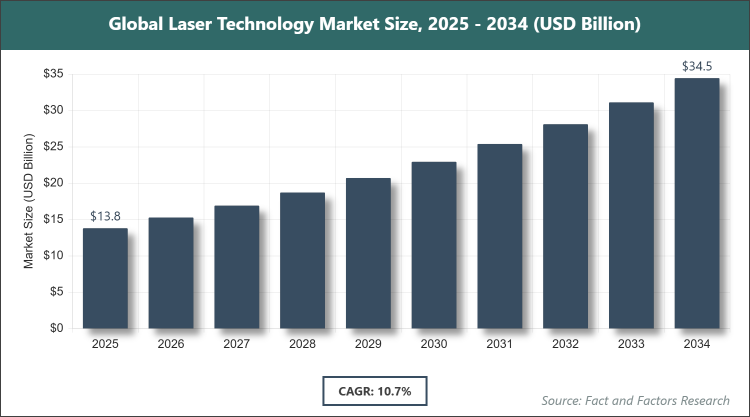
[235+ Pages Report] According to Facts & Factors, the global laser technology market size was estimated at USD 13.8 billion in 2025 and is expected to reach USD 34.3 billion by the end of 2034. The laser technology industry is anticipated to grow by a CAGR of 10.7% between 2026 and 2034. The laser technology Market is driven by increasing adoption in manufacturing and healthcare sectors.
 Market Overview
Laser technology encompasses the development, production, and application of devices that emit focused beams of coherent light through stimulated emission of electromagnetic radiation. It involves precise control of light amplification for various purposes, ranging from cutting and welding materials to transmitting data and performing medical procedures. This field integrates principles from physics, optics, and engineering to create tools that offer high accuracy, efficiency, and versatility across multiple industries without relying on numerical quantifications.
Key Insights
- As per the analysis shared by our research analyst, the global laser technology market is estimated to grow annually at a CAGR of around 10.7% over the forecast period (2026-2034)
- In terms of revenue, the global laser technology market size was valued at around USD 13.8 billion in 2025 and is projected to reach USD 34.3 billion, by 2034.
- The global laser technology market is projected to grow at a significant growth rate due to several driving factors.
- Based on the type, the solid-state lasers segment held the largest market share at 55%.
- Solid-state lasers dominate due to their high efficiency, reliability, and versatility in industrial applications like cutting and welding.
- Based on the application, the laser processing segment held the largest market share at 40%.
- Laser processing dominates because of its precision in material handling, enabling advancements in manufacturing and automotive sectors.
- Based on the end-user, the industrial segment held the largest market share at 35%.
- The industrial segment dominates owing to widespread use in automation, precision engineering, and cost-effective production processes.
- Based on region, Asia Pacific held the largest market share at 42%.
- Asia Pacific dominates due to rapid industrialization, high manufacturing output, and strong investments in technology infrastructure.
Growth Drivers
- Advancements in Manufacturing Processes
Laser technology is revolutionizing manufacturing by enabling precise cutting, welding, and engraving with minimal material waste. This precision enhances product quality and reduces production time, making it ideal for industries like automotive and electronics where accuracy is paramount. The integration of lasers with automation systems further boosts efficiency, allowing for complex designs and rapid prototyping that traditional methods cannot achieve.
Additionally, the shift towards sustainable manufacturing practices favors laser technology, as it often requires less energy and produces fewer emissions compared to conventional tools. As global demand for customized and high-quality products rises, manufacturers are increasingly adopting lasers to stay competitive, driving market expansion through innovation and operational improvements.
Restraints
- High Initial Investment Costs
The substantial upfront costs associated with acquiring and implementing laser systems pose a significant barrier for small and medium-sized enterprises. These expenses include not only the equipment but also training, maintenance, and integration into existing workflows, which can deter adoption in cost-sensitive markets.
Moreover, the need for specialized infrastructure, such as safety enclosures and power supplies, adds to the financial burden. In regions with limited access to financing or where economic instability prevails, these costs can slow market penetration and limit growth to larger, well-funded organizations.
Opportunities
- Expansion in Healthcare Applications
Lasers are increasingly used in medical procedures for their precision in surgeries, diagnostics, and therapies, offering minimally invasive options that reduce patient recovery time. Innovations in laser-based treatments for ophthalmology, dermatology, and oncology are opening new avenues for market growth.
The aging global population and rising healthcare demands further amplify opportunities, as lasers enable advanced treatments with better outcomes. Collaborations between technology firms and healthcare providers are fostering developments that could expand access to these solutions in emerging markets.
Challenges
- Regulatory and Safety Compliance
Strict regulations governing laser usage, particularly in medical and industrial settings, require compliance with safety standards to prevent hazards like eye damage or fires. Navigating these varying international regulations can complicate market entry and increase operational costs for manufacturers.
Additionally, ensuring consistent safety training and equipment certification adds layers of complexity. As technology evolves rapidly, keeping up with updated regulations poses an ongoing challenge, potentially delaying product launches and affecting market dynamics.
Report Scope
Report Attribute |
Details |
Market Size 2025 |
USD 13.8 Billion |
Projected Market Size in 2034 |
USD 34.3 Billion |
CAGR Growth Rate |
10.7% CAGR |
Base Year |
2025 |
Forecast Years |
2026-2034 |
Key Market Players |
Coherent Corp., TRUMPF, Han's Laser Technology Industry Group Co., Ltd, IPG Photonics Corporation, Jenoptik AG, and Others. |
Key Segment |
By Type, By Application, By End-User, and By Region |
Major Regions Covered |
North America, Europe, Asia Pacific, Latin America, and the Middle East & Africa |
Purchase Options |
Request customized purchase options to meet your research needs. Explore purchase options |
Market Segmentation
The laser technology market is segmented by type, application, end-user, and region.
Based on Type Segment, the laser technology market is divided into solid-state lasers, gas lasers, liquid lasers, semiconductor lasers, and others. The most dominant segment is solid-state lasers, followed by semiconductor lasers as the second most dominant. Solid-state lasers lead due to their robustness, high power output, and broad applicability in industrial processing and medical devices, driving market growth through enhanced efficiency and durability in demanding environments. Semiconductor lasers, as the second dominant, contribute significantly by enabling compact, cost-effective solutions for communications and consumer electronics, fueling expansion in data transmission and portable applications.
Based on Application Segment, the laser technology market is divided into optical communication, laser processing, and others. The most dominant segment is laser processing, with optical communication as the second most dominant. Laser processing dominates because of its critical role in precision manufacturing, material cutting, and welding, which accelerates industrial productivity and innovation across sectors like automotive and aerospace. Optical communication, the second dominant, drives growth through high-speed data transfer in telecommunications, supporting the surge in internet usage and cloud computing demands.
Based on End-User Segment, the laser technology market is divided into IT and telecom, electronics and semiconductor, healthcare, manufacturing, automotive, aerospace and defense, and others. The most dominant segment is manufacturing, followed by healthcare as the second most dominant. Manufacturing leads owing to lasers' efficiency in automation, precision engineering, and cost reduction, propelling market advancement in global production chains. Healthcare, as second dominant, boosts growth via applications in surgeries and diagnostics, improving patient outcomes and expanding medical capabilities.
Recent Developments
- In June 2025, University of Tokyo researchers achieved laser-machining speeds one-million-fold faster than conventional methods, promising transformative semiconductor through-glass-via drilling.
- In May 2025, QinetiQ secured a GBP 160 million UK MoD extension to accelerate DragonFire high-energy laser systems.
- In May 2025, Coherent Corp. posted USD 1.50 billion Q3 FY 2025 revenue, up 24% YoY, buoyed by AI datacenter optics.
- In March 2025, Alcon agreed to acquire LENSAR for USD 356 million, adding the ALLY robotic cataract laser platform.
Regional Analysis
- Asia Pacific to dominate the global market
Asia Pacific dominates the laser technology market, driven by rapid industrialization and technological advancements in countries like China, Japan, and South Korea. China stands out as the leading country, with its massive manufacturing base and government initiatives promoting high-tech industries. The region's focus on electronics, automotive, and semiconductor production fuels demand for precision laser applications. Investments in research and development, coupled with a skilled workforce, enhance innovation and market expansion. Additionally, increasing adoption in healthcare and communications sectors supports sustained growth, positioning Asia Pacific as a global leader in laser technology adoption and production.
North America holds a significant share in the laser technology market, with the United States as the dominant country due to its advanced research infrastructure and strong presence of key players. The region's emphasis on defense, aerospace, and medical applications drives innovation and market growth. High investments in R&D, along with collaborations between academia and industry, foster cutting-edge developments. The automotive and electronics sectors also contribute substantially, leveraging lasers for precision manufacturing. Regulatory support and a focus on technological superiority ensure North America's competitive edge in the global landscape.
Europe maintains a robust position in the laser technology market, led by Germany with its engineering prowess and industrial heritage. The region's automotive, machinery, and photonics industries heavily rely on laser solutions for efficiency and quality. Countries like the UK and France contribute through advancements in healthcare and defense applications. Strong emphasis on sustainability and precision manufacturing aligns with laser technology's benefits. Collaborative EU-funded projects and a skilled technical workforce further propel innovation and market penetration across the continent.
Latin America is emerging in the laser technology market, with Brazil as the dominant country due to its growing industrial sector and investments in technology. Applications in manufacturing, agriculture, and healthcare are gaining traction, supported by government initiatives for modernization. The region's natural resources sector also benefits from laser-based surveying and processing. Challenges like economic variability are offset by increasing foreign investments and partnerships, fostering gradual market expansion.
The Middle East & Africa region shows potential in the laser technology market, with South Africa leading through its mining and industrial applications. The UAE and Saudi Arabia are investing in diversification beyond oil, focusing on healthcare and manufacturing sectors. Laser technology aids in precision operations and infrastructure development. Regional challenges include limited R&D infrastructure, but international collaborations and technology transfers are driving progress and market growth.
Competitive Analysis
The global laser technology market is dominated by players:
- Coherent Corp.
- TRUMPF
- Han's Laser Technology Industry Group Co., Ltd
- IPG Photonics Corporation
- Jenoptik AG
- Lumentum Operations LLC
- MKS Instruments
- Bystronic Lasers
- Epilog Laser
- LaserStar
The global laser technology market is segmented as follows:
By Type
- Solid-State Lasers
- Gas Lasers
- Liquid Lasers
- Semiconductor Lasers
- Others
By Application
- Optical Communication
- Laser Processing
- Others
By End-User
- IT and Telecom
- Electronics and Semiconductor
- Healthcare
- Manufacturing
- Automotive
- Aerospace and Defense
- Others
By Region
- North America
- The U.S.
- Canada
- Mexico
- Europe
- France
- The UK
- Spain
- Germany
- Italy
- Rest of Europe
- Asia Pacific
- China
- Japan
- India
- Australia
- Southeast Asia
- Rest of Asia Pacific
- The Middle East & Africa
- Saudi Arabia
- UAE
- Egypt
- Kuwait
- South Africa
- Rest of the Middle East & Africa
- Latin America
- Brazil
- Argentina
- Rest of Latin America
Table of Content
Industry Major Market Players
The global laser technology market is dominated by players:
- Coherent Corp.
- TRUMPF
- Han's Laser Technology Industry Group Co., Ltd
- IPG Photonics Corporation
- Jenoptik AG
- Lumentum Operations LLC
- MKS Instruments
- Bystronic Lasers
- Epilog Laser
- LaserStar



Copyright © 2025 - 2026, All Rights Reserved, Facts and Factors