
Search Market Research Report
KVM Switches Market Size, Share Global Analysis Report, 2026-2034

KVM Switches Market Size, Share, Growth Analysis Report By Type (Desktop Switch, IP Switch, Secure Switch, High-Performance Switch, and Others), By Application (Data Centers, Control Rooms, Broadcast Studios, Enterprise & Corporate, and Others), By End-User (IT & Telecom, Government, BFSI, Healthcare, Media & Entertainment, and Others), and By Region - Global Industry Insights, Overview, Comprehensive Analysis, Trends, Statistical Research, Market Intelligence, Historical Data and Forecast 2026-2034
Industry Insights
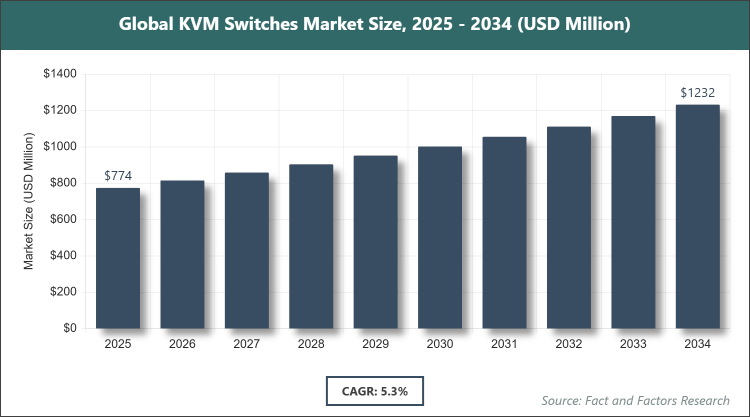
[226+ Pages Report] According to Facts & Factors, the global KVM switches market size was estimated at USD 774 million in 2025 and is expected to reach USD 1240 million by the end of 2034. The KVM switches industry is anticipated to grow by a CAGR of 5.3% between 2026 and 2034. The KVM switches Market is driven by increasing adoption in data centers for efficient server management.
 Market Overview
KVM switches, or Keyboard, Video, and Mouse switches, are hardware devices that allow users to control multiple computers or servers using a single set of peripherals, facilitating seamless switching between systems without the need for additional keyboards, monitors, or mice. These switches are essential in environments where space optimization, centralized control, and efficient resource management are critical, such as in IT infrastructures, control rooms, and broadcast setups. They come in various forms, including analog, digital, and IP-based models, catering to diverse operational needs from basic desktop control to advanced remote access over networks. The market encompasses a wide range of applications across industries, emphasizing reliability, security, and scalability to support modern computing demands.
Key Insights
- As per the analysis shared by our research analyst, the global KVM switches market is estimated to grow annually at a CAGR of around 5.3% over the forecast period (2026-2034).
- In terms of revenue, the global KVM switches market size was valued at around USD 774 million in 2025 and is expected to reach USD 1240 million by 2034.
- The KVM switches market is driven by rapid expansion of data centers and increasing demand for remote server management.
- Based on the type, the IP switch segment dominated with 34% share due to its ability to enable remote access and scalability in modern IT environments.
- Based on the application, the data centers segment dominated with 40% share as it supports efficient management of large-scale server infrastructures.
- Based on the end-user, the IT & telecom segment dominated with 35% share owing to high reliance on centralized control for network operations.
- North America dominated the global market with 39% share because of its advanced IT infrastructure and high concentration of data centers.
Growth Drivers
- Rapid Expansion of Data Centers
The proliferation of data centers worldwide, driven by the surge in cloud computing, big data analytics, and digital transformation initiatives, has significantly boosted the demand for KVM switches. These devices enable IT administrators to manage multiple servers efficiently from a single console, reducing operational complexity and enhancing productivity in high-density environments.
As enterprises invest heavily in hyperscale and edge data centers to handle increasing data volumes, KVM switches provide essential tools for seamless control and monitoring, minimizing downtime and optimizing space utilization. This trend is particularly evident in regions with robust tech ecosystems, where the need for reliable, low-latency management solutions continues to grow, further propelling market expansion.
Restraints
- High Initial Costs and Compatibility Issues
The elevated upfront costs associated with advanced KVM switches, especially IP-based and secure models, pose a significant barrier for small and medium-sized enterprises adopting these technologies. Additionally, compatibility challenges with legacy systems and varying hardware standards can complicate integration, leading to additional expenses and deployment delays.
These restraints are compounded by the rapid pace of technological advancements, which may render existing switches obsolete sooner than anticipated, discouraging investments from budget-conscious organizations. In emerging markets, where cost sensitivity is higher, this factor limits widespread adoption, potentially slowing overall market growth despite the clear benefits in efficiency and control.
Opportunities
- Rising Adoption of Remote and Hybrid Work Models
The shift towards remote and hybrid work environments has created new opportunities for KVM switches, particularly those with IP capabilities that allow secure remote access to on-premise systems. This enables IT teams to manage infrastructure from anywhere, aligning with the growing emphasis on flexibility and business continuity.
As organizations prioritize digital resilience post-pandemic, KVM solutions integrated with advanced security features and cloud compatibility are poised for increased demand. This opportunity extends to sectors like education and healthcare, where remote management can enhance operational efficiency, opening avenues for market players to innovate and capture untapped segments.
Challenges
- Competition from Software-Based Alternatives
The emergence of software-defined solutions and virtual desktop infrastructures presents a challenge to traditional KVM switches, as they offer similar functionalities at potentially lower costs without the need for physical hardware. This shift towards virtualization can erode market share for hardware-centric products.
Adapting to this challenge requires KVM manufacturers to differentiate through enhanced features like ultra-high resolution support and zero-latency switching, but the transition demands significant R&D investment. In highly virtualized environments, convincing users of the superiority of physical switches in terms of security and reliability remains a key hurdle.
Report Scope
Report Attribute |
Details |
Market Size 2025 |
USD 774 Million |
Projected Market Size in 2034 |
USD 1240 Million |
CAGR Growth Rate |
5.3% CAGR |
Base Year |
2025 |
Forecast Years |
2026-2034 |
Key Market Players |
ATEN International Co., Ltd., Vertiv Group Corp., Belkin International, Inc., Dell Technologies Inc., Adder Technology Ltd., Fujitsu Limited, Black Box Corporation, Raritan (Legrand), Hewlett Packard Enterprise, Schneider Electric SE, and Others. |
Key Segment |
By Type, By Application, By End-User, and By Region |
Major Regions Covered |
North America, Europe, Asia Pacific, Latin America, and the Middle East & Africa |
Purchase Options |
Request customized purchase options to meet your research needs. Explore purchase options |
Market Segmentation
The KVM switches market is segmented by type, application, end-user, and region.
Based on Type Segment, the KVM switches market is divided into desktop switch, IP switch, secure switch, high-performance switch, and others. The IP switch emerged as the most dominant segment, holding approximately 34% market share, primarily due to its advanced remote access capabilities that allow users to control systems over networks, making it ideal for distributed IT environments and reducing the need for physical presence. This dominance drives the market by enabling scalability and cost savings in large-scale operations. The desktop switch follows as the second most dominant, with its straightforward design suited for smaller setups, contributing to market growth through affordability and ease of use in enterprise and home office applications.
Based on Application Segment, the KVM switches market is divided into data centers, control rooms, broadcast studios, enterprise & corporate, and others. Data centers stand out as the most dominant segment, capturing around 40% share, as KVM switches facilitate efficient server management in high-density environments, minimizing clutter and enhancing operational reliability, which propels market expansion amid rising data demands. Control rooms rank as the second most dominant, benefiting from real-time switching for mission-critical monitoring, supporting market growth by ensuring seamless oversight in industries like utilities and transportation.
Based on End-User Segment, the KVM switches market is divided into IT & telecom, government, BFSI, healthcare, media & entertainment, and others. The IT & telecom segment leads with about 35% share, driven by the need for centralized network control and rapid troubleshooting, which accelerates market growth through improved efficiency in telecom infrastructures. Government follows as the second most dominant, leveraging secure KVM solutions for classified data handling, fostering market advancement by addressing stringent security requirements in public sector operations.
Recent Developments
- In June 2024, Eaton introduced the NetDirector line of KVM over IP switches, enabling data center managers to control and manage equipment remotely, enhancing flexibility and operational efficiency.
- In November 2023, TESmart launched the HDMI+DP port KVM switch HDK0202A2U, featuring USB 3.0 ports, simplified controls, and audio enhancements to improve user convenience and multimedia experiences.
- In April 2022, ATEN unveiled a new range of PSD PP v4.0-compliant secure KVM switches, designed for sensitive applications in government, military, and healthcare, providing isolation between network enclaves.
Regional Analysis
- North America to dominate the global market
North America maintains its position as the leading region in the KVM switches market, driven by its advanced technological landscape and extensive data center infrastructure. The United States, as the dominating country, benefits from major tech hubs and hyperscale facilities operated by companies like Google and Amazon, where KVM switches are integral for efficient server management. High adoption rates of remote IT solutions, coupled with strong investments in cybersecurity, further solidify the region's dominance. Innovation in IP-based switches caters to the growing demand for hybrid work models, ensuring seamless control over diverse systems.
Europe follows as a key player, with Germany emerging as the dominating country due to its robust manufacturing and IT sectors. The region's emphasis on data privacy regulations like GDPR drives the adoption of secure KVM solutions in financial and government institutions. Increasing investments in green data centers and edge computing enhance the need for reliable switching technologies, supporting operational efficiency across industries.
Asia Pacific is experiencing rapid growth, led by China as the dominating country, fueled by massive digital transformation and e-commerce expansion. The proliferation of data centers in urban areas, along with government initiatives for smart cities, boosts demand for KVM switches in telecom and enterprise applications, promoting cost-effective infrastructure management.
Latin America shows emerging potential, with Brazil as the dominating country, supported by rising cloud adoption and IT investments in banking and retail. Challenges like infrastructure limitations are offset by growing remote work trends, creating opportunities for affordable KVM solutions to streamline operations in developing economies.
The Middle East & Africa region is gradually advancing, with the United Arab Emirates dominating through its focus on smart infrastructure and oil & gas sectors. Investments in data sovereignty and cybersecurity drive KVM adoption for secure control rooms, aiding regional digital diversification efforts.
Competitive Analysis
The global KVM switches market is dominated by players:
- ATEN International Co., Ltd.
- Vertiv Group Corp.
- Belkin International, Inc.
- Dell Technologies Inc.
- Adder Technology Ltd.
- Fujitsu Limited
- Black Box Corporation
- Raritan (Legrand)
- Hewlett Packard Enterprise
- Schneider Electric SE
The global KVM switches market is segmented as follows:
By Type
- Desktop Switch
- IP Switch
- Secure Switch
- High-Performance Switch
- Others
By Application
- Data Centers
- Control Rooms
- Broadcast Studios
- Enterprise & Corporate
- Others
By End-User
- IT & Telecom
- Government
- BFSI
- Healthcare
- Media & Entertainment
- Others
By Region
- North America
- The U.S.
- Canada
- Mexico
- Europe
- France
- The UK
- Spain
- Germany
- Italy
- Rest of Europe
- Asia Pacific
- China
- Japan
- India
- Australia
- Southeast Asia
- Rest of Asia Pacific
- The Middle East & Africa
- Saudi Arabia
- UAE
- Egypt
- Kuwait
- South Africa
- Rest of the Middle East & Africa
- Latin America
- Brazil
- Argentina
- Rest of Latin America
Table of Content
Industry Major Market Players
The global KVM switches market is dominated by players:
- ATEN International Co., Ltd.
- Vertiv Group Corp.
- Belkin International, Inc.
- Dell Technologies Inc.
- Adder Technology Ltd.
- Fujitsu Limited
- Black Box Corporation
- Raritan (Legrand)
- Hewlett Packard Enterprise
- Schneider Electric SE



Copyright © 2025 - 2026, All Rights Reserved, Facts and Factors