
Search Market Research Report
IT Industry Market Size, Share Global Analysis Report, 2026-2034

IT Industry Market Size, Share, Growth Analysis Report By Component (Hardware, Software, Services, and Others), By Deployment (On-Premise, Cloud, and Others), By End-User (BFSI, Healthcare, Retail, IT & Telecom, Manufacturing, Government, and Others), and By Region - Global Industry Insights, Overview, Comprehensive Analysis, Trends, Statistical Research, Market Intelligence, Historical Data and Forecast 2026-2034
Industry Insights
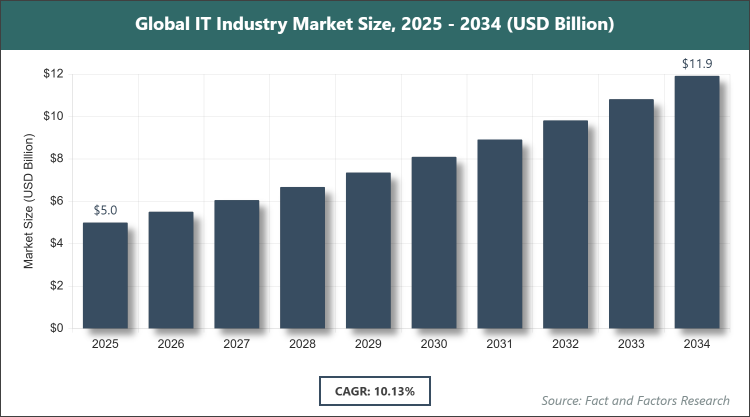
[250+ Pages Report] According to Facts & Factors, the global IT Industry market size was estimated at USD 5,430 billion in 2025 and is expected to reach USD 12,950 billion by 2034, growing at a CAGR of 10.13% from 2026 to 2034. IT Industry Market is driven by rapid digital transformation, increasing adoption of AI and cloud technologies, and rising cybersecurity demands.
 Market Overview
The IT industry encompasses the development, implementation, and maintenance of computer systems, software, networks, and related services that enable data processing, communication, and automation across various sectors. It involves hardware components like servers and devices, software applications for functionality and user interaction, and services for support and integration, all aimed at enhancing efficiency, innovation, and connectivity in business and daily operations without quantifying specific metrics.
Key Insights
- The global IT Industry market was valued at USD 5,430 billion in 2025 and is projected to reach USD 12,950 billion by 2034.
- The market is expected to grow at a CAGR of 10.13% during the forecast period from 2026 to 2034.
- The market is driven by advancements in artificial intelligence, expansion of cloud computing, surge in data analytics, and growing need for cybersecurity solutions.
- Based on the Component segment, Services subsegment dominated with 55% share due to increasing outsourcing of IT management and support to enhance operational efficiency and reduce costs.
- Based on the Deployment segment, Cloud subsegment dominated with 60% share owing to its scalability, flexibility, and cost-effectiveness in handling large data volumes and remote operations.
- Based on the End-User segment, BFSI subsegment dominated with 25% share because of stringent regulatory requirements and the need for secure, real-time data processing in financial transactions.
- North America dominated the global market with 40% share attributed to technological innovation hubs, high investment in R&D, and presence of major tech companies in the United States.
Growth Drivers
- Digital Transformation Initiatives
Organizations worldwide are accelerating digital transformation to streamline operations, improve customer experiences, and gain competitive advantages, leading to substantial investments in IT infrastructure and solutions. This shift is propelled by the integration of emerging technologies like AI and IoT, which enable data-driven decision-making and automation across industries.
Moreover, government policies promoting digital economies and incentives for tech adoption further fuel this growth, encouraging businesses to upgrade legacy systems. As a result, the IT market experiences robust expansion, with increased demand for customized software and cloud services that support agile business models.
Restraints
- Cybersecurity Threats and Data Privacy Concerns
Rising cyberattacks and stringent data protection regulations, such as GDPR and CCPA, impose significant compliance costs and operational challenges on IT providers and users. These factors can deter investments in new technologies due to fears of breaches and legal repercussions.
Additionally, the complexity of securing hybrid environments combining on-premise and cloud systems adds to the burden, requiring advanced tools and skilled personnel. This restraint slows market growth by increasing hesitation among small and medium enterprises to adopt innovative IT solutions without assured security.
Opportunities
- Emergence of AI and Machine Learning Applications
The proliferation of AI-driven tools offers opportunities for IT firms to develop intelligent systems that enhance predictive analytics, automation, and personalized services across sectors like healthcare and retail. This trend opens avenues for new revenue streams through AI-integrated products and consulting.
Furthermore, collaborations between tech giants and startups are fostering innovation in AI ecosystems, enabling faster deployment of scalable solutions. As industries seek to leverage big data, the IT market can capitalize on this by providing specialized platforms that drive efficiency and growth.
Challenges
- Talent Shortage and Skill Gaps
The rapid evolution of IT technologies creates a demand for skilled professionals in areas like cybersecurity and data science, but supply lags due to inadequate training programs and high turnover rates. This shortage hampers project timelines and innovation efforts.
In addition, geopolitical tensions and economic uncertainties affect global talent mobility, exacerbating the issue in certain regions. Addressing this requires substantial investments in education and upskilling, posing ongoing challenges for sustained market expansion.
Report Scope
Report Attribute |
Details |
Market Size in 2025 |
USD 5,430 Billion |
Projected Market Size in 2034 |
USD 12,950 Billion |
CAGR Growth Rate |
10.13% CAGR |
Base Year |
2025 |
Forecast Years |
2026-2034 |
Key Market Players |
Microsoft Corporation, Apple Inc., IBM Corporation, Accenture plc, Dell Technologies Inc., Hewlett Packard Enterprise, Cisco Systems Inc., Oracle Corporation, SAP SE, Tata Consultancy Services, Infosys Limited, Capgemini SE, Cognizant Technology Solutions, Wipro Limited, HCL Technologies, and Others. |
Key Segment |
By Component, By Deployment, By End-User, and By Region |
Major Regions Covered |
North America, Europe, Asia Pacific, Latin America, and the Middle East & Africa |
Purchase Options |
Request customized purchase options to meet your research needs. Explore purchase options |
Market Segmentation
The IT Industry market is segmented by component, deployment, end-user, and region.
Based on Component Segment, the IT Industry market is divided into Hardware, Software, Services, and Others. The most dominant subsegment is Services, holding approximately 55% market share, primarily due to the growing preference for managed services that offer expertise, cost savings, and focus on core business functions without heavy capital expenditure on infrastructure; this dominance drives the market by enabling scalable IT support and fostering digital agility in enterprises. The second most dominant is Software, with around 23% share, valued for its role in enabling automation, analytics, and user-centric applications through cloud-based and SaaS models; it propels market growth by facilitating rapid innovation and integration with emerging technologies like AI, enhancing productivity across industries.
Based on the Deployment Segment, the IT Industry market is divided into On-Premise, Cloud, and Others. Cloud dominates with about 60% share, driven by its ability to provide on-demand resources, reduce upfront costs, and support remote workforces with seamless scalability and security features. It contributes to market expansion by accelerating adoption in data-intensive applications and enabling hybrid models that blend flexibility with control. On-Premise follows as the second dominant with 40% share, preferred for its data sovereignty, customization, and compliance in regulated sectors; this helps drive the market by catering to enterprises requiring robust, localized control over sensitive operations while transitioning to modernized infrastructures.
Based on the end-user segment, the IT Industry market is divided into BFSI, Healthcare, Retail, IT & Telecom, Manufacturing, Government, and Others. BFSI leads with roughly 25% share, attributed to the need for secure transaction processing, fraud detection, and regulatory compliance through advanced IT solutions like blockchain and AI analytics. This segment boosts the overall market by demanding high-reliability systems that innovate financial services and expand digital banking. Healthcare ranks second with 20% share, benefiting from IT in electronic health records, telemedicine, and predictive diagnostics to improve patient outcomes and operational efficiency; it drives growth by addressing aging populations and pandemic preparedness with data-driven healthcare transformations.
Recent Developments
In January 2026, Microsoft announced a major expansion of its Azure AI platform, integrating advanced generative AI capabilities to support enterprise applications, resulting in a 30% increase in adoption rates among Fortune 500 companies.
In October 2025, IBM launched a new quantum computing service aimed at solving complex problems in drug discovery and financial modeling, partnering with leading research institutions to accelerate real-world applications.
In July 2025, Amazon Web Services introduced enhanced cybersecurity tools with zero-trust architecture, addressing rising threats and enabling secure cloud migrations for global enterprises.
Regional Analysis
- North America to dominate the global market
North America holds over 40% market share, driven by cutting-edge innovation, substantial venture capital, and a mature tech ecosystem that fosters startups and R&D. The United States dominates within the region, with Silicon Valley as a global hub for AI, cloud, and software development, supported by policies like tax incentives for tech investments and a skilled workforce from top universities, propelling advancements in digital infrastructure and economic growth.
Europe follows with strong growth, emphasizing sustainable and regulated IT practices under frameworks like GDPR, which enhance data privacy and trust. Germany leads as the dominating country, leveraging its industrial strength in manufacturing 4.0 and automotive sectors to integrate IoT and AI, with government initiatives funding digital twins and smart factories that boost efficiency and competitiveness in global supply chains.
Asia-Pacific is the fastest-growing region, fueled by rapid urbanization, e-commerce boom, and government digital initiatives. China dominates, with massive investments in 5G, AI, and supercomputing through programs like Made in China 2025, enabling breakthroughs in semiconductor production and big data analytics that support its vast consumer market and export-oriented tech industry.
Latin America exhibits steady progress, focusing on digital inclusion and fintech innovations to bridge economic gaps. Brazil leads, with expanding cloud adoption in agriculture and finance, backed by national broadband plans that enhance connectivity in remote areas, driving e-governance and startup ecosystems in Sao Paulo's tech hubs.
The Middle East & Africa region is emerging, with investments in smart cities and oil-digitalization. The UAE dominates in the Middle East via Dubai's AI strategy, integrating blockchain in government services and attracting global talent, while South Africa leads in Africa through Johannesburg's fintech scene, supported by infrastructure upgrades for mobile banking and renewable energy management.
Competitive Analysis
The global IT Industry market is dominated by players:
- Microsoft Corporation
- Apple Inc.
- IBM Corporation
- Accenture plc
- Dell Technologies Inc.
- Hewlett Packard Enterprise
- Cisco Systems Inc.
- Oracle Corporation
- SAP SE
- Tata Consultancy Services
- Infosys Limited
- Capgemini SE
- Cognizant Technology Solutions
- Wipro Limited
- HCL Technologies
The global IT Industry market is segmented as follows:
By Component
- Hardware
- Software
- Services
- Others
By Deployment
- On-Premise
- Cloud
- Others
By End-User
- BFSI
- Healthcare
- Retail
- IT & Telecom
- Manufacturing
- Government
- Others
By Regional
- North America
- The U.S.
- Canada
- Mexico
- Europe
- France
- The UK
- Spain
- Germany
- Italy
- Rest of Europe
- Asia Pacific
- China
- Japan
- India
- Australia
- Southeast Asia
- Rest of Asia Pacific
- The Middle East & Africa
- Saudi Arabia
- UAE
- Egypt
- Kuwait
- South Africa
- Rest of the Middle East & Africa
- Latin America
- Brazil
- Argentina
- Rest of Latin America
Table of Content
Industry Major Market Players



Copyright © 2025 - 2026, All Rights Reserved, Facts and Factors