
Search Market Research Report
Industrial Gears Market Size, Share Global Analysis Report, 2026-2034

Industrial Gears Market Size, Share, Growth Analysis Report By Type (Helical Gears, Spur Gears, Bevel Gears, Worm Gears, Planetary Gears, and Others), By Application (Automotive, Construction & Mining, Power Generation, Material Handling, Food & Beverage, and Others), By End-User (Manufacturing, Energy & Utilities, Construction, Oil & Gas, and Others), and By Region - Global Industry Insights, Overview, Comprehensive Analysis, Trends, Statistical Research, Market Intelligence, Historical Data and Forecast 2026-2034
Industry Insights
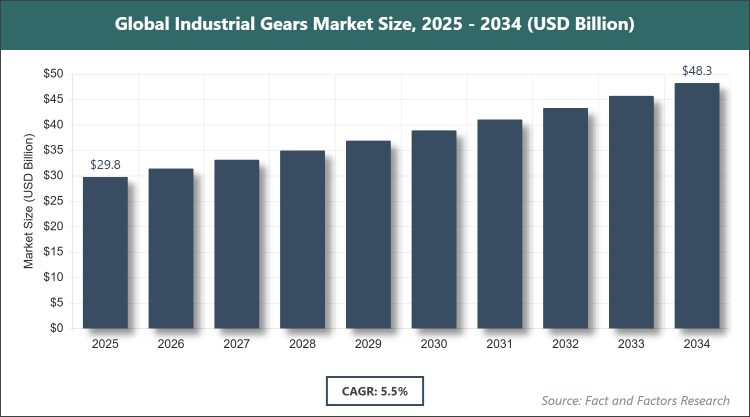
[229 + Pages Report] According to Facts & Factors, the global Industrial Gears market size was estimated at USD 29.8 billion in 2025 and is expected to reach USD 48.5 billion by the end of 2034. The Industrial Gears industry is anticipated to grow by a CAGR of 5.5% between 2026 and 2034. The Industrial Gears Market is driven by the expansion of manufacturing, automotive, and renewable energy sectors requiring efficient power transmission solutions.
 Market Overview
The Industrial Gears market encompasses precision-engineered mechanical components designed to transmit power, change speed, torque, and direction between rotating shafts in heavy-duty machinery and equipment. These gears are manufactured from high-strength materials such as alloy steel, cast iron, and specialized polymers to withstand extreme loads, high temperatures, and continuous operation in demanding industrial environments. Available in various configurations, including helical, spur, bevel, worm, and planetary designs, industrial gears serve as critical elements in gearboxes, conveyors, wind turbines, mining equipment, automotive transmissions, and material handling systems. The market emphasizes durability, noise reduction, energy efficiency, and customization to meet specific application requirements while supporting the global transition toward automated and sustainable industrial operations.
Key Insights
- As per the analysis shared by our research analyst, the Industrial Gears market is estimated to grow annually at a CAGR of around 5.5% over the forecast period (2026-2034).
- In terms of revenue, the Industrial Gears market size was valued at around USD 29.8 billion in 2025 and is projected to reach USD 48.5 billion by 2034.
- The Industrial Gears Market is driven by growth in manufacturing automation and renewable energy infrastructure.
- Based on the Type, the Helical Gears segment dominated the market in 2025 with a share of 38% due to superior load-carrying capacity, smooth operation, and reduced noise levels in high-speed applications.
- Based on the Application, the Automotive segment dominated the market in 2025 with a share of 26%, owing to rising vehicle production and demand for efficient transmission systems in electric and conventional vehicles.
- Based on the End-User, the Manufacturing segment dominated the market in 2025 with a share of 52% because of the continuous requirement for power transmission in assembly lines, robotics, and heavy machinery.
- Asia Pacific dominated the global Industrial Gears market in 2025 with a share of 48%, attributed to massive manufacturing output, infrastructure development, and expanding automotive and renewable energy sectors.
Growth Drivers
- Automation and Smart Manufacturing Expansion
Rapid adoption of Industry 4.0 technologies and collaborative robots across factories requires high-precision, durable gears for reliable power transmission and motion control in automated production lines.
Increasing investment in electric vehicles and renewable energy projects further boosts demand for specialized gears in transmissions, wind turbines, and solar tracking systems.
Restraints
- Raw Material Price Volatility and Supply Chain Disruptions
Fluctuations in steel and alloy prices directly impact production costs, while global supply chain challenges delay deliveries of high-grade materials needed for precision gears.
Intense competition from low-cost manufacturers in emerging regions puts pressure on pricing and margins for established players.
Opportunities
- Lightweight and Advanced Material Gears
Development of composite, polymer, and 3D-printed gears offers opportunities for weight reduction, noise reduction, and improved efficiency in electric vehicles and aerospace applications.
Growing aftermarket demand for replacement and upgraded gears in aging industrial infrastructure across developed economies creates recurring revenue streams.
Challenges
- Stringent Quality Standards and Customization Demands
Meeting diverse industry-specific certifications and performance requirements increases design and testing complexity for manufacturers.
Skilled labor shortages for precision gear manufacturing and maintenance limit production capacity and slow the adoption of advanced technologies in certain regions.
Report Scope
Report Attribute |
Details |
Market Size 2025 |
USD 29.8 Billion |
Projected Market Size in 2034 |
USD 48.5 Billion |
CAGR Growth Rate |
5.5% CAGR |
Base Year |
2025 |
Forecast Years |
2026-2034 |
Key Market Players |
Siemens AG (Flender), SEW-Eurodrive, Bonfiglioli Riduttori S.p.A., Sumitomo Heavy Industries, Timken Company, Regal Rexnord Corporation, Dana Incorporated, ZF Friedrichshafen AG, China High Speed Transmission Equipment Group, Eaton Corporation, and Others. |
Key Segment |
By Type, By Application, By End-User, and By Region |
Major Regions Covered |
North America, Europe, Asia Pacific, Latin America, and the Middle East & Africa |
Purchase Options |
Request customized purchase options to meet your research needs. Explore purchase options |
Market Segmentation
The Industrial Gears market is segmented by type, application, end-user, and region.
Based on Type Segment, the Industrial Gears market is divided into helical gears, spur gears, bevel gears, worm gears, planetary gears, and others. The most dominant segment is Helical Gears, driven by excellent load distribution and quiet operation. The second most dominant is Planetary Gears. Helical Gears dominate due to their ability to handle high torque and speeds with minimal vibration, helping drive market growth by becoming the preferred choice for heavy-duty industrial machinery and automotive transmissions.
Based on Application Segment, the Industrial Gears market is divided into automotive, construction & mining, power generation, material handling, food & beverage, and others. The most dominant segment is Automotive, supported by global vehicle production growth. The second most dominant is Construction & Mining. Automotive leads because of increasing demand for efficient drivetrains in electric and hybrid vehicles, propelling market expansion through high-volume OEM contracts and technological upgrades.
Based on End-User Segment, the Industrial Gears market is divided into manufacturing, energy & utilities, construction, oil & gas, and others. The most dominant segment is Manufacturing, due to broad use across assembly and processing equipment. The second most dominant is Energy & Utilities. Manufacturing dominates owing to the continuous need for reliable power transmission in factories and production facilities, driving market growth through steady replacement and expansion demand.
Recent Developments
- In January 2026, SEW-Eurodrive introduced a new series of helical-bevel gears with integrated IoT sensors for predictive maintenance in smart factories.
- In November 2025, Siemens expanded its Flender gear portfolio with lightweight planetary gears optimized for wind turbine applications.
- In September 2025, Bonfiglioli launched high-efficiency worm gears with advanced surface coatings for food and beverage processing equipment.
- In June 2025, Timken Company acquired a precision gear manufacturer to strengthen its position in the North American industrial aftermarket.
- In March 2025, Sumitomo Heavy Industries unveiled compact planetary gear units with higher torque density for robotics and automation systems.
Regional Analysis
- Asia Pacific to dominate the global market
Asia Pacific dominates the Industrial Gears market due to its status as the global manufacturing hub, supported by massive infrastructure projects, automotive production, and renewable energy investments. The region benefits from cost-effective production and strong domestic demand. China dominates within Asia Pacific, with its extensive heavy machinery, automotive, and wind power sectors driving large-scale consumption of helical and planetary gears through both OEM and aftermarket channels.
North America holds a technologically advanced position in the Industrial Gears market, focused on high-precision and customized solutions. The United States leads the region, with strong aerospace, oil & gas, and automation industries demanding durable, high-performance gears supported by innovation in materials and design.
Europe maintains steady growth driven by an emphasis on energy efficiency and sustainability in manufacturing. Germany leads the region, leveraging its engineering leadership in automotive and machinery to produce premium industrial gears for export and domestic use.
Latin America is expanding with infrastructure development and mining activities. Brazil leads, supported by growth in construction equipment and agricultural machinery requiring robust gear solutions.
The Middle East & Africa region shows emerging demand linked to oil & gas projects and new industrial zones. The United Arab Emirates leads through investments in diversified manufacturing and energy sectors, adopting modern gear technologies.
Competitive Analysis
The global Industrial Gears market is dominated by players:
- Siemens AG (Flender)
- SEW-Eurodrive
- Bonfiglioli Riduttori S.p.A.
- Sumitomo Heavy Industries
- Timken Company
- Regal Rexnord Corporation
- Dana Incorporated
- ZF Friedrichshafen AG
- China High Speed Transmission Equipment Group
- Eaton Corporation
The global Industrial Gears market is segmented as follows:
By Type
- Helical Gears
- Spur Gears
- Bevel Gears
- Worm Gears
- Planetary Gears
- Others
By Application
- Automotive
- Construction & Mining
- Power Generation
- Material Handling
- Food & Beverage
- Others
By End-User
- Manufacturing
- Energy & Utilities
- Construction
- Oil & Gas
- Others
By Region
- North America
- The U.S.
- Canada
- Mexico
- Europe
- France
- The UK
- Spain
- Germany
- Italy
- Rest of Europe
- Asia Pacific
- China
- Japan
- India
- Australia
- Southeast Asia
- Rest of Asia Pacific
- The Middle East & Africa
- Saudi Arabia
- UAE
- Egypt
- Kuwait
- South Africa
- Rest of the Middle East & Africa
- Latin America
- Brazil
- Argentina
- Rest of Latin America
Table of Content
Industry Major Market Players
- Siemens AG (Flender)
- SEW-Eurodrive
- Bonfiglioli Riduttori S.p.A.
- Sumitomo Heavy Industries
- Timken Company
- Regal Rexnord Corporation
- Dana Incorporated
- ZF Friedrichshafen AG
- China High Speed Transmission Equipment Group
- Eaton Corporation



Copyright © 2025 - 2026, All Rights Reserved, Facts and Factors