
Search Market Research Report
Hydrotalcite Market Size, Share Global Analysis Report, 2026-2034

Hydrotalcite Market Size, Share, Growth Analysis Report By Type (Synthetic Hydrotalcite and Natural Hydrotalcite), By Application (PVC Stabilizers, Flame Retardants, Antacids, Catalysis, Solid Sorbents, and Others), By End-User (Plastics Industry, Pharmaceutical Industry, Chemical Industry, and Others), and By Region - Global Industry Insights, Overview, Comprehensive Analysis, Trends, Statistical Research, Market Intelligence, Historical Data and Forecast 2026-2034
Industry Insights
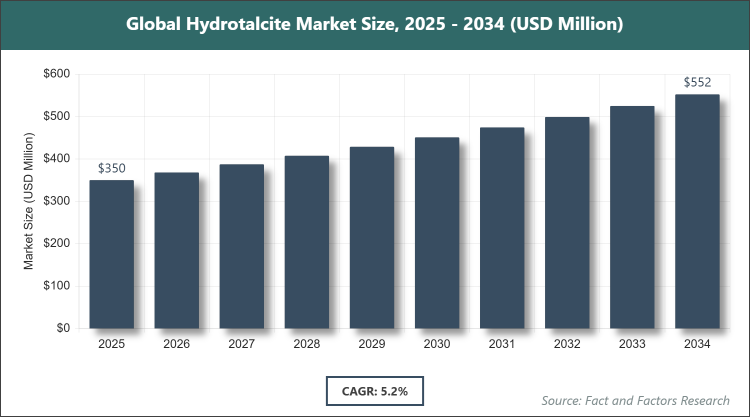
[238 + Pages Report] According to Facts & Factors, the global Hydrotalcite market size was estimated at USD 0.35 billion in 2025 and is expected to reach USD 0.55 billion by the end of 2034. The Hydrotalcite industry is anticipated to grow by a CAGR of 5.2% between 2026 and 2034. The Hydrotalcite Market is driven by strong demand as an acid scavenger and stabilizer in PVC processing, combined with expanding use in flame-retardant and pharmaceutical applications.
 Market Overview
The Hydrotalcite market comprises layered double hydroxide compounds with a unique brucite-like structure that enables anion exchange, acid neutralization, and thermal stability. These materials function as highly effective acid scavengers, thermal stabilizers, flame retardants, and antacids. Synthetic hydrotalcite is produced via controlled precipitation and widely preferred for its purity and consistency, while natural variants are sourced from minerals. Primary applications include neutralizing HCl released during PVC degradation, improving flame retardancy in polyolefins, serving as antacids in pharmaceuticals, and acting as catalysts or adsorbents in chemical processes. The market supports sustainable polymer processing by replacing heavy-metal stabilizers and contributes to eco-friendly flame-retardant formulations.
Key Insights
- As per the analysis shared by our research analyst, the Hydrotalcite market is estimated to grow annually at a CAGR of around 5.2% over the forecast period (2026-2034).
- In terms of revenue, the Hydrotalcite market size was valued at around USD 0.35 billion in 2025 and is projected to reach USD 0.55 billion by 2034.
- The Hydrotalcite Market is driven by demand in PVC stabilization and flame-retardant applications.
- Based on the Type, the Synthetic Hydrotalcite segment dominated the market in 2025 with a share of 88% due to superior purity, consistency, and tailored performance in industrial applications.
- Based on the Application, the PVC Stabilizers segment dominated the market in 2025 with a share of 62% owing to its critical role in replacing toxic heavy-metal stabilizers in global PVC production.
- Based on the End-User, the Plastics Industry segment dominated the market in 2025 with a share of 70% because of massive consumption in rigid and flexible PVC processing worldwide.
- Asia Pacific dominated the global Hydrotalcite market in 2025 with a share of 52% attributed to the world's largest PVC production capacity and rapid growth in plastics manufacturing.
Growth Drivers
- Replacement of Heavy-Metal Stabilizers in PVC
Global regulations phasing out lead and cadmium stabilizers have created strong demand for hydrotalcite as a non-toxic, high-performance acid scavenger in PVC extrusion and calendering.
Expanding infrastructure, construction, and automotive sectors in emerging economies continue to drive PVC consumption, directly boosting hydrotalcite requirements.
Restraints
- Volatility in Raw Material Prices
Fluctuations in magnesium and aluminum precursor costs, combined with energy-intensive synthesis processes, impact production economics and final pricing.
Limited availability of high-purity grades for pharmaceutical applications adds further cost pressure in specialized segments.
Opportunities
- Growth in Halogen-Free Flame Retardants
Increasing demand for environmentally friendly flame-retardant additives in wire & cable, electronics, and construction creates new volume opportunities for hydrotalcite-based formulations.
Expansion of pharmaceutical antacid applications and wastewater treatment adsorbents offers diversification beyond traditional polymer uses.
Challenges
- Competition from Alternative Additives
Calcium-zinc stabilizers and organic-based alternatives are gaining share in certain PVC applications due to lower cost or easier processing in some regions.
Technical challenges in achieving uniform dispersion at high loadings and maintaining performance in highly filled compounds limit broader adoption.
Report Scope
Report Attribute |
Details |
Market Size 2025 |
USD 0.35 Billion |
Projected Market Size in 2034 |
USD 0.55 Billion |
CAGR Growth Rate |
5.2% CAGR |
Base Year |
2025 |
Forecast Years |
2026-2034 |
Key Market Players |
Kyowa Chemical Industry Co., Ltd. (Kisuma Chemicals), Clariant AG, Sakai Chemical Industry Co., Ltd., Doobon, Sinwon Chemical, Nippon Chemical Industrial Co., Ltd., GCH Technology Co., Ltd., Akdeniz Chemson, Sasol Germany GmbH, Elementis plc, and Others. |
Key Segment |
By Type, By Application, By End-User, and By Region |
Major Regions Covered |
North America, Europe, Asia Pacific, Latin America, and the Middle East & Africa |
Purchase Options |
Request customized purchase options to meet your research needs. Explore purchase options |
Market Segmentation
The Hydrotalcite market is segmented by type, application, end-user, and region.
Based on Type Segment, the Hydrotalcite market is divided into synthetic hydrotalcite and natural hydrotalcite. The most dominant segment is Synthetic Hydrotalcite, driven by precise control over composition and particle size. The second most dominant is Natural Hydrotalcite. Synthetic Hydrotalcite dominates due to higher purity and consistency required for high-performance stabilization and pharmaceutical grades, helping drive market growth by meeting stringent regulatory and technical specifications across industries.
Based on Application Segment, the Hydrotalcite market is divided into PVC stabilizers, flame retardants, antacids, catalysis, solid sorbents, and others. The most dominant segment is PVC Stabilizers, reflecting massive global PVC output. The second most dominant is Flame Retardants. PVC Stabilizers lead because hydrotalcite provides superior HCl scavenging and long-term heat stability essential for durable PVC products, propelling market expansion through steady replacement of legacy stabilizers.
Based on End-User Segment, the Hydrotalcite market is divided into plastics industry, pharmaceutical industry, chemical industry, and others. The most dominant segment is Plastics Industry, accounting for the bulk of volume consumption. The second most dominant is Pharmaceutical Industry. Plastics Industry dominates due to continuous demand from PVC pipe, profile, and film production, driving market growth through large-scale, recurring purchases and technical support requirements.
Recent Developments
- In October 2025, Kisuma Chemicals (Kyowa Chemical) commissioned a new synthetic hydrotalcite production line in the Netherlands to serve European PVC and polyolefin markets.
- In May 2025, Clariant introduced a new high-purity hydrotalcite grade specifically developed for pharmaceutical antacid and excipient applications.
- In February 2025, Sakai Chemical Industry expanded capacity at its Japanese facility to meet rising demand for flame-retardant hydrotalcite in electric vehicle wire insulation.
- In August 2025, Doobon announced a joint venture with a Chinese partner to establish a manufacturing plant in Vietnam targeting Southeast Asian PVC producers.
- In December 2025, Sinwon Chemical launched a surface-modified hydrotalcite product offering improved dispersion in highly filled polyolefin compounds.
Regional Analysis
- Asia Pacific to dominate the global market
Asia Pacific commands the Hydrotalcite market due to its overwhelming share of global PVC production, rapid industrialization, and cost-competitive manufacturing. The region benefits from integrated supply chains and growing domestic demand for stabilized plastics. China dominates within Asia Pacific, supported by massive PVC capacity, government focus on environmental compliance, and vertical integration between resin producers and additive suppliers that accelerates adoption of hydrotalcite as the preferred stabilizer.
Europe maintains a technologically advanced position, driven by stringent REACH regulations that favor non-toxic stabilizers and high-performance flame retardants. Germany leads the region, with its strong automotive and construction sectors demanding premium hydrotalcite grades for durable, environmentally compliant products.
North America shows steady demand focused on high-value applications in wire & cable and pharmaceutical excipients. The United States leads, supported by innovation in specialty grades and strong technical service networks that ensure performance in demanding end-use conditions.
Latin America is growing with expanding PVC infrastructure projects and increasing local production capacity. Brazil leads, leveraging regional plastics manufacturing and rising regulatory pressure on heavy-metal stabilizers.
The Middle East & Africa region exhibits emerging potential tied to new plastics processing investments and construction growth. The United Arab Emirates leads through modern manufacturing facilities serving local and export markets.
Competitive Analysis
The global Hydrotalcite market is dominated by players:
- Kyowa Chemical Industry Co., Ltd. (Kisuma Chemicals)
- Clariant AG
- Sakai Chemical Industry Co., Ltd.
- Doobon
- Sinwon Chemical
- Nippon Chemical Industrial Co., Ltd.
- GCH Technology Co., Ltd.
- Akdeniz Chemson
- Sasol Germany GmbH
- Elementis plc
The global Hydrotalcite market is segmented as follows:
By Type
- Synthetic Hydrotalcite
- Natural Hydrotalcite
By Application
- PVC Stabilizers
- Flame Retardants
- Antacids
- Catalysis
- Solid Sorbents
- Others
By End-User
- Plastics Industry
- Pharmaceutical Industry
- Chemical Industry
- Others
By Region
- North America
- The U.S.
- Canada
- Mexico
- Europe
- France
- The UK
- Spain
- Germany
- Italy
- Rest of Europe
- Asia Pacific
- China
- Japan
- India
- Australia
- Southeast Asia
- Rest of Asia Pacific
- The Middle East & Africa
- Saudi Arabia
- UAE
- Egypt
- Kuwait
- South Africa
- Rest of the Middle East & Africa
- Latin America
- Brazil
- Argentina
- Rest of Latin America
Table of Content
Industry Major Market Players
- Kyowa Chemical Industry Co., Ltd. (Kisuma Chemicals)
- Clariant AG
- Sakai Chemical Industry Co., Ltd.
- Doobon
- Sinwon Chemical
- Nippon Chemical Industrial Co., Ltd.
- GCH Technology Co., Ltd.
- Akdeniz Chemson
- Sasol Germany GmbH
- Elementis plc



Copyright © 2025 - 2026, All Rights Reserved, Facts and Factors