
Search Market Research Report
Headless Compression Screws Market Size, Share Global Analysis Report, 2026-2034

Headless Compression Screws Market Size, Share, Growth Analysis Report By Type (Fully Threaded Screw, Both Ends Threaded Screw), By Application (Hand, Wrist, Foot, Ankle, Others), By End-User (Hospitals, Medical Centers, Clinics), and By Region - Global Industry Insights, Overview, Comprehensive Analysis, Trends, Statistical Research, Market Intelligence, Historical Data and Forecast 2026-2034
Industry Insights
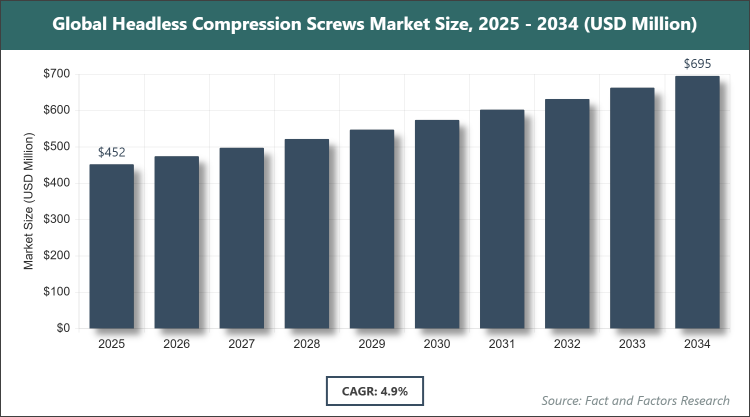
[238+ Pages Report] According to Facts & Factors, the global Headless Compression Screws market size was estimated at USD 452 million in 2025 and is expected to reach USD 754 million by the end of 2034. The Headless Compression Screws industry is anticipated to grow by a CAGR of 4.9% between 2026 and 2034. The Headless Compression Screws Market is driven by the increasing prevalence of orthopedic injuries, advancements in minimally invasive surgical techniques, and the rising geriatric population.
 Market Overview
Headless compression screws are orthopedic implants designed for internal fixation of bone fractures, particularly in small bones and joints. These screws feature a thread along their entire length or specific sections, allowing for compression without a protruding head that could irritate surrounding soft tissues. They are commonly used in procedures involving the hands, feet, wrists, and ankles to promote bone healing by drawing fracture fragments together securely. This design minimizes the need for additional hardware removal and supports minimally invasive approaches in orthopedic surgery.
Key Insights
- As per the analysis shared by our research analyst, the Headless Compression Screws market is estimated to grow annually at a CAGR of around 4.9% over the forecast period (2026-2034).
- In terms of revenue, the Headless Compression Screws market size was valued at around USD 452 million in 2025 and is projected to reach USD 754 million by 2034.
- The market is driven by the increasing prevalence of orthopedic injuries, advancements in minimally invasive surgical techniques, and the rising geriatric population.
- Based on the type, the fully threaded screw segment dominated with a 61.5% share due to its effectiveness in providing uniform compression and stability for bone fragment fixation without requiring additional compression mechanisms.
- Based on the application, the hand segment dominated with a 32% share because of the high incidence of hand fractures from sports and accidents, coupled with the screws' suitability for precise fixation in small bones, reducing tissue irritation and promoting faster healing.
- Based on the end-user, the hospitals segment dominated with a 55% share owing to their advanced surgical infrastructure, access to specialized orthopedic teams, and high volume of complex fracture cases requiring reliable fixation solutions.
- The North America region dominated with a 38% share attributed to its robust healthcare systems, high adoption of innovative implants, and significant investments in orthopedic research and development.
Growth Drivers
- Rise in Incidences of Orthopedic Injuries and Fractures
The growing number of orthopedic injuries stemming from road accidents, sports activities, and falls among the elderly has significantly boosted demand for effective fixation devices like headless compression screws. These screws offer reliable stabilization for complex fractures, particularly in extremities, enabling better patient outcomes and quicker recovery times. As lifestyles become more active and populations age, the frequency of such injuries continues to rise, driving market expansion.
Furthermore, advancements in trauma care and emergency response systems have increased the survival rates from severe injuries, leading to a higher need for surgical interventions. This trend is particularly evident in urban areas where accident rates are higher, further propelling the adoption of these specialized screws in orthopedic procedures.
- Advancements in Minimally Invasive Surgical Techniques
Minimally invasive surgeries reduce tissue damage, shorten hospital stays, and minimize postoperative complications, making headless compression screws ideal due to their low-profile design. Innovations in surgical tools and imaging technologies have facilitated precise placement of these screws, enhancing their efficacy in procedures like arthrodesis and osteotomies.
These techniques align with patient preferences for less invasive options, encouraging surgeons to adopt headless compression screws over traditional methods. As training programs evolve and more healthcare facilities invest in advanced equipment, the integration of these screws in routine orthopedic practices is expected to accelerate.
- Increase in Geriatric Population
The aging global population is prone to osteoporosis and related fractures, necessitating durable fixation solutions that support bone healing without additional surgeries. Headless compression screws provide compression and stability tailored to fragile bones, addressing the unique needs of elderly patients.
Government initiatives and healthcare policies focused on senior care have increased access to orthopedic treatments, boosting market growth. This demographic shift is particularly pronounced in developed regions, where longer life expectancies correlate with higher surgical demands.
Restraints
- High Costs Associated with Advanced Materials and Procedures
The elevated price of premium materials like titanium and bioresorbable alloys used in headless compression screws limits accessibility, especially in emerging markets with constrained healthcare budgets. This cost factor can deter adoption in price-sensitive regions, impacting overall market penetration.
Additionally, the need for specialized surgical instruments and trained personnel adds to the procedural expenses, making these screws less viable for routine use in underfunded facilities. Economic disparities further exacerbate this restraint, hindering equitable market growth.
- Complexity of Surgical Procedures Requiring Specialized Training
Implementing headless compression screws demands precise surgical skills and familiarity with advanced techniques, which not all orthopedic surgeons possess. This learning curve can slow adoption rates and increase the risk of intraoperative errors if training is inadequate.
Healthcare systems in developing areas often lack comprehensive training programs, leading to reliance on conventional fixation methods. This restraint underscores the need for enhanced educational initiatives to broaden the screws' application.
Opportunities
- Innovation in Screw Design and Materials
Ongoing research into bioabsorbable and self-compressing screws presents opportunities to eliminate secondary removal surgeries and improve biocompatibility. These innovations can expand applications in pediatric and sensitive cases, attracting new market segments.
Collaborations between manufacturers and research institutions are accelerating the development of customizable implants, tailored to individual patient anatomies via 3D printing. This personalization trend could revolutionize orthopedic care and drive sustained market growth.
- Expansion in Emerging Markets
Rising healthcare investments in Asia-Pacific and Latin America offer untapped potential for headless compression screws, as infrastructure improves and awareness of advanced orthopedics grows. Affordable variants could capture significant shares in these regions.
Medical tourism and government health initiatives are facilitating access to quality surgeries, creating a conducive environment for market entry. Strategic partnerships with local distributors can further capitalize on this opportunity.
Challenges
- Risk of Complications Such as Screw Loosening or Infection
Despite low incidence, potential issues like implant failure or postoperative infections can influence clinician preferences and patient trust. These risks necessitate rigorous quality controls and monitoring, adding to development costs.
Addressing these through enhanced materials and coatings is essential, but variability in patient responses remains a hurdle. Ongoing clinical studies are crucial to mitigate perceptions of unreliability.
- Stringent Regulatory Processes for Approval
Navigating complex regulatory frameworks delays product launches and increases compliance expenses for manufacturers. Differences in standards across regions complicate global strategies.
This challenge requires robust documentation and trials, potentially slowing innovation cycles. Harmonization efforts could alleviate this, but current disparities persist as a barrier.
Report Scope
Report Attribute |
Details |
Market Size 2025 |
USD 452 Million |
Projected Market Size in 2034 |
USD 754 Million |
CAGR Growth Rate |
4.9% CAGR |
Base Year |
2025 |
Forecast Years |
2026-2034 |
Key Market Players |
Johnson & Johnson, Zimmer Biomet, Smith & Nephew, Stryker Corporation, Arthrex, Acumed, Medartis, Integra LifeSciences Corporation, Wright Medical Group, Skeletal Dynamics, and Others. |
Key Segment |
By Type (Fully Threaded Screw, Both Ends Threaded Screw), By Application (Hand, Wrist, Foot, Ankle, Others), By End-User (Hospitals, Medical Centers, Clinics), and By Region |
Major Regions Covered |
North America, Europe, Asia Pacific, Latin America, and the Middle East & Africa |
Purchase Options |
Request customized purchase options to meet your research needs. Explore purchase options |
Market Segmentation
The Headless Compression Screws market is segmented by type, application, end-user, and region.
Based on Type Segment, the Headless Compression Screws market is divided into fully threaded screw, both ends threaded screw. The most dominant segment is the fully threaded screw, which holds a significant market position due to its ability to provide consistent compression across the fracture site, enhancing bone stability and healing. The second most dominant is the both ends threaded screw, valued for its precision in aligning bone fragments in complex procedures. The fully threaded variant drives the market by offering versatility in various orthopedic applications, reducing the need for additional hardware, and minimizing soft tissue irritation, while the both ends threaded supports specialized cases requiring targeted compression, contributing to overall market growth through improved surgical outcomes.
Based on Application Segment, the Headless Compression Screws market is divided into hand, wrist, foot, ankle, others. The most dominant segment is the hand application, prominent for its frequent use in treating scaphoid and metacarpal fractures common in trauma cases. The second most dominant is the foot application, essential for metatarsal and phalangeal fixations. The hand segment dominates due to high injury rates from accidents and sports, driving market expansion by enabling precise, low-profile fixation that accelerates recovery; the foot segment aids growth by addressing common podiatric issues, supporting weight-bearing stability and reducing postoperative complications.
Based on End-User Segment, the Headless Compression Screws market is divided into hospitals, medical centers, clinics. The most dominant segment is hospitals, which lead due to their capacity for handling high-volume and complex surgeries. The second most dominant is medical centers, focused on specialized orthopedic care. Hospitals drive the market through advanced facilities and multidisciplinary teams, ensuring widespread adoption; medical centers contribute by offering targeted treatments, enhancing accessibility and innovation in implant usage.
Recent Developments
- In October 2025, Johnson & Johnson announced its intent to separate its orthopedics division, DePuy Synthes, as a standalone business, aiming to focus on innovation in fixation devices including headless compression screws to better address market needs.
- In October 2025, Zimmer Biomet completed the acquisition of Monogram Technologies, strengthening its robotics and joint reconstruction portfolio, which indirectly bolsters its offerings in orthopedic fixation solutions like headless compression screws through enhanced digital integration.
- In July 2025, Zimmer Biomet entered a strategic partnership with Getinge to distribute operating room products to ambulatory surgery centers, complementing its orthopedic implants including headless compression screws and expanding market reach.
- In August 2023, Acumed launched the New Acutrak 3 headless compression screw system, featuring an improved thread pitch design for better performance in fracture fixation, emphasizing simplicity and versatility.
Regional Analysis
- North America to dominate the global market
North America maintains its leadership in the Headless Compression Screws market, primarily driven by the United States as the dominating country with its cutting-edge healthcare infrastructure and high investment in medical research. The region's focus on minimally invasive procedures and rapid adoption of technological advancements in orthopedics ensure sustained demand. Strong reimbursement policies and a large patient pool suffering from sports injuries and age-related fractures further solidify its position. Collaborations between key players and academic institutions foster innovation, while regulatory support accelerates product approvals. Overall, the emphasis on patient-centric care and advanced surgical training programs contributes to robust market dynamics in this area.
Europe holds a substantial share in the Headless Compression Screws market, with Germany emerging as the dominating country due to its precision engineering heritage and strong emphasis on quality healthcare standards. The region's aging population drives demand for reliable fixation solutions in orthopedic surgeries. Initiatives promoting research in biomaterials and surgical techniques enhance market growth. Countries like the UK and France contribute through public health systems that prioritize trauma care. Regulatory harmonization across the EU facilitates easier market entry for new products, while medical conferences and training boost surgeon expertise.
Asia Pacific is experiencing rapid growth in the Headless Compression Screws market, led by China as the dominating country with its expanding healthcare infrastructure and rising medical tourism. Urbanization and increasing sports participation heighten injury rates, boosting demand for advanced implants. Government investments in hospital modernization and skill development programs support adoption. Japan and India add momentum through technological innovations and cost-effective manufacturing. The region's focus on affordable healthcare solutions addresses diverse economic segments, paving the way for broader market penetration.
Latin America shows promising potential in the Headless Compression Screws market, with Brazil as the dominating country benefiting from its large population and improving healthcare access. Economic growth enables investments in orthopedic facilities, addressing trauma from accidents. Public-private partnerships enhance surgical capabilities and training. Rising awareness of minimally invasive options drives adoption among surgeons. Challenges like economic variability are offset by regional trade agreements facilitating import of advanced devices.
The Middle East & Africa region is gradually advancing in the Headless Compression Screws market, dominated by Saudi Arabia with its ambitious healthcare reforms and investments in modern hospitals. Oil revenues fund infrastructure upgrades, increasing access to orthopedic care. South Africa contributes through established medical hubs and focus on trauma management. International aid and partnerships introduce advanced technologies to underserved areas. Growing medical tourism in the UAE adds to demand for high-quality implants.
Competitive Analysis
The global Headless Compression Screws market is dominated by players:
- Johnson & Johnson
- Zimmer Biomet
- Smith & Nephew
- Stryker Corporation
- Arthrex
- Acumed
- Medartis
- Integra LifeSciences Corporation
- Wright Medical Group
- Skeletal Dynamics
The global Headless Compression Screws market is segmented as follows:
By Type
- Fully Threaded Screw
- Both Ends Threaded Screw
By Application
- Hand
- Wrist
- Foot
- Ankle
- Others
By End-User
- Hospitals
- Medical Centers
- Clinics
By Region
- North America
- The U.S.
- Canada
- Mexico
- Europe
- France
- The UK
- Spain
- Germany
- Italy
- Rest of Europe
- Asia Pacific
- China
- Japan
- India
- Australia
- Southeast Asia
- Rest of Asia Pacific
- The Middle East & Africa
- Saudi Arabia
- UAE
- Egypt
- Kuwait
- South Africa
- Rest of the Middle East & Africa
- Latin America
- Brazil
- Argentina
- Rest of Latin America
Table of Content
Industry Major Market Players
The global Headless Compression Screws market is dominated by players:
- Johnson & Johnson
- Zimmer Biomet
- Smith & Nephew
- Stryker Corporation
- Arthrex
- Acumed
- Medartis
- Integra LifeSciences Corporation
- Wright Medical Group
- Skeletal Dynamics



Copyright © 2025 - 2026, All Rights Reserved, Facts and Factors